You are around forty-five. You are more tired than you used to be. You carry weight around your middle that was not there a few years ago, and your drive at work and at home has dropped. You said all of this in a short appointment. A basic panel came back, and you were told your labs were normal. Being tired and gaining weight with normal labs is a common place to end up, and a maddening one, because the word "normal" closed the visit without answering the question you walked in with.
Since then the cheaper offers have found you: an app, a short questionnaire, a compounded prescription at a fraction of what a membership costs. Your question is fair. Why pay $299 a month when compounded is cheaper? This piece answers it with the prices on the table and the dates beside them. The honest answer starts one step earlier than the price. Nobody has measured your testosterone, your free testosterone or your thyroid properly, so any treatment you buy now, cheap or expensive, would treat something nobody has diagnosed.
- A basic panel that never measured total testosterone, free testosterone or a full thyroid panel cannot explain fatigue, weight gain and low drive.
- Compounded GLP-1 acts on weight and does not look for a cause; the FDA's last compounding grace periods closed in spring 2025.
- GoodLife Health is $299 a month, $598 at sign-up for the first two months, month to month after; $3,588 for year one, medication billed separately by your pharmacy.
- If the clinician cannot accept you, the $598 is refunded in full; once accepted, the first two months are non-refundable, and pharmacy-billed medication follows that pharmacy's own policy.
- Whatever you decide, ask this week for a morning testosterone with free testosterone and SHBG, a full thyroid panel and fasting insulin, and keep copies.
Normal labs, and you still feel like this
The visit probably went the way these visits go. You named three things: the tiredness, the weight, the drive. The clinician had a schedule to keep and ordered the panel that insurance pays for without argument. The results sat inside their reference ranges. The explanation offered was some mix of age, stress and work, perhaps with advice to sleep more and eat less. None of that advice is wrong, but nobody in the room was looking for a cause.
A reference range describes a population. It tells you where most results fall. It cannot tell you whether a result is right for you, and it says nothing about markers that were never drawn. In your case the markers that speak most directly to fatigue, weight gain and low drive were not on the requisition. There was no total testosterone, no free testosterone and no full thyroid panel. You were told the labs were normal, and that was true of the labs that were run.
Some men in this position push back and get a second version of the same answer. A single total testosterone is drawn in the afternoon, it lands somewhere in the range for their age, and the subject is closed again. If that happens to you, know what that number is. One afternoon number is not a diagnosis, either way: it neither rules the question out nor answers it. The morning draw, the repeat, and the markers beside it turn a number into an answer.
So you do what capable people do when a system stalls, and you look for another route. The route on offer is fast and cheap: a questionnaire, a compounded GLP-1 to bring the weight down, a vial shipped to your door. Some men's clinics offer the hormone route instead, folded into a monthly fee. Both appeal for the same reason. They promise to do something this month, for less money than a membership.
You are right to want action after being told there is nothing to act on. The question is what the action would be aimed at.
What a basic panel leaves out, and what a cheaper prescription skips
Fatigue, weight gain and low drive do not point at one organ, and a clinician cannot tell from the symptoms alone which system, if any, is involved. That is why the panel that answers them reads the thyroid (TSH, free T4 and free T3), total and free testosterone with SHBG, and the metabolic markers, fasting insulin among them, side by side. Read together, they can show a pattern that no single result shows. Left undrawn, they show nothing.
Medicine is moving in this direction, and the shift is already visible. Testing comes before treating. ApoB and fasting insulin are drawn where LDL and glucose alone used to settle the question. Membership care is replacing the eight-minute visit for people who want one clinician to hold the whole picture. The appointment you had belongs to the older model: screen, reassure, move on.
Now look at what the cheaper option would do with the same three symptoms. A GLP-1 is a once-a-week medicine that lowers appetite. A compounded copy is mixed by a pharmacy from raw ingredients, and the FDA has not reviewed it for safety or effectiveness. Prescribed for your weight, it would act on the scale. It would not ask why you are tired, measure your testosterone or read your thyroid. If one of those turned out to be the cause, the weight might move while the cause stayed where it was.
A cheaper treatment for an undiagnosed problem is still a guess, sold at a lower price.
A dated change shapes what "compounded" means in 2026. During the shortage years, federal law let pharmacies make copies of semaglutide and tirzepatide, and millions of people used them legally. The FDA declared the tirzepatide shortage resolved in December 2024 and the semaglutide shortage resolved on February 21, 2025, and the last grace periods closed in spring 2025. Both manufacturers have sued companies selling compounded versions. What remains is a narrow exception for one patient with a documented clinical need the branded product cannot meet, such as an allergy to an ingredient. The FDA sets out its concerns about unapproved GLP-1 drugs on its own site. None of this makes a compounded product dangerous in itself. It means a business still built on mass-market compounding in 2026 rests on an exception rather than a rule, and the prescribing clinician's licence carries the responsibility for that choice.
Then there is the question of who earns what. Our plain-language whitepaper on how GLP-1 telehealth companies make money describes the three ways these companies are paid. In one of them the company earns a margin on the medicine, and the membership fee looks small because the medicine carries the profit. Under that model the business is rewarded when a prescription is written and when the dose goes up. That describes what the structure pays for; it is no judgment of the people who work inside it.
The men's clinic route often runs on a version of the same structure. As our piece on hormone therapy at pharmacy cost shows, the hormones themselves are among the least expensive prescriptions in medicine, and many clinics fold membership, medication margin and mandatory lab packages into one monthly number. When the bundle is the product, you cannot see what you pay for the medicine and what you pay for the care.
A single total testosterone, drawn once in the afternoon, cannot settle the question in either direction. It is read beside a morning repeat, SHBG, free testosterone, the thyroid panel and the metabolic markers before anything is decided.
So the real comparison is between two different purchases. The app sells a treatment at a low monthly price. The membership sells the diagnosis first, then whatever treatment the diagnosis calls for, with the medicine bought separately at your pharmacy's price. Setting their monthly fees side by side compares a prescription with a workup.
What the membership does, what it costs, and what it does not do
GoodLife Health is clinician-led, precision direct primary care for Cardiometabolic Optimization. The order matters: diagnosis first, then treatment, then the long haul.
For you, the first step is the panel your earlier visit skipped: thyroid, total and free testosterone with SHBG, and the metabolic markers, read against the full story of your symptoms. A licensed clinician reads every result with you, and every result is in your hands. The panel repeats every quarter, four cardiometabolic panels a year, so your markers are followed over time and no decision rests on one draw. Between visits you message the care team, and video visits are part of the fee. The clinician stays the same, so you do not retell your history to someone new.
If the panel points to a treatment, the clinician prescribes branded, FDA-approved medication to the pharmacy you choose, at that pharmacy's own price. GoodLife Health sets nothing, sees nothing and takes nothing on medication. Thyroid medication is prescribed where it is indicated. Testosterone is a Schedule III controlled substance; it is prescribed and dispensed only where federal and state law allow, through our clinical partner's arrangement. The membership never promises it. The clinician decides, from your numbers.
If a GLP-1 is indicated, the price is the manufacturer's, and it is public. As published in September 2026, NovoCare lists Wegovy pens at $199 a month for the first two fills, an introductory offer for new patients through December 2026, and $349 a month after; the Wegovy pill starts from $149 a month at lower doses. LillyDirect lists Zepbound vials at $299 to $449 a month depending on dose. Whether insurance covers any medication is between you, your plan and the pharmacy, and prior authorization is the pharmacy's process. We do not promise coverage, and we do not run, speed or win a prior authorization.
The membership fee is the same whatever medication is indicated and whatever the dose, with no molecule upcharge and no dose upcharge. That is Medication-Neutral Pricing in practice. We never prescribe compounded GLP-1. That choice costs you something, because branded medication is the more expensive medicine, and we would rather say so than hide it.
Year one, side by side
Prices as published on the dates shown
| Item | The $99-a-month compounded app | GoodLife Health membership |
|---|---|---|
| Monthly fee | $99 a month, the low end of the market | $299 a month, month to month (October 2026) |
| Year-one fee | Shown on the app's own pricing page | $3,588 (October 2026) |
| First charge | Set by the app | $598 at sign-up, covering the first two months |
| Medication | Compounded GLP-1, under the narrow exception left after spring 2025 | Branded, FDA-approved, at your pharmacy's price (manufacturer prices dated September 2026) |
| Earnings on medication | Set by the app's own model | None |
| Labs | As listed by the app | Four cardiometabolic panels a year, every result yours |
We print only figures we can date and stand behind. The app's year-one total belongs on its own pricing page, together with whatever its dose steps add. Ours is $3,588 for the membership, with any medication billed separately by your pharmacy at the prices above. We will not argue that $299 is a bargain next to $99. It costs more, and it buys a different thing.
The fee is generally eligible for HSA or FSA pre-tax dollars. The membership pairs with insurance and does not replace it: keep your plan for catastrophic coverage, and let the membership replace the primary-care relationship that gave you a short visit and the word normal.
Not everyone is accepted. The path is the eligibility check, the intake, the checkout, then a clinician's review. If the clinician cannot accept you into care, the $598 is refunded in full. Once you are accepted, the first two months are non-refundable. Medication billed by a pharmacy follows that pharmacy's own return and refund policy.
The membership does not promise weight loss, a number on the scale, a testosterone prescription or a cure, and it places no pellets. It finds out what is going on and treats what it finds.

Before you buy the cheaper option
Whatever you decide, you can do something useful this week. Ask your current doctor, through the portal if you can, for a morning total testosterone with free testosterone and SHBG, a thyroid panel with TSH, free T4 and free T3, and fasting insulin. Ask for copies of every result, including the ones marked normal, and write down your symptoms and when each one started. If your doctor orders the tests, you will know more than you do today. If you are told insurance will not cover them, you will know that too, and you can decide what the answer is worth to you.
If you are still weighing the compounded app, ask it three questions before you pay: which labs it draws before it prescribes, how its prescribers decide when to raise the dose, and how the company earns its money. A business that answers those plainly deserves a hearing. One that cannot answer them has told you something.
We do not know what is causing your symptoms. Neither does anyone who has not drawn the panel, and that is why the panel comes first.
Who this is not for
If you want the lowest monthly price on a weight-loss prescription and are content not to know why the weight arrived, the $99 app is built for that and this membership is not. We would rather you choose it with clear eyes than join us expecting a cheaper version of it. If you want a testosterone prescription guaranteed before anyone reads your labs, this is not for you either; the clinician decides, and the answer may be no. If you have no health insurance and hope a membership will stand in for it, it will not. If you live outside the fifty states, we cannot care for you. And if your own doctor will order the full panel, read it with you and follow it every quarter, keep that doctor.
The offer, in plain terms
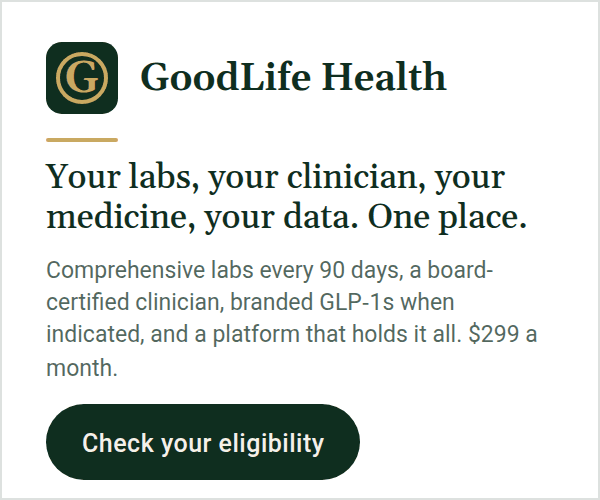
GoodLife Health is $299 a month: $598 at sign-up covers the first two months, then it runs month to month. If the clinician cannot accept you, the $598 is refunded in full; once you are accepted, the first two months are non-refundable, and medication billed by a pharmacy follows that pharmacy's own refund policy. The fee buys the quarterly panel, a clinician who stays, and medication prescribed to your pharmacy at that pharmacy's price, with nothing taken on it. In return you get the diagnosis your last visit never produced, your markers followed over time, and no repeat of the eight-minute visit. The difference is the order of things: we test first, treat second, and sell neither the drug nor the dose. The reason to start now is your own. You have spent months tired and heavier with an answer of "normal," and each month on a cheaper guess is another month without the panel that would tell you whether the guess was right.
Related Reading
- How GLP-1 Telehealth Companies Make Money: A Plain-Language Whitepaper
- Bioidentical Hormone Therapy at Pharmacy Cost: The Real Numbers
References
- FDA's Concerns with Unapproved GLP-1 Drugs Used for Weight Loss (U.S. Food and Drug Administration). 2025. www.fda.gov/drugs/postmarket-drug-safety-information-patients-and-providers/fdas-concerns-unapproved-glp-1-drugs-used-weight-loss
- NovoCare Pharmacy — Wegovy self-pay pricing (Novo Nordisk). 2026. www.novocare.com/pharmacy/wegovy.html
- Zepbound Self Pay Journey Program — LillyDirect vial pricing (Eli Lilly). 2026. zepbound.lilly.com/savings