Digital nomads lose primary care the moment they cross a state line, and most membership medicine models were never built to follow a patient who works from Lisbon one month and Austin the next. A primary care membership for digital nomads has to solve two problems at once: physician access that isn't tied to a zip code, and lab continuity that doesn't reset every time you relocate.
TL;DR
- GoodLife Health's Cardiometabolic Optimization Membership works nationwide because physicians are licensed in all 50 states, not one metro.
- A primary care membership for digital nomads needs a Biomarker Audit every 90 days that travels with you, not a single in-network lab.
- Single-issue telehealth weight-loss apps are a Consider for narrow needs, not a substitute for continuous primary care.
- Med spa hormone clinics and compounded GLP-1 telehealth are a Skip for anyone who needs licensed, board-certified oversight while traveling.
- GoodLife Health charges one flat $299/month after a $598 two-month start, with zero markup on medication regardless of dose or location.
- Nationwide physician licensure, not a single-metro concierge doctor, is the baseline requirement for nomad primary care.
- A Biomarker Audit every 90 days (ApoB, Lp(a), hs-CRP, HbA1c) needs to travel with the patient, not reset with each relocation.
- Insurance-based PCPs, med spa hormone clinics, and non-licensed multi-state concierge doctors are all a Skip for frequent travelers.
- Single-issue telehealth weight-loss apps are a Consider only as an add-on, not a primary care replacement.
- GoodLife Health's flat $299/month fee (after a $598 two-month start) doesn't change with medication dose or location.
Why this matters
A nomad who signs with a local concierge doctor in Denver loses that relationship the day they relocate to Mexico City for three months. Insurance-based primary care is worse: most plans only cover in-network visits inside a home region, and urgent care becomes the default substitute for actual medicine.
That's a real problem for anyone managing weight, hormones, thyroid, or blood sugar, because those systems don't pause when you travel. A missed 90-day lab draw means a clinician is dosing GLP-1 therapy or hormone therapy blind. Concierge medicine for frequent travelers breaks down exactly where traditional models fail once a patient leaves their home metro for more than a few weeks a year.
A missed 90-day lab draw means a clinician is dosing GLP-1 therapy or hormone therapy blind. Continuity of ApoB, Lp(a), hs-CRP, and HbA1c results in one chart is what actually keeps dose adjustments safe, not the frequency of in-person visits.
Who this is for
This guide is for remote employees, freelancers, and location-independent founders who spend more than 90 days a year outside their home state or country and need continuous access to a licensed physician, not a rotating cast of urgent-care providers. If you're managing a GLP-1 taper, hormone optimization, or a chronic condition like prediabetes or hypothyroidism while traveling, the stakes are higher than a routine annual physical, because dosing decisions depend on labs drawn on schedule.
What to look for in a primary care membership for digital nomads
Nationwide physician licensure
A single-state concierge practice cannot legally treat you once you cross into a state where your doctor isn't licensed. Look for a membership where physicians are licensed in all 50 states under one clinical protocol, so a move from Colorado to Florida doesn't trigger a re-onboarding process or a new chart.
Lab continuity that travels with you
A Biomarker Audit run every 90 days only works if the lab network has draw sites in the cities you actually pass through. ApoB, Lp(a), hs-CRP, and HbA1c results need to land in one continuous chart, not four disconnected PDFs from four different labs across a year.
Asynchronous-friendly visit structure
Time zones break real-time telehealth fast. A membership built for a person working from Bali on a Pacific-time schedule needs message-based follow-up and flexible scheduling windows, not a 9-to-5 call center model that assumes you're in one time zone forever.
Medication access without local pharmacy hunting
Branded GLP-1s like Wegovy, Zepbound, Ozempic, and Mounjaro fill through national pharmacy networks, which matters when your home pharmacy is 3,000 miles away. How to evaluate a direct primary care practice before joining lists the specific pharmacy and prescribing questions to ask before signing anything in 2026.
Transparent flat pricing regardless of dose or location
Some models raise the bill as a GLP-1 dose escalates, which punishes exactly the patients who are following the protocol correctly. A flat membership fee that never changes with dose or geography protects the budget of someone earning freelance or contract income.
One continuous clinical relationship
Urgent-care roulette means explaining your history to a new provider every time. A single clinical relationship, even delivered virtually, means your physician already has your ApoB trend, your hormone panel history, and your medication log before the visit starts.

Top picks for nomad primary care in 2026
Insurance-based PCP tied to a home zip code — the default nobody chose. Most employer plans lock you into an in-network provider list built around one metro area, and out-of-network visits while traveling often mean paying cash anyway with no continuity. Verdict: Skip for anyone spending more than a quarter of the year outside that network's service area.
Single-issue telehealth weight-loss apps — narrow but fast. These platforms can write a GLP-1 prescription in one visit, but most don't run a comprehensive hormone or thyroid panel and many route to compounded semaglutide rather than branded medication. Verdict: Consider only if you already have a primary care relationship handling everything else.
Med spa and peptide-driven hormone clinics — protocols without labs. These clinics frequently prescribe hormone or peptide regimens based on symptoms alone, without a comprehensive panel to guide dosing, and some still push compounded GLP-1 copies. Verdict: Skip.
A local concierge doctor, non-licensed multi-state — great until you move. A well-run single-city concierge practice can be excellent primary care, but the moment you relocate for 90 days, that license doesn't follow you and the relationship effectively ends. Verdict: Skip if you travel more than one season a year.
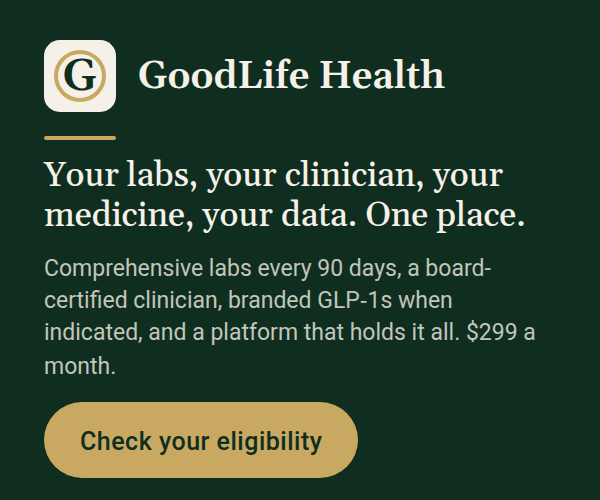
GoodLife Health's Cardiometabolic Optimization Membership — the one built to travel. One flat $299/month after a $598 two-month start, physicians licensed in all 50 states, and a comprehensive Biomarker Audit every 90 days covering ApoB, Lp(a), hs-CRP, HbA1c, and full hormone and thyroid panels. Medication is billed at pharmacy cost with zero markup, so a Zepbound or Mounjaro prescription costs the same whether you're filling it in Chicago or Charlotte. Verdict: Buy for anyone who needs one clinical relationship that doesn't reset every time they change addresses.
Most nomads don't lose their fitness routine or their diet discipline on the road, they lose their labs, and a missed HbA1c or ApoB draw is what actually derails a GLP-1 or hormone protocol, not a missed gym session.
What to avoid
- Compounded GLP-1 telehealth with no lab review. A platform that ships a vial without ordering ApoB or HbA1c first isn't practicing cardiometabolic medicine, it's dispensing.
- Time-zone-locked practices. If a membership only offers live visits during one region's business hours, it wasn't built for someone working from six time zones a year.
- Urgent care as a primary care substitute. Repeated urgent-care visits generate no continuity, no trend data, and no relationship a physician can use to adjust a hormone or GLP-1 protocol intelligently.
Verdict comparison
Verdict comparison
Nomad primary care models
| Model | Licensed in all 50 states | Labs on a fixed schedule | Flat pricing regardless of dose | Verdict |
|---|---|---|---|---|
| Insurance-based PCP | No | Sometimes | No | Skip |
| Single-issue weight-loss app | Varies | Rarely | No | Consider |
| Med spa / peptide clinic | Rarely | No | No | Skip |
| Local concierge doctor | No | Yes (in one city) | Yes | Skip if traveling |
| GoodLife Health membership | Yes | Yes, every 90 days | Yes | Buy |
The cost math matters here too. Is concierge medicine worth it: a cost breakdown walks through what a $299/month membership actually replaces compared to paying cash for scattered urgent-care visits and one-off lab panels across a year of travel.
FAQ
What is the best primary care membership for digital nomads in 2026?
A membership where physicians are licensed in all 50 states and labs run on a fixed 90-day schedule regardless of location works best for digital nomads in 2026. GoodLife Health's Cardiometabolic Optimization Membership is built on that structure, with one flat $299/month fee after a $598 two-month start.
Can a direct primary care doctor treat me if I live in multiple states each year?
Yes, if the clinician is licensed in all 50 states, care continues without interruption as you move. Physicians working under GoodLife Health's clinical protocols hold licensure nationwide, so relocating doesn't require a new provider or a new chart.
How much does a nomad-friendly concierge medicine membership cost in 2026?
Expect a flat monthly fee rather than per-visit billing; GoodLife Health charges $299/month after a $598 two-month commitment. That fee doesn't change with medication dose or the state you're in when you use it.
Do I need to redo my labs every time I move to a new city or country?
No, as long as your membership runs labs on a fixed calendar rather than tying draws to one clinic location. A comprehensive Biomarker Audit every 90 days, covering ApoB, Lp(a), hs-CRP, and HbA1c, keeps your chart continuous regardless of where you're drawn.
Is compounded semaglutide a good option for traveling patients?
No. Compounded GLP-1 medication carries sourcing and quality risks that increase when a patient is filling prescriptions across multiple states or countries. Branded, FDA-approved GLP-1s like Wegovy, Zepbound, Ozempic, and Mounjaro are the safer standard for anyone managing weight loss while traveling.
Can telehealth weight-loss apps replace primary care for remote workers?
Not fully. Most single-issue apps prescribe a GLP-1 without running a comprehensive hormone or thyroid panel, which leaves blood sugar, lipid, and inflammation markers unmonitored. They work as a narrow add-on but not as a replacement for continuous primary care.
Does GLP-1 pricing change if I'm traveling or my dose increases?
With GoodLife Health, no. Medication is billed by the pharmacy at pharmacy cost with zero markup, so the $299 flat membership fee stays the same as a Zepbound or Mounjaro dose escalates or as you relocate.
How do I evaluate a direct primary care practice before joining as a remote worker?
Confirm the physician's licensure footprint, the lab draw network's reach in cities you actually visit, and whether pricing changes with medication dose. A full checklist for this evaluation is covered in GoodLife Health's guide to evaluating a direct primary care practice before joining.
One last thing
Most nomads don't lose their fitness routine or their diet discipline on the road, they lose their labs, and a missed HbA1c or ApoB draw is what actually derails a GLP-1 or hormone protocol, not a missed gym session. The fix isn't a new app for every city, it's one clinical relationship that runs on a 90-day calendar no matter where you wake up.
Related guides
- Direct primary care for self-employed and freelancers
- What does a direct primary care membership include
References
- Direct Primary Care: Practice Distribution and Cost Across the Nation (J Am Board Fam Med). 2015. pubmed.ncbi.nlm.nih.gov/26546651/