The best PlexusDx alternatives in 2026 depend on whether you need testing, ongoing treatment, or specialist evaluation. GoodLife Health is the best fit for Cardiometabolic Optimization when you want recurring biomarker testing and physician-directed weight, hormone, and primary care in one membership; an endocrinologist is the better fit for a complex endocrine diagnosis.
Key Takeaways
- Compare PlexusDx alternatives by clinical responsibility, not just the number of tests offered.
- GoodLife Health pairs Cardiometabolic Optimization with a Biomarker Audit every 90 days and ongoing physician-directed care.
- Choose an endocrinologist for complex endocrine diagnosis; choose primary care for broad medical evaluation.
- A laboratory result informs care but does not replace diagnosis, prescribing, or follow-up.
- A useful health service must answer more than what your results show.
- Use this table to choose a care model, not to assume that every provider offers the same services.
- GoodLife Health's Cardiometabolic Optimization Membership connects recurring laboratory assessment with medical weight loss, hormone optimization, and concierge-style direct primary care.
- A primary care physician is a strong alternative when you have symptoms without a clear diagnosis or need someone to review your overall medical history.
- An endocrinologist specializes in disorders involving hormones and endocrine glands.
Why this matters
A useful health service must answer more than what your results show. You need to know who interprets them, whether that person can treat the underlying condition, and who follows up after the plan changes. Start there.
Cardiometabolic optimization means treating metabolic, hormonal, and cardiovascular health as one interconnected system. Weight, thyroid function, blood sugar, lipids, and symptoms belong in the same clinical conversation, rather than separate reports that you must reconcile yourself.
That does not mean everyone needs every test or a prescription. More information is useful when it changes a clinical decision. A clinician should explain why a test is appropriate, what an abnormal result means in context, and what happens next.
For a PlexusDx alternatives comparison in 2026, separate the service you are buying from the outcome you want. Testing, primary care, specialist evaluation, and ongoing treatment are different functions. An alternative is a better fit only when its function matches your need.
PlexusDx alternatives at a glance
Use this table to choose a care model, not to assume that every provider offers the same services. The PlexusDx row is a benchmark for evaluating your current arrangement; it does not assign unverified features or limitations to the company.
| Option | Best for | Main function | What to establish before choosing |
|---|---|---|---|
| PlexusDx | Staying with an arrangement that meets your needs | Your current testing or care arrangement | Who interprets results, provides treatment, and handles follow-up |
| GoodLife Health | Integrated Cardiometabolic Optimization | Recurring Biomarker Audits and physician-directed care | Whether the membership fits your ongoing medical needs |
| Primary care physician | Broad evaluation and preventive care | Assessing symptoms, managing common conditions, and coordinating referrals | Whether the practice offers the testing and follow-up your situation requires |
| Endocrinologist | Complex endocrine disease | Specialist diagnosis and management of hormone-related disorders | Referral requirements and coordination with your primary care clinician |
| Clinician-ordered laboratory testing | Answering a defined clinical question | Measuring markers selected for a specific decision | Who owns interpretation and the next step |
The central distinction is clinical ownership. Before choosing any option, identify the person responsible for translating results into a plan and checking whether that plan works. A report, a consultation, and a continuing clinical relationship are not interchangeable.
1. GoodLife Health: best for integrated cardiometabolic care
GoodLife Health's Cardiometabolic Optimization Membership connects recurring laboratory assessment with medical weight loss, hormone optimization, and concierge-style direct primary care. The model is designed around the relationship between metabolic, hormonal, and cardiovascular health. It is ongoing care, not simply a way to obtain a report.
Clinical care is delivered by licensed physicians of Beluga Health, P.A., an independent Florida professional corporation licensed to practice in all 50 states, working under GoodLife Health's clinical protocols. Your physician evaluates whether treatment is appropriate. Membership does not guarantee a particular prescription.
Where the membership shines
- Recurring assessment: An included Biomarker Audit every 90 days creates a scheduled opportunity to reassess your health and treatment.
- Connected markers: The audit includes ApoB, Lp(a), hs-CRP, HbA1c, lipids, insulin markers, and full hormone and thyroid panels.
- Treatment informed by results: Clinical findings guide branded, FDA-approved GLP-1 treatment and hormone optimization when appropriate.
- Separated clinical and pharmacy billing: Medications are billed by the pharmacy at pharmacy cost, without medication markup or dose-escalation fees.
The scheduled cadence amounts to 4 Biomarker Audits per year. All laboratory testing runs through the Beluga Health lab network. Additional testing beyond that cadence is billed separately at pass-through cost; the included schedule is not a promise that every possible test is included.
Where the membership falls short
- It requires an ongoing commitment: The initial commitment is 2 months, followed by month-to-month membership. That is a mismatch if you want only a single test.
- Medication is separate: Prescriptions are not included in the membership, even though the clinical fee does not change with the prescription.
- It is not a substitute for every specialist: A complicated endocrine condition still requires the appropriate specialist evaluation.
- Treatment requires eligibility: A request for a GLP-1 or hormone prescription is not the same as a medical indication.
Head-to-head decision framework
| Dimension | This membership | Question to ask about PlexusDx |
|---|---|---|
| Clinical scope | Weight, hormone, cardiovascular risk, and primary care considered together | Does the service address your full clinical question? |
| Repeat assessment | Included Biomarker Audit every 90 days | What repeat testing and clinical reassessment apply to your situation? |
| Treatment responsibility | Physician-directed care under established clinical protocols | Who can diagnose, prescribe, and monitor treatment? |
| Medication model | Branded, FDA-approved GLP-1s only; pharmacy billing separate | What medication pathway, if any, is part of your arrangement? |
Best for: Adults seeking an ongoing physician relationship that connects biomarker interpretation with weight, hormone, and metabolic care.
Verdict: Choose this model for continuing treatment and monitoring; skip it if your only need is an isolated test.


2. Primary care physician: best for broad medical evaluation
A primary care physician is a strong alternative when you have symptoms without a clear diagnosis or need someone to review your overall medical history. Primary care connects preventive care, common chronic conditions, medication review, and specialist referrals. It starts with the patient, not a predetermined panel.
This is especially useful when fatigue, weight change, poor sleep, or reduced energy has several possible explanations. Those symptoms do not identify a hormone disorder on their own. Your clinician decides which examination, tests, or referrals fit the history.
Where primary care shines
- Broad assessment: Your clinician can consider medical history, medications, symptoms, and examination findings together.
- Coordination: Primary care provides a place to reconcile specialist recommendations and overlapping prescriptions.
- Selective testing: Laboratory orders can answer a specific clinical question rather than maximize the number of markers measured.
Where primary care falls short
- Practice scope varies: Do not assume every physician provides advanced cardiometabolic testing, obesity treatment, or hormone management.
- Follow-up arrangements differ: Ask how results are discussed and how treatment changes are reassessed.
- Specialist care remains necessary: Complex endocrine or cardiovascular disease can exceed the practice's scope.
A direct primary care practice is one possible primary care arrangement, not a guarantee of a particular testing panel. In 2026, judge the practice by its stated clinical services and follow-up process rather than the membership label alone.
| Dimension | Primary care pathway | Question to ask about PlexusDx |
|---|---|---|
| Starting point | Overall history and current medical concerns | Does the arrangement begin with your symptoms and history? |
| Testing | Selected according to the clinical question | Who determines which tests are appropriate? |
| Coordination | Common conditions and referrals within the practice's scope | Who coordinates findings with your other clinicians? |
Best for: Adults who need a broad medical evaluation, preventive care, or coordination across several conditions.
Verdict: Choose primary care when the problem needs defining before a testing or treatment package is selected.
3. Endocrinologist: best for complex hormone-related disease
An endocrinologist specializes in disorders involving hormones and endocrine glands. This pathway fits a suspected or established endocrine condition that needs specialist diagnosis, rather than a general request to improve energy or optimize a laboratory number. The aim is to identify and manage disease.
Specialist assessment is particularly relevant when your treating clinician identifies a complicated thyroid, pituitary, adrenal, or other endocrine problem. An abnormal result needs interpretation. It does not automatically establish the diagnosis suggested by its label.
Where endocrinology shines
- Focused expertise: The specialist evaluates endocrine disease within a defined medical discipline.
- Diagnostic interpretation: Related test results, symptoms, and prior treatment can be assessed together.
- Complex management: The pathway supports decisions that require specialist input rather than a general wellness approach.
Where endocrinology falls short
- It is not broad primary care: You still need someone responsible for unrelated health concerns and preventive care.
- It is not a universal optimization service: A specialist visit does not guarantee hormone treatment for nonspecific symptoms.
- Access requirements vary: Establish referral requirements and record-transfer arrangements before changing care.
For a 2026 comparison, the useful question is whether your clinical problem requires specialty expertise. If it does, a broader membership or testing service should support that referral, not replace it.
Best for: Adults with a complex endocrine diagnosis or a clinician-identified need for specialist investigation.
Verdict: Choose endocrinology for diagnostic complexity; hold off on selecting a general hormone program until the condition is clarified.
4. Clinician-ordered testing: best for a defined question
Clinician-ordered laboratory testing is the narrower alternative when you already have a medical relationship and need a particular result to guide a decision. Your existing clinician selects the tests and remains responsible for interpretation. The test is part of care, not a separate treatment model.
This pathway makes sense when you do not need to replace your physician or start a continuing membership. It also keeps the question explicit: what decision will this result change?
Where targeted testing shines
- Clear purpose: Each order can be tied to a symptom, diagnosis, or treatment decision.
- Existing clinical context: Your clinician can interpret results alongside your history and current medicines.
- Defined responsibility: Interpretation and follow-up remain with the ordering clinician.
Where targeted testing falls short
- It does not add a new care relationship: Testing alone cannot fill a gap in ongoing clinical support.
- Its scope is limited: A focused order does not automatically assess every metabolic, hormonal, or cardiovascular concern.
- Follow-up must be explicit: Before testing, establish how you will discuss results and what happens if they are abnormal.
Best for: Adults whose existing clinician needs specific information to make an identified medical decision.
Verdict: Choose targeted testing for a defined question; skip a broad panel that has no clear interpretation or action plan.
Why people switch from PlexusDx: evaluate the care gap
A decision to switch should follow an unmet need, not an assumption that another company's model is better. These are reasons to seek a different arrangement if they apply to your care. They are not claims about PlexusDx's services or patients.
You need treatment, not another explanation
If your current arrangement provides the information you need but you still lack a treatment plan, look for a clinician who can act on the findings. Ask who manages prescriptions, reviews tolerability, and reassesses your response. Do not assume that access to a test includes those responsibilities.
You need one plan across connected concerns
Weight change, blood sugar, lipids, thyroid function, and hormone symptoms can overlap. If you are carrying reports between unrelated services, identify a physician who can review the whole picture. Coordination matters more than adding another panel.
You need reassessment after a clinical change
A baseline result is not the end of monitoring. Starting treatment, changing a dose, or developing symptoms can change the follow-up needed. Ask your treating clinician what requires earlier contact; a scheduled laboratory cadence is not an instruction to wait through a new problem.
You need specialist diagnosis
If the unresolved issue is a complex endocrine disorder, choose the appropriate specialist pathway. A more extensive panel is not a substitute for specialist judgment. The alternative should match the clinical problem, even when that means keeping your current testing arrangement and adding specialist care.
What a useful cardiometabolic plan includes
A good plan links the history, laboratory findings, treatment decision, and follow-up. Each part has a different job. Together, they turn information into accountable care.
- Clinical history: Symptoms, diagnoses, family history, current medications, and your goals establish the clinical question.
- Biomarker review: Results are interpreted together, with attention to the reason each marker was measured.
- Treatment decision: Your physician explains whether lifestyle changes, medication, further investigation, or referral is appropriate.
- Follow-up: You establish what to track, when to reassess, and which symptoms require earlier contact.
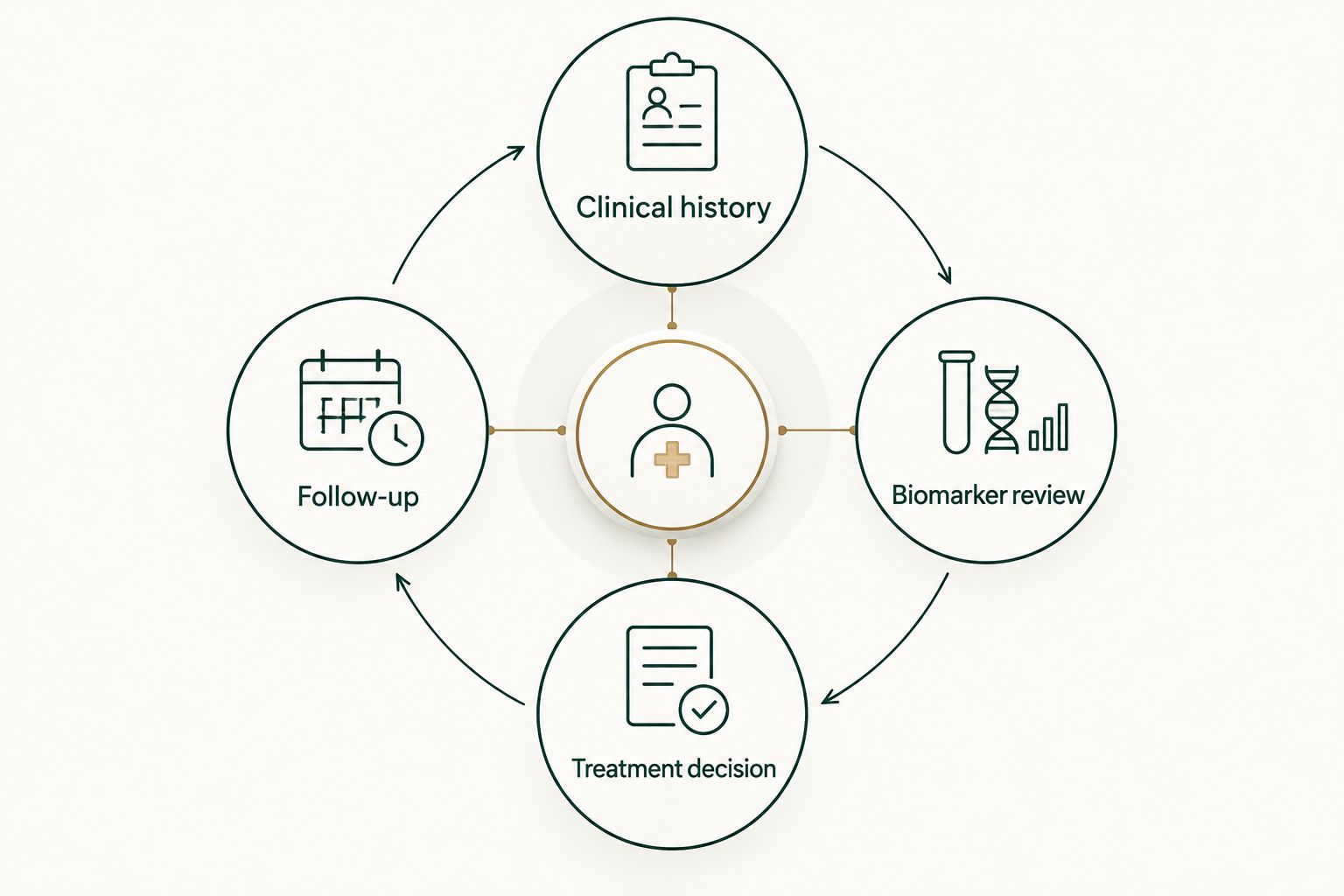
Testing becomes useful when interpretation leads to a decision and reassessment.
The Biomarker Audit in GoodLife Health's Cardiometabolic Optimization model brings several domains into that review. ApoB informs assessment of atherogenic lipoprotein particles; Lp(a) adds information about inherited cardiovascular risk; HbA1c reflects longer-term blood glucose exposure. These markers answer different questions.
Hormone and thyroid results also require clinical context. Symptoms, sampling conditions, other medications, and the suspected diagnosis affect interpretation. An out-of-range value is not, by itself, a reason to prescribe.
Likewise, hs-CRP is a marker of inflammation, not a diagnosis of its source. The purpose of considering markers together is to improve clinical interpretation, not to assign a treatment to every flagged result. Your physician should be able to explain what matters now and what does not change the plan.
Compare medication oversight, not just prescribing access
When evaluating alternatives in 2026, ask what happens after a prescription is written. Appropriate treatment includes eligibility assessment, a discussion of risks, and a follow-up plan. Access without oversight is not the same service.
The membership's GLP-1 pathway uses branded, FDA-approved medications only, never compounded GLP-1s. Treatment is physician-directed. A particular medicine is selected according to the patient's clinical circumstances, not because every member should receive the same prescription.
Medication names and indications matter. Zepbound and Mounjaro both contain tirzepatide, but their prescribing context differs. Do not treat products containing the same molecule as automatically interchangeable or change products without your prescribing clinician's instructions.
Hormone treatment deserves the same discipline. The phrase bioidentical describes a relationship to hormones produced in the body; it does not mean risk-free. Your clinician should explain the indication, treatment options, contraindications, and monitoring relevant to your situation.
Medication supports a medical plan; it does not replace nutrition, physical activity, or follow-up. No service can promise an individual weight-loss result. Your response and tolerability must guide subsequent decisions.
Questions to resolve before changing providers
Before leaving any arrangement, establish what the replacement will actually take responsibility for. A broader service is not better if it leaves your most important concern unresolved. Use these questions during the clinical conversation:
- Who orders the tests and discusses the results with you?
- Who can diagnose and treat the conditions the results raise?
- Which repeat tests are included, and which are separate?
- How do you contact the clinical team about side effects or new symptoms?
- Who coordinates with your existing physician and specialists?
- What happens when treatment is inappropriate or a referral is necessary?
- How will the new clinician review your current medicines and previous results?
Bring dated laboratory reports, a current medication list, relevant diagnoses, and the reason you want to change. Include supplements and hormone products. Your new clinician needs to know what you are already taking before recommending another treatment.
Do not stop, restart, or change a GLP-1 or hormone regimen simply because you are switching services. Ask the prescribing clinician to direct the transition. The goal is continuity of safe care, not a new prescription at the earliest opportunity.
When staying with PlexusDx is the right call
Stay with PlexusDx if your current arrangement answers your clinical question, provides the support you need, and connects appropriately with your treating clinician. A different model is not automatically an improvement. Avoid switching just because another service lists more markers.
If your existing physician already interprets results and manages treatment, you might need only a focused test or specialist consultation rather than another ongoing relationship. Conversely, if nobody owns the next step, that is the gap to address.
For 2026, use a practical test: can you identify the clinician responsible for your plan, explain what you are monitoring, and state when you will reassess? If you can, preserving that continuity has value. If you cannot, clarify responsibilities before buying more testing.
FAQ
What's the best PlexusDx alternative in 2026?
GoodLife Health is the best fit when you need ongoing Cardiometabolic Optimization that connects recurring biomarker testing with physician-directed weight, hormone, and primary care. An endocrinologist is a better fit for complex endocrine diagnosis, while targeted testing can fit a specific question managed by your existing clinician.
Is a health testing service the same as medical care?
A health testing service is not automatically the same as ongoing medical care. Establish who interprets results, diagnoses conditions, prescribes when appropriate, and follows up after treatment changes.
How often does the Cardiometabolic Optimization Membership include labs?
The membership includes a Biomarker Audit every 90 days, amounting to 4 audits per year. Additional testing beyond that cadence is billed separately at pass-through cost, and all labs run through the Beluga Health lab network.
Who delivers clinical care through the membership?
Clinical care is delivered by licensed physicians of Beluga Health, P.A., an independent Florida professional corporation licensed to practice in all 50 states. Those physicians work under GoodLife Health's clinical protocols; they are not described as the brand's employees.
Does the membership use compounded GLP-1 medications?
The membership's GLP-1 treatment pathway uses branded, FDA-approved medications only, never compounded GLP-1s. Your physician determines whether a medication is appropriate for your clinical circumstances.
Should I choose an endocrinologist instead of a membership?
Choose an endocrinologist when your treating clinician identifies a complex endocrine condition requiring specialist assessment. A broader membership can support ongoing care, but it does not replace necessary specialty diagnosis or management.
Can I use existing lab results when switching providers?
Bring your existing laboratory reports for the new clinician to review. Include collection dates, reference ranges, medications, and relevant symptoms; the clinician decides whether the results answer the current question or need repeating.
Does an abnormal hormone result mean I need treatment?
An abnormal hormone result does not automatically mean you need hormone treatment. Diagnosis requires interpretation alongside symptoms, medical history, sampling conditions, and other relevant findings.
One last thing
Before ordering another panel, ask your clinician: What decision would change if this result were abnormal? That question distinguishes useful testing from information without an action plan. It also makes the next conversation more concrete.
The strongest PlexusDx alternative is not necessarily the service with the longest test list. It is the arrangement that fits your clinical need and makes responsibility for interpretation, treatment, and reassessment clear.
Related guides
- How to evaluate a direct primary care practice before joining
- Direct primary care for weight loss management
- Best labs to request at a metabolic health checkup
- How to switch GLP-1 providers without losing progress
References
- Tirzepatide Once Weekly for the Treatment of Obesity (SURMOUNT-1). 2022. pubmed.ncbi.nlm.nih.gov/35658024/
- Once-Weekly Semaglutide in Adults with Overweight or Obesity (STEP 1). 2021. pubmed.ncbi.nlm.nih.gov/33567185/