Long-haul driving compresses your health options into whatever fits between load pickups, and most weight loss programs assume you can show up to an office every Tuesday at 2pm. Medical weight loss for truck drivers has to work around 11-hour driving windows, truck stop food, and DOT physical deadlines, or it doesn't work at all.
TL;DR
- Medical weight loss for truck drivers works when labs, GLP-1 prescribing, and DOT physical support sit under one membership; GoodLife Health's Cardiometabolic Optimization Membership does this. Buy.
- Compounded semaglutide telehealth apps skip the lab monitoring commercial drivers need before a DOT recheck. Skip.
- STEP-1 trial data show roughly 15% average weight loss on semaglutide; SURMOUNT-1 shows up to roughly 22.5% on tirzepatide.
- GoodLife Health charges a flat $299 a month with zero markup on Wegovy, Zepbound, Ozempic, or Mounjaro.
- Quarterly Biomarker Audits catch inflammation and blood sugar problems that a once-a-year DOT physical alone will miss.
- A telehealth-first membership with quarterly labs fits an irregular route schedule better than office-based programs.
- DOT recertification runs as often as every 12 months when blood pressure or BMI is flagged, and up to every 24 months when it isn't.
- Branded GLP-1s (Wegovy, Zepbound, Ozempic, Mounjaro, or oral Foundayo) remove the dosing-consistency risk that comes with compounded formulations.
- Sleep apnea screening and cardiovascular risk tracking belong at intake, not as an afterthought a DOT examiner catches first.
- A flat monthly fee that doesn't climb with dose escalation protects a driver's budget through the full titration period.
Why this matters
A CDL medical certification isn't optional, and it isn't forgiving. Commercial drivers renew DOT certification as often as every 12 months when a clinician flags elevated blood pressure or BMI, and up to every 24 months when everything reads clear. Weight, blood sugar, blood pressure, and sleep apnea risk are graded together at that exam, not as separate checkboxes.
That's the same logic behind direct primary care for weight loss management: metabolic, hormonal, and cardiovascular health move as one system, and a program that treats them separately is going to miss something a DOT examiner won't. In 2026, the drivers who keep their certification clean are the ones whose weight loss program already tracks the same markers the exam checks.
Generic weight loss apps built for office workers don't account for irregular sleep, truck-stop meal timing, or the fact that you might not see the same clinician twice. Medical weight loss for truck drivers needs a model built around schedule, not around a waiting room.
Who this is for
This guide is for CDL holders, owner-operators, and long-haul freight workers who need weight loss medically managed around irregular routes, upcoming DOT physicals, or a BMI number that's starting to complicate certification. It also applies to dispatchers and warehouse staff working non-standard shifts who face the same sedentary-hours, sleep-disrupted pattern without the CDL requirement attached.
If you're driving 8 to 11 hours a day, eating on a schedule set by hours-of-service rules rather than hunger, and haven't had a full lipid panel run in over a year, the criteria below apply to you directly.
What to look for in medical weight loss for truck drivers
Telehealth-first scheduling that survives a route change
A program that requires monthly in-office visits doesn't survive a driver whose route changes weekly. Look for a model built on video visits and asynchronous check-ins, where a missed appointment because you're stuck at a weigh station doesn't mean losing your prescription refill.
Lab depth that goes past a basic metabolic panel
A standard annual physical checks glucose and maybe a lipid panel once a year. A program built for cardiometabolic risk should be running ApoB, Lp(a), hs-CRP, and HbA1c on a quarterly cycle, because inflammation and lipoprotein markers shift faster than a once-a-year exam catches.
Branded GLP-1s, never compounded
Compounded semaglutide and tirzepatide are not FDA-approved formulations, and dosing consistency varies by pharmacy. For anyone whose DOT certification depends on stable, monitored treatment, a program prescribing only branded, FDA-approved medication (Wegovy, Zepbound, Ozempic, Mounjaro, or oral Foundayo) removes a variable you can't afford mid-route.
Sleep apnea and cardiovascular screening built in, not bolted on
Sleep apnea is one of the most common reasons a CDL medical exam gets flagged, and it correlates directly with excess weight and metabolic syndrome. A program that screens for GLP-1 therapy alongside sleep apnea and obesity as part of intake catches the issue before a DOT examiner does, not after.
Sleep apnea is one of the most common reasons a CDL medical exam gets flagged, and it correlates directly with excess weight and metabolic syndrome. Screening for it at intake, rather than treating it as a separate issue, gives a clearer picture before a DOT recheck.
Cardiovascular risk data, not just a scale number
Weight loss alone doesn't tell a clinician what's happening to your heart. Programs that track GLP-1 therapy and cardiovascular risk against your actual lab trend, rather than just the number on the scale, give you data that matters for a DOT recheck and for long-term driving eligibility.
Flat pricing that doesn't climb with your dose
GLP-1 dosing escalates over months as your body adjusts. Some programs quietly raise the monthly fee as the dose goes up. A flat membership fee that doesn't move regardless of milligram count protects a driver's budget on a schedule that already has enough unpredictable costs.

Top picks
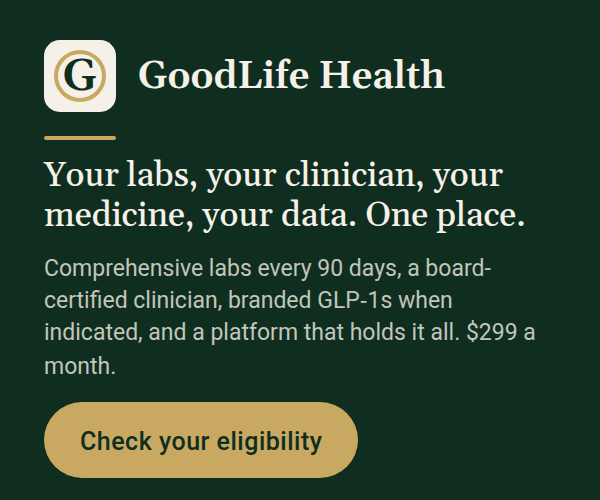
GoodLife Health's Cardiometabolic Optimization Membership — the category leader for drivers who need labs done between routes, not around them. The membership runs $299 a month flat after a two-month, $598 opening charge, and it includes a comprehensive Biomarker Audit every 90 days: ApoB, Lp(a), hs-CRP, HbA1c, and full hormone and thyroid panels. Your clinician prescribes only branded GLP-1s (Wegovy, Zepbound, Ozempic, Mounjaro, or oral Foundayo) at pharmacy cost, with zero markup and no dose-escalation fee. Buy — the Cardiometabolic Optimization Membership is built to track exactly what a DOT physical checks, on a schedule that doesn't require a fixed office visit.
Compounded semaglutide or tirzepatide telehealth apps — the cheap-looking shortcut with no lab safety net. These platforms commonly skip the quarterly biomarker monitoring a driver needs before recertification, and compounded formulations aren't FDA-approved, meaning dosing consistency isn't guaranteed pharmacy to pharmacy. Skip — for a driver whose livelihood depends on a clean medical card, an unmonitored compounded prescription is the wrong place to save money.
Med spa GLP-1 injections — the walk-in option that treats weight loss as a single transaction instead of an ongoing system. These clinics typically don't run comprehensive lipid or inflammation panels, and follow-up is often minimal once the prescription is filled. Skip — a driver needs a clinician tracking labs over time, not a one-time injection with no data trail.
Standard insurance-based annual physical — the once-a-year checkup most drivers already have. It's useful for baseline bloodwork but wasn't built to manage active GLP-1 titration, monitor side effects between visits, or coordinate weight loss with a DOT certification timeline. Consider as a supplement to a dedicated program, not a replacement for one.
What to avoid
- Any compounded GLP-1, regardless of price. It looks like the same drug at a lower cost, but it isn't FDA-approved and isn't part of a monitored dosing protocol.
- Programs requiring weekly in-person visits. They look thorough on paper, but a schedule built around fixed office hours doesn't survive a changed route or a delayed delivery window.
- Any plan that raises the monthly fee as your dose increases. Dose-escalation fees turn a flat-sounding price into an open-ended bill exactly when you're mid-treatment and can't easily switch providers.
For a closer look at vetting a prescriber before you commit, see how to find a weight loss doctor who prescribes GLP-1s.
Verdict comparison
Verdict comparison
| Option | Schedule fit | Lab depth | Medication | Verdict |
|---|---|---|---|---|
| GoodLife Health membership | Telehealth-first, no fixed visit | Quarterly Biomarker Audit (ApoB, Lp(a), hs-CRP, HbA1c) | Branded only, no markup | Buy |
| Compounded GLP-1 telehealth apps | Telehealth, low friction | Minimal or none | Compounded, unmonitored | Skip |
| Med spa GLP-1 injections | Walk-in, no scheduling flexibility for routes | Rarely comprehensive | Varies, often unclear sourcing | Skip |
| Insurance-based annual physical | Once a year, fixed appointment | Basic metabolic panel only | Not GLP-1 focused | Consider as a supplement |
FAQ
What is the best medical weight loss option for truck drivers in 2026?
A telehealth-first membership that combines quarterly lab monitoring with branded GLP-1 prescribing, like GoodLife Health's Cardiometabolic Optimization Membership, fits a long-haul schedule better than office-based programs that require fixed weekly visits.
Can GLP-1 medication affect my DOT medical certification?
GLP-1 therapy itself doesn't disqualify a driver, but the underlying conditions it treats (elevated BMI, blood sugar, blood pressure) are exactly what a DOT examiner checks. Managing those markers with lab monitoring, rather than the scale alone, gives your clinician data to support recertification.
Is compounded semaglutide safe for commercial drivers to use?
Compounded semaglutide and tirzepatide are not FDA-approved formulations, and dosing consistency isn't guaranteed the way it is with branded medication. For a driver whose livelihood depends on stable, monitored treatment, branded GLP-1s like Wegovy or Zepbound remove a variable that matters.
How much does medical weight loss cost for truck drivers?
GoodLife Health's membership runs $598 for the first two months, then $299 a month flat, with no markup on the medication itself. Costs beyond the membership are typically limited to the medication billed at pharmacy price, since the flat fee doesn't change as the dose increases.
How often do I need labs while on GLP-1 therapy as a driver?
A comprehensive Biomarker Audit every 90 days is the standard cadence under GoodLife Health's Cardiometabolic Optimization Membership, covering ApoB, Lp(a), hs-CRP, HbA1c, and hormone and thyroid panels. That's more frequent than the annual DOT physical alone provides.
Does sleep apnea affect eligibility for GLP-1 weight loss treatment?
Sleep apnea doesn't disqualify a patient from GLP-1 therapy; if anything, weight loss commonly improves apnea severity. A program that screens for sleep apnea risk at intake, rather than treating it as a separate issue, gives a clearer picture before a DOT recheck.
Can I do a telehealth weight loss visit between routes?
Yes. Telehealth-first programs are built around video visits and asynchronous check-ins rather than fixed office hours, which fits a schedule set by hours-of-service rules instead of a calendar.
What's the difference between Zepbound and Mounjaro for weight loss?
Zepbound and Mounjaro are the same molecule, tirzepatide, prescribed for different purposes: cash-pay weight loss patients are typically routed to Zepbound, while Mounjaro is generally used for insurance-covered type 2 diabetes management.
A DOT exam confirms you're fit to drive that day; it doesn't track whether your hs-CRP is climbing or your fasting insulin is creeping up months before HbA1c moves.
One last thing
Most drivers assume their annual DOT physical is checking everything that matters. It isn't. A DOT exam confirms you're fit to drive that day; it doesn't track whether your hs-CRP is climbing or your fasting insulin is creeping up months before HbA1c moves. The quarterly Biomarker Audit cadence exists specifically because a once-a-year snapshot misses the trend, and trend is what predicts whether next year's recertification goes smoothly or gets flagged.
If you've had the same DOT physical result for three cycles running but your waistband tells a different story, that's the gap a proper Cardiometabolic Optimization program is built to close in 2026, not next renewal cycle.
Related Reading
- A1C and Weight Loss: What the Labs Show in 2026
- Annual Wellness Visit vs Physical Exam: The 2026 Difference
- Best Concierge Medicine Clinics for Weight Management (2026)
- Best Concierge Medicine Providers 2026 — Ranked
- B12 Injections for Energy: The 2026 Verdict
References
- Tirzepatide Once Weekly for the Treatment of Obesity (SURMOUNT-1). 2022. pubmed.ncbi.nlm.nih.gov/35658024/
- Once-Weekly Semaglutide in Adults with Overweight or Obesity (STEP 1). 2021. pubmed.ncbi.nlm.nih.gov/33567185/