You priced it on a Sunday night, between two board decks. The app said $99 a month. Three screens later, you saw that the medication was compounded semaglutide in a vial you would draw up yourself. You closed the tab. You were ready to pay for a GLP-1 and unwilling to inject something you could not trace to its manufacturer, prescribed by someone you might never hear from twice.
That scene is a composite, built from situations people in your position describe. It is not one real patient. The question it leaves is a fair one. Is a $99 app the same thing as branded GLP-1 telehealth with a clinician who knows you? GoodLife Health's answer is specific. It prescribes branded, FDA-approved GLP-1 medication only: Wegovy, Zepbound, Mounjaro and Ozempic. It draws labs before the prescription and every quarter after. It sends each prescription to the pharmacy you choose at that pharmacy's price and takes nothing on it.
- A $99 fee and a $299 membership pay for different jobs, so the two prices do not compare on their face.
- GoodLife Health prescribes branded, FDA-approved GLP-1 only: Wegovy, Zepbound, Mounjaro and Ozempic.
- Labs come before the prescription and every quarter after, with every result in your hands.
- Your pharmacy sets the medication price. GoodLife Health takes nothing on it.
- The fee is $299 a month at every dose and for every molecule.
- If you want the cheapest possible prescription, this is the wrong purchase.
Why the $99 offer looks like the same thing
The objection holds up as far as it goes. A GLP-1 is a prescription. Any prescriber licensed in your state can write one. If the drug is what does the work, the cheapest licensed route to it looks like the rational purchase. On that logic, paying $299 a month for the same prescription looks like paying for a logo.
You may have heard this from a colleague who started on an app last spring and is pleased with the result. Your colleague may be right about their own case. Your situation differs because you were never shopping for a prescription alone. You wanted three things together: branded medication from the manufacturer's supply, the same clinician next year and the numbers that show whether any of it is working.
Your current care has given you none of the three. The annual visit is the eight-minute kind. The panel is the basic one. When you raised your weight, the advice fit in a single sentence about eating less. Nobody drew fasting insulin or ApoB. Nobody could tell you whether something sat behind the weight that the basic panel does not measure. You left with the word normal and the question you had brought in.
Time is the other cost you track. You do not have hours for waiting rooms. You do not want to repeat your history to a new face at every appointment. A service that fits around your calendar matters to you as much as the number on the page.
Then you looked at the apps. Each one put a low fee at the top of the page and the medication further down. On some services, the medication was a compounded copy. On others, the fee covered a prescriber while the branded drug was a separate bill from the manufacturer's own channel. You could see clearly what each fee bought on the first day. You could not tell who would be reading your numbers in the third month, if anyone would.
You are used to paying for quality. You are also used to asking what a price buys before you pay it. That habit is the right one to bring here, because the offers in front of you are priced for different work. The rest of this piece sets out what that work is.
What each fee is built to pay for
Every GLP-1 service has clinicians, staff and software to pay for. The advertised fee is only one place it can collect that money. Our guide to the real ROI of a $299 membership found that GLP-1 subscription services commonly advertise a low fee and recover their margin on the drug.
On a compounded service, the vial is the product. On some platforms that bundle branded medication, the margin sits in the gap between what you pay and what the manufacturer charges. The same guide found branded Zepbound or Mounjaro on legacy platforms priced at up to $1,899 a month. Bought directly from Lilly in September 2026, the same medicine cost $299 to $449 a month.
That is a lawful business model. It does mean that the company writing your prescription earns more when you take more of the drug or a costlier one. A dose that climbs on the refill schedule suits that company whether or not your numbers support it. How a company is paid tells you what it is selling.
How a company is paid tells you what it is selling.
Your refusal of the compounded vial needs no fear to justify it. The record is enough. Compounded GLP-1 was legal and common during the 2021 to 2025 FDA shortage. That shortage has resolved. Large-scale compounding is now restricted. The FDA has published its concerns about unapproved GLP-1 drugs used for weight loss. The manufacturers have pursued remaining sellers in court. There have also been reports about the dosing and additives used in some compounded products.
These facts make no claim about any one compounded product or any one patient. Patients who used compounded medication did nothing wrong. The facts do mean that the branded product is the one with manufacturing controls, a dosing device and trial evidence behind it, from STEP 1 for semaglutide and SURMOUNT-1 for tirzepatide. Whoever prescribes it puts a clinician's license behind the decision. Your instinct was about traceability, which the branded product gives you.
The prescription is also the smallest part of the decision. The larger parts come after the first fill. Which molecule suits you, which dose and when to change it are questions a clinician answers well only with data. Weight is one number. Fasting Insulin, Hemoglobin A1c (HbA1c), Apolipoprotein B (ApoB) and thyroid function are others. A service that never draws them can still prescribe. It cannot show you what is happening below the scale.
The data also needs a reader who remembers the last result. One panel is a snapshot. Four panels a year, read by the same clinician, show direction. A clinician who saw your ApoB in the spring can tell you in the summer whether it moved. A prescriber you meet once can only tell you where it stood that day.
The same logic answers the second half of the objection, which says the drug is the expensive part anyway. It often is the larger cost. The pharmacy sets that price whoever writes the prescription. The membership pays for the judgment about how much of the drug you take and on what evidence.
The field is moving in the direction you already lean. In September 2026, NovoCare listed Wegovy pens at $199 a month for the first two fills. That price is an introductory offer for new patients through December 2026. After it, the pens are $349 a month. The Wegovy pill starts at $149 a month at lower doses. Through LillyDirect, Zepbound vials cost $299 to $449 a month depending on dose. With the manufacturers publishing their own prices, the question left is who decides on the dose and what they read first.
Four questions to ask any GLP-1 service before you pay
| Question | Why it matters | GoodLife Health's answer |
|---|---|---|
| Is the medication branded and FDA-approved? | A compounded copy is a different product class | Branded only: Wegovy, Zepbound, Mounjaro and Ozempic |
| Does the company make money on the medication? | A margin on the drug rewards a higher dose | It sets nothing, sees nothing and takes nothing on medication |
| Who reads your labs and how often? | A dose decision needs data | Your clinician reads four panels a year with you |
| Does the fee change with the dose? | A dose upcharge ties the fee to the drug | No. It is $299 a month at every dose |
What the membership does and what it costs
GoodLife Health is precision direct primary care for cardiometabolic optimization. It is clinician-led and labs-first. It prescribes branded, FDA-approved GLP-1 only: Wegovy, Zepbound, Mounjaro and Ozempic. Labs come before the prescription and every quarter after. For a GLP-1 decision, that fixes the order of events. Diagnosis comes first, treatment comes second and the long haul follows.
On price, the membership has two familiar neighbors. A concierge practice can cost $20,000 a year. A compounded app can cost $99 a month. GoodLife Health sits between them by design, with quarterly labs and a clinician who stays.
The path starts with the eligibility check. The intake, the checkout and a clinician's review follow it. Not everyone is accepted. If you are, your first cardiometabolic panel is read before any prescription is written.
Each panel covers nine biomarkers. Apolipoprotein B (ApoB), Lipoprotein (A) and Hs-CRP are in every panel. Fasting Insulin and Hemoglobin A1c (HbA1c) are read together. TSH With Reflex To Free T4 is drawn every quarter. There are four panels a year. Every result is in your hands, so you see what your clinician sees.
Your clinician reads the panel with you and decides whether a GLP-1 is indicated. If one is, the prescription is for a branded, FDA-approved medication. It goes to the pharmacy you choose. That pharmacy sets the price and bills you for the medication. GoodLife Health sets nothing, sees nothing and takes nothing on medication.
The fee does not move with the drug. It is $299 a month whatever medication is indicated and whatever the dose. There is no molecule upcharge and no dose upcharge. This is what we call Medication-Neutral Pricing. Your clinician gains nothing from a higher dose. When the scale stops moving, the first task is to find out why before the dose goes up. The next quarterly panel is where that answer is looked for.
Between visits, you message the care team. Video visits are part of the fee. The same clinician follows your panels over time, which is what a clinician who stays means in practice. Clinicians are licensed in all fifty states, so a move between states does not end the relationship.
If you have insurance, whether it covers a GLP-1 is between you, your plan and your pharmacy. Prior authorization is the pharmacy's process. GoodLife Health does not promise coverage or an approval. The membership pairs with your insurance for catastrophic cover. It replaces the primary-care relationship and leaves the insurance in place.
Whether a GLP-1 is indicated is your clinician's decision after the first panel, as is the choice of molecule and dose. The panel is drawn again every 90 days, so each later decision is checked against the same markers.
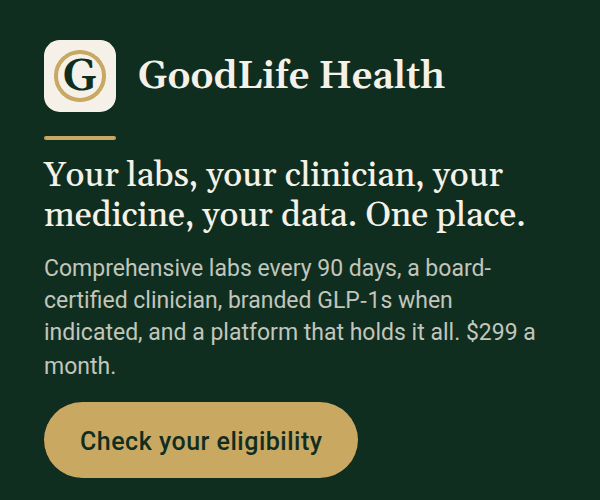
The cost is $299 a month. At sign-up, $598 is held on your card to cover the first two months. That hold is charged only once a clinician accepts you. If the clinician cannot accept you into care, the hold is released and you are never charged. Once you are accepted, the first two months are charged and are non-refundable. From month three, the membership is month to month. Medication billed by your pharmacy follows that pharmacy's own return and refund policy. Over a year, the membership is $3,588.
You should also know what the membership does not do before you pay. It does not promise weight loss of any amount. It does not prescribe compounded GLP-1 at any price. It does not replace your insurance or promise that a medication will be covered. Its scope is cardiometabolic care in depth. It does not claim to be full-scope primary care.

What to do this week, whichever way you go
You can move this decision forward this week whether or not you join anything. Four steps help either way.
- Find your last lab report. Look for Fasting Insulin, Apolipoprotein B (ApoB) and Lipoprotein (A). If they are not listed, they were not drawn.
- Put the four questions in the table above to any GLP-1 service in writing before you pay it.
- Read the manufacturers' own prices on NovoCare and LillyDirect, so any quote you receive has a reference point.
- If you are insured, ask your plan whether it covers the medication you are considering. That answer sits between you, the plan and the pharmacy.
If you already have a prescriber, put the same questions to them. A prescriber who reads your labs every quarter, keeps you on branded medication and earns nothing on the dose already gives you what this membership gives. In that case, stay where you are.
We do not know yet whether a GLP-1 is right for you. Nobody can know that before reading your numbers. Your first panel may point somewhere other than a GLP-1. If it does, your clinician will say so. The value of the membership in that case is the diagnosis a visit never produced.
Who this is not for
If you want the lowest monthly price for a prescription, this membership is the wrong purchase. The $99 app is built for that buyer. If you want compounded GLP-1, we will not prescribe it. If you want a promised result, nobody here will give you a number of pounds or a date. If you are a healthy adult who sees a doctor twice a year and takes no medication, you will not recoup $3,588 in a year. You should not buy this. If you want one fee to replace your health insurance, the membership does not do that. It pairs with insurance and replaces the primary-care relationship. It is open only to residents of the fifty states.
For everyone else, here is the offer in full. The membership is $299 a month. At sign-up, $598 is held on your card for the first two months and is charged only once a clinician accepts you. If you are not accepted, the hold is released and you are never charged. Once you are accepted, those two months are non-refundable. After them, the membership is month to month. The fee buys four cardiometabolic panels a year, a clinician who stays, messaging between visits, video visits and branded medication prescribed to your pharmacy at that pharmacy's price. GoodLife Health takes nothing on that medication. In return, you get the diagnosis a visit never produced and your markers followed over time. The eight-minute visit is not repeated. The difference is the order and the incentive. We test first, treat second and sell neither the drug nor the dose. You have already ruled out the vial. The decision left is who prescribes the branded medication and who reads your numbers while you consider it. If your clinician judges Wegovy indicated, the manufacturer's introductory price for new patients runs through December 2026.
Related Reading
- The True Monthly Cost of GLP-1 Telehealth: An Honest Comparison
- The Real ROI of a $299/Month Health Membership: Every Alternative, Priced Honestly
References
- NovoCare Pharmacy — Wegovy self-pay pricing (Novo Nordisk). 2026. www.novocare.com/pharmacy/wegovy.html
- Zepbound Self Pay Journey Program — LillyDirect vial pricing (Eli Lilly). 2026. zepbound.lilly.com/savings
- FDA's Concerns with Unapproved GLP-1 Drugs Used for Weight Loss (U.S. Food and Drug Administration). 2025. www.fda.gov/drugs/postmarket-drug-safety-information-patients-and-providers/fdas-concerns-unapproved-glp-1-drugs-used-weight-loss
- Once-Weekly Semaglutide in Adults with Overweight or Obesity (STEP 1). 2021. pubmed.ncbi.nlm.nih.gov/33567185/
- Tirzepatide Once Weekly for the Treatment of Obesity (SURMOUNT-1). 2022. pubmed.ncbi.nlm.nih.gov/35658024/