Most online guides to Zepbound cost without insurance fail at the full year because they quote a monthly list price and stop. The honest 2026 answer is that self-pay Zepbound commonly runs roughly $500 to $1,100 per month depending on the pathway you use. That puts a real year somewhere between about $6,000 and $13,000 for the medication alone. The plan that wraps around it determines whether that money produces results or just refills.
We will show the math in full, including the fees nobody mentions and then show the alternative structure we use: medication at pharmacy cost with zero markup, inside a flat-fee membership that never rises with your dose.
- Self-pay Zepbound commonly runs $500 to $1,100 per month, making a real year roughly $6,000 to $13,000 for the drug alone.
- Every self-pay pathway sells the medicine. None of them sells the physician oversight and titration that make it work.
- Cash-pay comprehensive labs outside a membership commonly run $200 to $500 per panel, needed several times a year.
- SURMOUNT-1 showed average weight loss up to 22.5% of body weight at 72 weeks, the strongest published effect of any approved obesity medication.
- GoodLife Health's membership is a flat $299 per month ($598 first charge for the initial two-month commitment), with medication billed separately at pharmacy cost and zero markup.
- Zepbound and Mounjaro are the same molecule, tirzepatide, routed to different diagnoses and insurance situations.
The four self-pay pathways for Zepbound
Eli Lilly sells tirzepatide, branded as Zepbound for weight management and Mounjaro for type 2 diabetes, through several self-pay channels. The commonly reported 2026 landscape:
Self-Pay Pathways Compared
Figures change frequently, verify current terms before deciding
| Pathway | Commonly reported monthly cost | What it includes | What it does not include |
|---|---|---|---|
| LillyDirect self-pay vials | Roughly $499 at the lowest doses, rising with dose step | Zepbound vials, shipped | Physician care, labs, titration guidance |
| LillyDirect single-dose pens | Higher than vials, commonly $600 to $1,100 | Zepbound KwikPens, shipped | Physician care, labs, titration guidance |
| Pharmacy retail, cash price | Varies widely, commonly $1,000 or more at list | The prescription itself | Everything else and discount cards only partially blunt list pricing |
| Platform subscriptions | Vary, commonly bundle the drug with thin clinical oversight | Drug plus app access | Real physician relationships, comprehensive labs, zero-markup pricing |
Every figure above is hedged on purpose. Self-pay programs change prices frequently, so verify current terms before deciding. What does not change is the structural point: every self-pay pathway sells you the medicine and none of them sells you the clinical care that makes the medicine work. The vial program prices the drug attractively and leaves you titrating yourself. The subscription platforms bundle clinical oversight thin enough to fit inside the drug margin.
The fees nobody quotes in the monthly number
A year of self-pay GLP-1 therapy costs more than twelve prescriptions:
- Clinical oversight. Someone must decide the starting dose, manage titration, handle side effects and decide when to stop or down-titrate. Subscription platforms either omit this or dilute it and DIY means the physician is you.
- Laboratory monitoring. GLP-1 therapy deserves metabolic monitoring: HbA1c, lipids, ApoB, liver enzymes and hormone and thyroid panels, especially as weight comes off. Cash-pay labs outside a membership commonly run $200 to $500 per comprehensive panel, several times a year.
- Lean-mass protection. Unsupervised GLP-1 use loses muscle along with fat, which worsens long-term metabolism. Resistance training and protein structure are part of proper care, not optional extras.
- The compounding fee problem. When patients move to compounded copies to cut cost, the savings arrive with an unverified product. We do not facilitate that path under any circumstance.
Unsupervised GLP-1 use loses muscle along with fat, which worsens long-term metabolism. Resistance training and protein structure are part of proper care, not optional extras.
Add those to a $499 or $600 monthly drug price and the honest annual figure for real care, not just refills, climbs well above the headline.
What the trials say you are buying
SURMOUNT-1, the pivotal trial for tirzepatide in weight management, produced average weight loss up to 22.5% of body weight over 72 weeks at the highest dose, the strongest published effect of any approved obesity medication, with individual results varying [1]. For patients with type 2 diabetes, the SURPASS program showed A1c reductions of 1.9 to 2.4 percentage points alongside substantial weight loss. Those are exceptional results for the patients the medication fits and they were produced inside structured care with monitoring, which is precisely the part self-pay pathways omit.

The math of our model, side by side
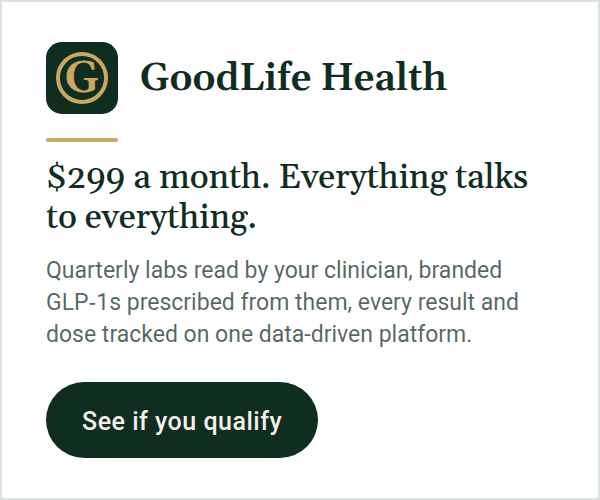
Our Cardiometabolic Optimization Membership is one flat $299 per month, no tiers, beginning with a $598 first charge that covers the initial two-month commitment, then $299 monthly, cancel anytime after. Every 90 days a comprehensive Biomarker Audit is included, reading ApoB, Lp(a), hs-CRP, HbA1c, lipids, fasting insulin and full hormone and thyroid panels.
Medication is billed separately by the pharmacy at pharmacy cost with zero markup from us. If your physician prescribes Zepbound, the vial program's pharmacy pricing flows straight through to you with no platform fee layered on top, because the flat fee covers the doctor and the medicine is a pass-through charge.
GLP-1 therapy deserves metabolic monitoring: HbA1c, lipids, ApoB, liver enzymes and hormone and thyroid panels, especially as weight comes off.
The first-year comparison, using hedged self-pay figures:
First-Year Cost Comparison
| Component | Typical self-pay setup | GoodLife Health membership |
|---|---|---|
| Zepbound vials, 12 months | ~$6,000 to $7,200 (drug only) | Pharmacy cost, zero markup, no platform fee |
| Physician care and titration | Often absent or bundled thin | Included, $299 per month flat |
| Comprehensive labs, 4 per year | $800 to $2,000 cash-pay outside membership | Included every 90 days |
| Structural incentive | Platform revenue rises with dose | Our revenue does not scale with dose |
The self-pay column is not a straw man. It is the actual structure patients describe when they arrive having spent a year and several thousand dollars without anyone measuring their ApoB or watching their thyroid panel.
Who each path actually fits
LillyDirect vials alone fit the experienced patient who already has a physician they trust for monitoring and titration guidance and who simply wants the drug at a fair price. That is a legitimate use and the pricing is real.
Platform subscriptions fit the patient who wants app-based convenience and accepts diluted clinical oversight in exchange.
A flat-fee membership fits the patient whose real problem was never the drug price but the absence of a clinical relationship: someone who titrates, monitors, de-escalates and treats the metabolic system the weight problem lives inside. If you also carry high ApoB, prediabetes, fatty liver or hormonal symptoms, this is the cardiometabolic model built for exactly that picture and our medical weight loss program is one pillar of it.
One more structural note. Zepbound and Mounjaro are the same molecule, tirzepatide. Cash-pay weight-management patients are routed to Zepbound, while Mounjaro belongs in the conversation when type 2 diabetes is the diagnosis and insurance is in play. Your physician sorts that out on the first visit, which is one more thing the drug-only pathways leave to chance.
FAQ
How much does Zepbound cost per year without insurance in 2026?
The medication alone commonly runs roughly $500 to $1,100 per month through self-pay pathways depending on dose and format, so a realistic year sits between about $6,000 and $13,000. Comprehensive labs and physician oversight are additional unless your care model includes them.
What is the cheapest way to get Zepbound without insurance?
LillyDirect self-pay vials are commonly the lowest branded price, around $499 monthly at lower doses. Remember that the drug price is not the total cost of safe, effective therapy.
Is Zepbound worth it if I have to pay cash?
For patients whose labs and history support it, the trial evidence is strong, up to 22.5% average weight loss in SURMOUNT-1. The better question is whether your plan includes monitoring, because unmonitored use loses muscle and misses metabolic follow-through.
Why do some platforms advertise Zepbound for under $300 per month?
Those offers are typically compounded copies, not branded Zepbound or heavily subsidized first months designed to convert into dose-escalated subscriptions. We prescribe branded medication only and never facilitate compounded tirzepatide.
Does GoodLife Health charge extra for prescribing Zepbound?
No. The membership fee is flat and never rises with dose. The pharmacy bills the medication at pharmacy cost with zero markup from us.
Does the membership include the medication?
No. The fee covers the doctor and the quarterly Biomarker Audit. Medication is a separate charge billed by the pharmacy, at exactly what the medicine costs.
What is the first charge?
$598, covering the initial two-month commitment. After that it is $299 per month, cancel anytime after the commitment period.
Can GoodLife Health help me down-titrate off Zepbound eventually?
Yes and that is a feature of a flat fee. De-escalation decisions are made clinically against quarterly data, with no revenue at stake in keeping the dose high.
One last thing
The price tag people compare is the drug. The money that actually determines whether a year of GLP-1 therapy changes your health is the care around it: who titrates, who monitors, who protects your lean mass and who decides when less medicine is enough.
Buy the care first. The drug is the easy part.
Related guides
- Wegovy cost without insurance: what patients pay
- Medical weight loss at GoodLife Health
- The definitive guide to cardiometabolic optimization
References
- Tirzepatide Once Weekly for the Treatment of Obesity (SURMOUNT-1). 2022. pubmed.ncbi.nlm.nih.gov/35658024/
- Once-Weekly Semaglutide in Adults with Overweight or Obesity (STEP 1). 2021. pubmed.ncbi.nlm.nih.gov/33567185/