Choose GoodLife Health if you want Cardiometabolic Optimization that connects weight, hormones, thyroid function, blood sugar, and cardiovascular risk; choose Hers if you want condition-focused online care for a specific concern, such as weight management, mental health, skin, or hair. The deciding question in 2026 is whether you need an integrated clinical relationship or a targeted treatment program.
Key Takeaways
- GoodLife Health vs Hers is a choice between integrated Cardiometabolic Optimization and condition-focused telehealth.
- GoodLife Health includes a Biomarker Audit every 90 days and pharmacy-billed medication without markup.
- Hers fits adults seeking targeted online care, including mental health, skin, hair, or weight management.
- Choose by clinical scope, monitoring, and billing structure, not by a promised prescription or weight-loss result.
- A weight-loss prescription does not explain every reason you feel tired, gain abdominal fat, or struggle with blood sugar.
- Use this 2026 comparison to match the care model to your situation.
- Hers has dedicated online treatment categories for mental health, skin, and hair.
- The membership includes a Biomarker Audit every 90 days, equivalent to 4 audits per year.
- Hormone optimization within the membership includes estrogen, progesterone, testosterone, and thyroid treatment when clinically appropriate.
Why this matters
A weight-loss prescription does not explain every reason you feel tired, gain abdominal fat, or struggle with blood sugar. Thyroid disease, menopause symptoms, medication effects, sleep, and cardiovascular risk can affect the same patient. Treating these concerns as unrelated purchases leaves you responsible for connecting the information.
A targeted service has a different advantage. If you already have a primary care clinician who manages your broader health, you do not necessarily need another primary care membership to address one concern. A focused online program can fit alongside that existing relationship.
GoodLife Health is best for adults who want metabolic, hormonal, and cardiovascular care managed as one system. Hers is the more relevant starting point when your priority is a particular treatment category rather than an integrated cardiometabolic membership. Neither model guarantees that a clinician will prescribe the medication you request.
At a glance
Use this 2026 comparison to match the care model to your situation. For Hers, confirm the scope, medication formulation, testing requirements, and payment terms of the specific program you select rather than applying one program's terms to the entire platform.
| Dimension | GoodLife Health | Hers |
|---|---|---|
| Best for | Connected metabolic, hormonal, and cardiovascular care | Targeted online care for a specific concern |
| Targeted treatment access | Membership organized around an ongoing clinical relationship | Condition-focused online treatment pathways |
| Mental health, skin, and hair | Cardiometabolic Optimization is the defined focus | Dedicated treatment categories for these concerns |
| Standout feature | Included recurring Biomarker Audit | Multiple condition-focused telehealth categories |
| Hormone and thyroid care | Hormone optimization connected to metabolic and cardiovascular assessment | Evaluate the exact program against your hormone-care needs |
| Weight-loss medication approach | Branded, FDA-approved GLP-1 medications only; never compounded | Confirm the exact drug and formulation within your selected program |
| Prescription eligibility and safety | Individual clinical assessment determines treatment | Individual clinical assessment determines treatment |
| Pricing model | Flat clinical membership; medication billed separately by the pharmacy | Program-specific terms to evaluate before enrollment |
Integrated care wins when several health concerns overlap
Choose the integrated membership when the problem crosses treatment categories. An adult with weight gain, worsening blood sugar, fatigue, and menopause symptoms needs an assessment that connects those findings. A prescription aimed only at appetite does not establish whether another condition needs attention.
Cardiometabolic Optimization treats metabolic, hormonal, and cardiovascular health as one system. The membership combines concierge-style direct primary care, recurring biomarker assessment, medical weight loss, and hormone optimization when clinically appropriate. The clinical purpose is to connect decisions, not to prescribe every treatment in the catalog.
Clinical care is delivered by licensed physicians of Beluga Health, P.A., an independent Florida professional corporation licensed to practice in all 50 states. They work under GoodLife Health's clinical protocols. These clinicians are not described as the brand's employees; your relationship is with the physician delivering your care.
The tradeoff is commitment. A membership is a broader relationship than a single-condition purchase, and the initial commitment lasts 2 months. If an established primary care clinician already manages your laboratory results, cardiovascular risk, and medication interactions, another ongoing membership needs a clear purpose.
Before joining, identify that purpose in one sentence: you want a clinician to connect the findings, manage the treatment plan, and explain what changes next. The guide to evaluating a direct primary care practice before joining gives you a practical framework for that conversation.


Hers fits better when you want one targeted treatment pathway
Choose Hers when your goal is a focused online program alongside existing primary care. Hers organizes care around treatment categories, including weight management, mental health, skin, and hair. That structure is useful when you can clearly name the concern you want addressed.
Consider an adult whose regular clinician already reviews blood pressure, cholesterol, glucose, and preventive care. If that person wants a separate online evaluation for a skin concern, a cardiometabolic membership is not the obvious substitute. The narrower service matches the narrower task.
A focused pathway also gives you a simpler question to answer: does this program cover the concern you have? You can evaluate its clinician access, treatment options, follow-up process, and payment terms without assuming it will become your primary care relationship.
The limitation is coordination. A condition-focused program does not automatically mean that someone is responsible for your entire medical picture. Share your medication list, relevant diagnoses, and outside test results, and decide which clinician owns follow-up when a finding falls outside the selected program.
In 2026, evaluate the specific Hers service rather than treating the platform name as a single clinical package. Do not assume that a feature described for one treatment category applies to another.
Hers is the stronger category match for mental health, skin, and hair
Hers has dedicated online treatment categories for mental health, skin, and hair. If one of those is your primary reason for seeking care, that is a genuine reason to start there rather than purchase a membership centered on cardiometabolic health.
This is a scope verdict, not an outcomes verdict. A dedicated category does not prove better clinical results, a particular appointment length, or a particular response time. It tells you that the platform has a pathway organized around the concern you brought.
The cardiometabolic model answers a different question: how should weight, blood sugar, hormones, thyroid function, lipids, and inflammation be assessed together? It is not a substitute for every mental health or dermatology service simply because these conditions sometimes overlap.
The practical distinction matters when symptoms have several possible explanations. Hair loss, for example, can require evaluation beyond a cosmetic treatment request. Tell the treating clinician about weight changes, nutrition, thyroid history, and medications, and ask whether you need an examination or additional assessment.
Pick the service whose clinical scope matches your main concern. Do not buy broader care merely because it sounds more complete, and do not use a narrow service to avoid evaluating a symptom that needs broader attention.
The recurring Biomarker Audit favors connected risk monitoring
The membership includes a Biomarker Audit every 90 days, equivalent to 4 audits per year. The panel includes ApoB, Lp(a), hs-CRP, HbA1c, lipids, insulin markers, and full hormone and thyroid panels. Testing runs through the Beluga Health lab network.
Those markers answer different questions. ApoB helps assess the burden of atherogenic lipoprotein particles; Lp(a) informs inherited cardiovascular risk; HbA1c reflects longer-term blood sugar exposure. Thyroid and hormone results need interpretation alongside symptoms, medical history, and current treatment.
The advantage is an included monitoring structure, not a larger pile of results. Your clinician orders and reads the labs, then uses the findings to guide the clinical plan. A result that does not change treatment still needs an explanation, including whether it needs follow-up or simply belongs in your risk history.
The framework connects three areas:
- Metabolic health: Weight, blood sugar, insulin markers, and treatment response.
- Hormonal health: Symptoms, hormone findings, thyroid function, and medication decisions.
- Cardiovascular health: Lipids, ApoB, Lp(a), inflammation, and overall risk assessment.
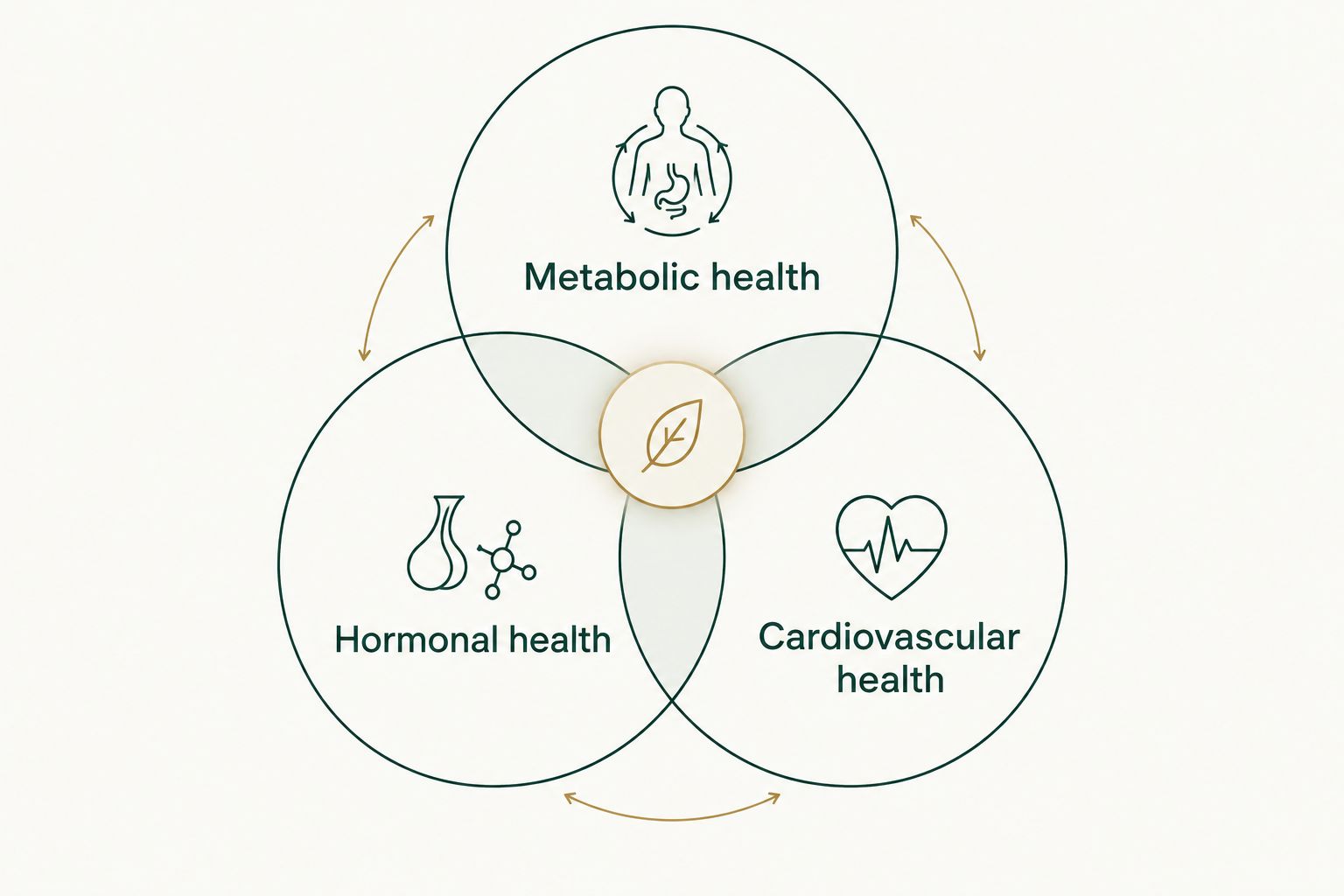
The clinical plan connects these findings rather than treating each panel as a separate purchase.
Quarterly testing is a membership cadence, not a claim that every marker needs to change every quarter. Additional labs beyond that schedule are billed at pass-through cost, and clinical needs can require testing outside the routine cycle.
For a Hers program, ask which tests are required, who interprets them, and who manages abnormal findings. A targeted program can fit well when your existing clinician already supplies that broader monitoring. The recurring audit is the stronger fit when you want those responsibilities within the membership.
Integrated hormone care fits symptoms that overlap with metabolism
Hormone optimization within the membership includes estrogen, progesterone, testosterone, and thyroid treatment when clinically appropriate. These decisions sit within the same assessment as weight, blood sugar, lipids, and cardiovascular risk. A symptom does not automatically establish a deficiency or justify a prescription.
That distinction matters for perimenopause and menopause. Sleep disruption, hot flashes, changes in body composition, and fatigue can occur together, but they do not all require the same intervention. Your clinician should separate the treatment goal from the assumption that one hormone explains everything.
The same principle applies to testosterone. Treatment requires an appropriate clinical assessment, not merely a desire for more energy or muscle. Fertility goals, sleep apnea, medication history, and monitoring requirements belong in the discussion before treatment decisions.
Choose integrated hormone care when you want one plan connecting symptoms, laboratory findings, and metabolic risk. Choose a targeted service when your need is narrow and another clinician already manages the surrounding medical issues.
For Hers, confirm that the exact program addresses the hormone-related concern you have. Do not assume that a weight-management pathway includes thyroid management, testosterone treatment, or a full hormone assessment. Equally, do not assume that it excludes a service without checking the current program.
In 2026, compare the clinical responsibility rather than the word optimization. Ask who reviews your symptoms after treatment begins, which findings trigger a change, and how the clinician handles a result that contradicts the original explanation.
A branded-only GLP-1 policy suits patients who want that boundary
The membership's GLP-1 policy is explicit: branded, FDA-approved medication only, never compounded GLP-1 medication. Named options include Wegovy, Zepbound, Ozempic, and Mounjaro, subject to clinical appropriateness. A medication's presence in the treatment options is not a promise that you qualify for it.
Zepbound and Mounjaro contain the same molecule, tirzepatide, but their clinical uses and prescribing context differ. Within the stated care model, cash-pay patients are routed to Zepbound, while Mounjaro fits insurance-covered type 2 diabetes. Semaglutide and tirzepatide are not interchangeable merely because both appear in weight-related discussions.
Choose the branded-only model if that medication boundary matters to you. Its limitation is equally clear: it does not provide compounded GLP-1 medication as an alternative. Medication is billed separately, so an included clinical membership does not mean an included drug.
For Hers, verify the exact medication and formulation in the selected program before making a comparison. Do not infer a current prescription option from an advertisement, a previous patient's experience, or a statement about a different program. Ask whether the proposed prescription is FDA-approved or compounded and who dispenses it.
FDA-approved and compounded are not equivalent regulatory descriptions. Compounded medications do not undergo the FDA approval process applied to approved drug products. That distinction does not establish what Hers prescribes to a particular patient; the program-specific prescription does.
Neither medication model removes the need for nutrition, physical activity, follow-up, or management of side effects. Weight-loss results vary, and no platform choice guarantees a particular outcome.
Neither platform can bypass clinical eligibility or safety
This is a tie on patient responsibility: a prescription requires an appropriate clinical assessment. Choosing an online service does not turn medication into a retail purchase. Your medical history, current medicines, treatment goals, and contraindications remain relevant.
Before a weight-loss consultation, prepare your medication list, previous treatment history, relevant laboratory results, and any history of significant side effects. Tell the clinician about pregnancy plans and any symptoms that need evaluation rather than assuming they belong to the weight-loss program.
Ask what happens if you develop persistent vomiting, cannot maintain hydration, or experience severe abdominal pain. You need an escalation plan, not just refill instructions. Seek urgent medical assessment for severe or concerning symptoms rather than waiting for a routine online response.
Telehealth also has physical limits. An online relationship does not replace every examination, procedure, specialist assessment, or emergency service. A responsible care plan identifies when you need in-person care and how information returns to the clinician managing ongoing treatment.
Do not award either platform a safety win based on a short signup process or a promised medication. Evaluate the actual assessment, follow-up responsibilities, and escalation instructions. Speed of enrollment is not evidence of clinical quality.
Pricing models: separate the clinical relationship from the medication
The GoodLife Health membership uses one flat clinical fee with no tiers. It begins with a 2-month commitment, then continues month to month with cancellation permitted after the initial commitment. The recurring Biomarker Audit is included; additional testing beyond the quarterly cadence is billed at pass-through cost.
Medication is billed by the pharmacy at pharmacy cost. There is no medication markup, molecule upcharge, or dose-escalation fee added by the membership. The clinical fee does not change with the prescription.
One flat fee for the doctor. Zero markup on the medicine. That Unbundled Pharmacy Model separates payment for clinical care from payment for the medication. It makes the membership structure predictable, but it does not make the total treatment bill fixed.
For Hers, review the selected program's current payment and renewal terms. Identify what the payment includes, whether medication is separate, how follow-up is handled, and what happens when treatment changes. Compare those answers with the integrated membership rather than comparing introductory offers with ongoing clinical care.
For a 2026 decision, write down four billing responsibilities: clinical care, medication, routine testing, and additional testing. Then add the initial commitment and cancellation terms. Neither model deserves a cheapest label without comparing the same treatment scope and your actual medication needs.
Final verdict: choose the clinical relationship you need
Choose GoodLife Health if you need connected care
Winner for the connected-care patient: the adult with overlapping weight, blood sugar, hormone, thyroid, or cardiovascular concerns who wants recurring biomarker review within a direct primary care relationship. The membership has a defined monitoring cadence and a clear separation between the clinical fee and pharmacy billing.
Accept its tradeoffs: an initial commitment, separately billed medication, and additional testing charges beyond the included schedule. Broader clinical scope is useful only if you need and use it.
Choose Hers if you need a targeted online program
Winner for the focused-care patient: the adult who already has broader medical care and wants an online treatment pathway for a specific concern. Hers is particularly relevant when that concern falls within its dedicated mental health, skin, hair, or weight-management categories.
Accept its coordination burden. Confirm the selected program's boundaries and decide who manages findings outside them. A targeted pathway works best when it complements existing care rather than leaving important responsibilities unassigned.
| Dimension | Winner |
|---|---|
| Connected metabolic, hormonal, and cardiovascular care | Integrated membership |
| One targeted online treatment pathway | Hers |
| Dedicated mental health, skin, and hair categories | Hers |
| Defined included recurring biomarker assessment | Integrated membership |
| Hormone care connected to cardiometabolic assessment | Integrated membership |
| Explicit branded-only GLP-1 boundary | Integrated membership |
| Need for individual assessment and safety planning | Tie: required regardless of platform |
| Total treatment spending | No universal winner; compare matched clinical scope |
FAQ
Is GoodLife Health better than Hers for weight loss?
GoodLife Health is the better fit when you want weight treatment connected to hormone, thyroid, blood sugar, and cardiovascular assessment. Hers fits a targeted online weight-management pathway, especially when another clinician manages your broader health. Neither choice guarantees a prescription or a weight-loss result.
Which option is better if I already have a primary care doctor?
Hers fits better when you need one targeted online service and your existing primary care clinician manages broader monitoring. An integrated membership is more relevant if you want to move those connected clinical responsibilities into a direct primary care relationship.
Does the membership include regular blood work?
The Cardiometabolic Optimization Membership includes a Biomarker Audit every 90 days, equivalent to 4 audits per year. Panels include metabolic, cardiovascular, hormone, and thyroid markers through the Beluga Health lab network. Additional labs beyond that cadence are billed at pass-through cost.
Does GoodLife Health prescribe compounded GLP-1 medication?
GoodLife Health never prescribes compounded GLP-1 medication within its care model. Its GLP-1 options are branded and FDA-approved, with the prescription determined by clinical appropriateness. Its policy on compounded bioidentical hormone treatment is separate from its GLP-1 policy.
How much does either option cost?
Total spending depends on the clinical program, medication, and testing you need. The integrated membership separates its flat clinical fee from pharmacy-billed medication, while a Hers comparison requires reviewing the selected program's current terms. Compare ongoing obligations and the same treatment scope.
Who provides clinical care through the membership?
Clinical care is delivered by licensed physicians of Beluga Health, P.A., an independent Florida professional corporation licensed to practice in all 50 states. Those physicians work under GoodLife Health's clinical protocols and are not described as its employees.
Is Hers a better choice for skin, hair, or mental health care?
Hers is the stronger category match when your main goal is its dedicated online skin, hair, or mental health care. Confirm that the selected program suits your condition and decide whether symptoms also require an examination or broader medical assessment.
Can I switch providers without changing my medication myself?
Yes, changing providers does not require you to change your medication independently. Share your prescription, dose history, treatment response, and relevant records with the receiving clinician. Let that clinician determine the safe continuation plan rather than restarting or adjusting treatment on your own.
One last thing
Ask one question before enrolling: Who is responsible when a result does not fit the original treatment plan? A weight-loss program can uncover a thyroid concern; hormone assessment can raise a cardiovascular question. The important feature is not simply that testing exists, but that a named clinician owns interpretation and the next step.
For your 2026 decision, write that responsibility down. If you need one connected clinical plan, choose the integrated membership. If you need one targeted service, choose Hers and keep broader follow-up assigned to your existing clinician.
Related guides
- How to choose a telehealth weight-loss clinic
- Hormone optimization for women in perimenopause
- How membership pricing works for medical weight loss
References
- Tirzepatide Once Weekly for the Treatment of Obesity (SURMOUNT-1). 2022. pubmed.ncbi.nlm.nih.gov/35658024/
- Once-Weekly Semaglutide in Adults with Overweight or Obesity (STEP 1). 2021. pubmed.ncbi.nlm.nih.gov/33567185/