Best overall for transparent billing and ongoing medical care: GoodLife Health. Best for using an existing health plan: an insurance-billing telehealth clinic, if your plan covers the visits and prescribed medication. Best for a prescription-focused visit: a direct-pay telehealth clinic that discloses its clinical fees, pharmacy charges, and follow-up terms before you enroll. No clinic can be ranked by your final monthly cost without your coverage and prescription details.
TL;DR
- GoodLife Health is the best GLP-1 telehealth clinic for patients who want labs, primary care, and clear pharmacy billing together.
- GLP-1 telehealth clinics ranked by cost must include clinical fees, medication bills, labs, and follow-up—not the advertised fee alone.
- An insurance-billing clinic is the best option for using existing coverage when both visits and medication qualify.
- A prescription-focused clinic fits patients who need limited care, but its fee does not establish the full treatment cost.
- GoodLife Health ranks best overall for transparent billing and ongoing medical care, not just a GLP-1 prescription.
- No clinic can be fairly ranked by cost alone without knowing your coverage and prescribed medication.
- GoodLife Health includes a Biomarker Audit every 90 days, with the pharmacy billing medication separately at cost, without a clinic markup.
- Insurance-billing clinics only make sense if your plan covers both the visit and the prescribed medication.
- Direct-pay prescription-focused clinics suit narrower needs but require a written breakdown of every charge.
- Zepbound and Mounjaro share the same molecule, tirzepatide, but differ in indicated use and coverage path.
Why this matters in 2026
A telehealth fee and a GLP-1 medication bill are different charges. One clinic can advertise a low fee while leaving the pharmacy bill, lab work, and follow-up visits outside that figure. Another can charge for broader care while billing the medicine separately. Comparing only the number on a sign-up page tells you little about what you will pay or receive.
GoodLife Health is best for people seeking GLP-1 care alongside ongoing primary care and cardiometabolic monitoring, not merely an isolated prescription visit. Its membership includes a Biomarker Audit every 90 days and clinician-led care; the pharmacy bills medication separately without a GoodLife Health markup. That distinction matters when you compare it with a visit-only service or an insurance-based option.
This is a 2026 ranking of billing and care models, not a claim that unnamed competitors charge a particular amount. Only GoodLife Health’s terms are specified here. Treat the other entries as types of clinic to evaluate, then confirm the terms of any provider you consider.
What makes the best GLP-1 telehealth clinic by cost
Check what sits behind a clinic’s advertised fee before deciding that it is cheaper:
- Total bill: Separate the clinical fee, pharmacy charge, labs, and any follow-up charges. Ask which party bills each one.
- Medication source: Confirm whether the prescription is for a branded, FDA-approved medication or a compounded product. Do not treat them as interchangeable.
- Clinical assessment: Look for a conversation about your health history, current medications, treatment goals, and whether a GLP-1 is appropriate.
- Lab interpretation: Ask which tests are included, who reads the results, and whether repeat testing carries another charge.
- Dose changes: Find out whether changing the prescribed dose changes the clinic’s fee. Pharmacy charges are a separate question.
- Continuity: Establish who handles side effects, medication adjustments, and broader health concerns after the first visit.
These criteria keep the 2026 comparison tied to care you can actually identify. A lower entry fee does not settle the question if essential parts of treatment are billed elsewhere.
GLP-1 telehealth clinics at a glance
GLP-1 telehealth clinics at a glance
Ranked on fit and billing clarity, not verified totals
| Rank and care model | Best for | Standout feature | Key limitation |
|---|---|---|---|
| 1. GoodLife Health | Ongoing cardiometabolic care with branded GLP-1 options | Included Biomarker Audit every 90 days; pharmacy bills medication separately without markup | Medicine is not included in the membership; an initial commitment applies |
| 2. Insurance-billing telehealth clinic | Patients whose plan covers relevant visits and medication | Potential to use existing health benefits | Coverage, prior authorization, and patient responsibility depend on the plan |
| 3. Direct-pay prescription-focused telehealth clinic | Patients seeking a narrower clinical service | A limited care scope can be easier to compare | Labs, medication, and continuing care must be checked individually |
The table ranks fit and billing clarity, not verified cheapest-to-most-expensive totals. No competitor’s current fee, lab inclusion, or pharmacy terms have been supplied. In 2026, a responsible cost comparison leaves those fields open until you have a written breakdown and a prescription decision.
1. GoodLife Health: best GLP-1 clinic for ongoing cardiometabolic care
GoodLife Health combines direct primary care with medical weight loss and hormone optimization in one Cardiometabolic Optimization Membership. A clinician orders and reads a Biomarker Audit every 90 days, including ApoB, Lp(a), hs-CRP, HbA1c, insulin markers, and hormone and thyroid panels. The clinical team assesses those results alongside symptoms and treatment goals rather than treating weight as an isolated number.
If a prescription is appropriate, the available GLP-1 approach uses branded, FDA-approved medications, including Wegovy and Zepbound. GoodLife Health does not offer compounded GLP-1 medications. Clinical care is delivered by licensed physicians of Beluga Health, P.A., an independent Florida professional corporation licensed to practice in all 50 states, working under GoodLife Health’s clinical protocols.
One flat fee for the doctor; zero markup on the medicine.
GoodLife Health billing model
The billing distinction is direct: one flat fee for the doctor; zero markup on the medicine. The pharmacy bills medication separately at pharmacy cost, while the membership fee does not increase with the prescribed molecule or dose. Additional labs beyond the included quarterly cadence are billed to the patient at pass-through cost. A separate pharmacy bill still exists, so the membership fee alone is not your full treatment total.
GoodLife Health pros:
- A Biomarker Audit is included every 90 days, giving your clinician repeat results to interpret.
- The same membership covers direct primary care, medical weight loss, and hormone optimization when clinically appropriate.
- Medication is billed by the pharmacy without a clinic markup or dose-escalation fee.
- The stated GLP-1 approach is branded and FDA-approved only.
GoodLife Health cons:
- Medication is billed separately, so the membership charge is not an all-in GLP-1 bill.
- Membership starts with a 2-month commitment before becoming month-to-month.
- Someone who wants only a single prescription consultation must decide whether broader ongoing care fits their needs.
GoodLife Health billing: One flat membership fee covers the specified clinical care and quarterly Biomarker Audits; the pharmacy bills medication separately. Check your expected medication bill and any additional lab needs before calculating your total.
Best for: Adults who want a clinician to connect weight, blood sugar, lipids, inflammation, thyroid function, and hormones over time. Verdict: Buy if you want the ongoing care as well as GLP-1 evaluation; skip if you need only a one-off visit.
2. Insurance-billing telehealth clinic: best for using your plan
An insurance-billing telehealth clinic is the first model to examine when you want to use existing health coverage. Its appeal is conditional: your plan must cover the relevant visit and your prescribed medication under the applicable rules. Coverage for a consultation does not establish coverage for the drug, and a covered drug does not establish that every lab or follow-up visit is included.
Before booking, ask the clinic and your insurer separate questions. Is the clinician in your plan’s network? How are visits and labs billed? Does the medication require prior authorization, and what does the plan say about the proposed prescription? Get the answers for your own policy rather than relying on a general statement that insurance is accepted.
Insurance-billing clinic pros:
- This model gives you a route to apply existing health benefits when the provider and service qualify.
- A written benefits check can identify which portions of care are covered.
- It allows a direct comparison between expected patient responsibility and a membership model.
Insurance-billing clinic cons:
- The clinic’s participation in an insurance plan does not guarantee medication coverage.
- Prior authorization and plan rules can affect access to a prescribed drug.
- Without a named clinic and plan, lab inclusion, follow-up arrangements, and the final bill remain unknown.
Insurance-billing clinic billing: Request the expected patient responsibility for the visit, medication, labs, and ongoing care separately. Confirm it against your current benefits; an advertised clinic fee is not an insurance determination.
Best for: Patients with a plan that covers the relevant care and who prefer to use that coverage. Verdict: Buy only after checking both visit and medication benefits; hold if either part of the bill is unclear.
3. Direct-pay prescription-focused clinic: best for a narrower visit
A direct-pay, prescription-focused telehealth clinic is a model for patients who want to evaluate a specific service without taking on a broad primary care membership. Its scope is the deciding factor. The visit, any prescribed medication, lab testing, and subsequent appointments can be separate parts of the bill; none should be assumed included just because the first fee is clear.
Ask what the clinician reviews before making a treatment decision. A sound comparison establishes who takes your medical history, who assesses contraindications and current medications, how you report side effects, and who decides whether to adjust or stop treatment. If you already have a primary care clinician, establish who will coordinate findings rather than letting each provider assume the other will do it.
Do not compare a prescription-focused clinic with an ongoing-care membership as if both deliver the same service. A narrower visit can suit a narrower need. It does not replace the work of interpreting metabolic markers, reviewing other conditions, and following changes over time unless the clinic expressly provides those services.
Direct-pay prescription-focused clinic pros:
- A limited service can match a limited need without requiring a broader care relationship.
- Separate line items make it possible to question each charge before enrollment.
- You can compare its stated scope with care you already receive elsewhere.
Direct-pay prescription-focused clinic cons:
- A quoted visit fee says nothing by itself about the pharmacy bill.
- Labs and continued clinical follow-up require explicit confirmation.
- You must establish who handles broader conditions that affect treatment decisions.
Direct-pay clinic billing: Ask for a written breakdown of the initial assessment, repeat visits, labs, and medication billing. If the clinic cannot explain who charges for each component, its advertised fee is not a usable total.
Best for: Patients who already have coordinated primary care and need a clearly defined additional service. Verdict: Buy when the clinical scope and separate bills are explicit; skip when the only clear figure is the sign-up fee.

Compare the bill before comparing the clinics
For a fair 2026 comparison, place each provider’s answers under the same headings: clinical care, included labs, pharmacy bill, and follow-up. Do not add a drug estimate before you know which medication a clinician would prescribe or what your insurance covers. A clinic should not promise a prescription before assessing whether treatment fits your medical history.
Clinical care. Identify what the stated fee covers. Is it an initial visit, continuing access, or primary care as well as weight-loss management? Ask whether the clinician reviews existing conditions and medicines. A subscription label does not answer any of those questions.
Included labs. Name the tests rather than accepting an unspecified lab package. GoodLife Health includes a Biomarker Audit every 90 days; tests listed for it include ApoB, Lp(a), hs-CRP, HbA1c, insulin markers, and hormone and thyroid panels. When comparing another clinic, ask who interprets each result and whether repeat testing is covered.
Pharmacy bill. Establish whether the pharmacy or clinic bills the medication and whether a change in dose changes the clinic fee. Also establish whether the proposed medication is branded and FDA-approved or compounded. The drug name matters: Zepbound and Mounjaro both contain tirzepatide, but they have different indicated uses and coverage paths. A shared molecule is not a shared bill.
Follow-up. Ask who responds when nausea, reduced intake, or another concern affects treatment. Determine whether follow-up is scheduled, billed separately, or part of ongoing care. A low first-visit fee cannot stand in for an answer about what happens after treatment starts.
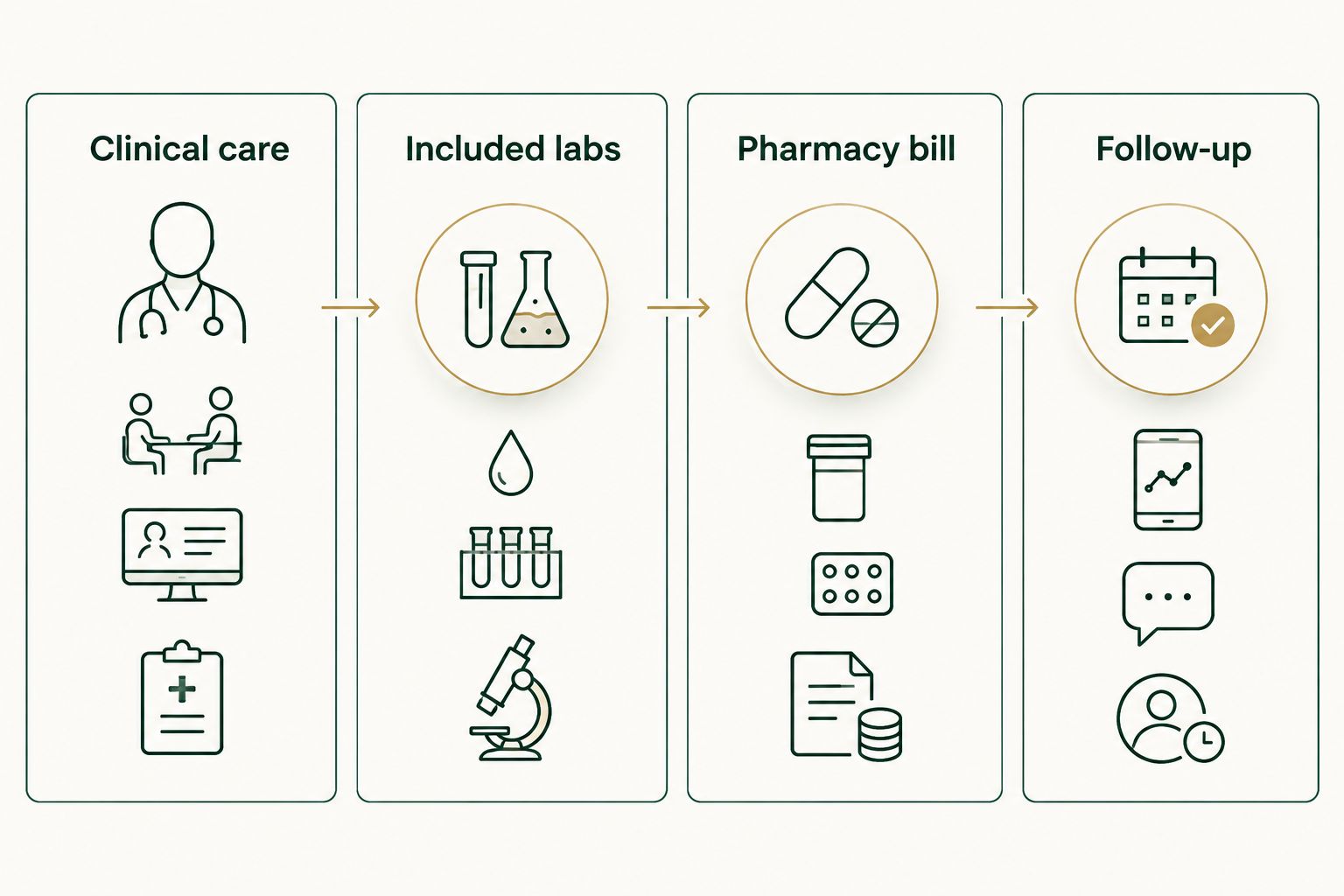
Compare the full care arrangement, not the sign-up fee alone.
Put the answers side by side for the same treatment period. Note what is included, what is separately billed, and what remains subject to an insurer’s decision or a clinician’s prescription. If a provider cannot answer a category, mark it unknown rather than entering an assumed amount. That keeps a 2026 comparison useful even when medication or coverage changes.
Clinical fit is part of the cost decision
A GLP-1 medication is not the right outcome of every telehealth visit. Your clinician needs your medical history, current medications, relevant conditions, and treatment goals before making a prescribing decision. A clinic that gives you a clear bill but no clear account of clinical follow-up has answered only half the question.
Cardiometabolic optimization treats metabolic, hormonal, and cardiovascular health as one connected system. HbA1c and insulin markers speak to glucose regulation; ApoB and Lp(a) inform a discussion of cardiovascular risk; thyroid and hormone results add context when symptoms or history warrant assessment. No single result automatically determines whether you should receive a GLP-1.
Cardiometabolic optimization treats metabolic, hormonal, and cardiovascular health as one connected system. HbA1c and insulin markers speak to glucose regulation; ApoB and Lp(a) inform a discussion of cardiovascular risk; thyroid and hormone results add context when symptoms or history warrant assessment. No single result automatically determines whether you should receive a GLP-1. Your clinician reads the results and decides what they mean together.
Treatment also requires attention beyond the scale. Discuss nutrition, physical activity, side effects, and what you will monitor during care. Medication does not remove the need for those conversations. If you are comparing clinics in 2026, ask who will have them with you after the prescription decision, not only at intake.
How these GLP-1 clinic models were ranked
The ranking favors a clearly defined care scope and an explainable bill. GoodLife Health takes the overall slot because its supplied terms specify included quarterly Biomarker Audits, continuing primary care, branded-only GLP-1 prescribing, and separate pharmacy billing without medication markup. Its separate drug bill and starting commitment remain real limitations.
The insurance-billing model comes next for patients who can use applicable benefits, but no plan-specific result can be ranked in advance. The prescription-focused model follows for people who already have other care and want a narrower service. Neither model represents a verified individual competitor in this list; each is a set of questions to take to a provider.
There is no defensible cheapest-clinic winner here. A cost ranking needs the same clinical scope, medication, coverage decision, and treatment period for every option. Without those, sorting advertised fees from smallest to largest would make the least informative number look decisive.
Which GLP-1 telehealth clinic should you choose?
Choose GoodLife Health if you want GLP-1 evaluation within continuing primary care and recurring biomarker review. Choose an insurance-billing clinic if confirmed benefits make that route appropriate for your visits and prescribed medicine. Choose a direct-pay prescription-focused clinic if you already have broader care and its full scope and billing are written down.
For an undecided reader in 2026, start with the model that will own your follow-up and explain every part of the bill. Then compare what you would receive, not just what you would pay to enroll. A prescription decision comes after a clinical conversation.
FAQ
What's the best GLP-1 telehealth clinic for ongoing care in 2026?
GoodLife Health is the best fit here for patients seeking GLP-1 evaluation alongside direct primary care and recurring biomarker review. Its membership includes a Biomarker Audit every 90 days, while the pharmacy bills medication separately.
Which GLP-1 telehealth clinic has the lowest monthly cost?
No lowest-cost clinic can be identified without your prescribed medication, insurance decision, and each provider's full billing terms. Compare clinical fees, medication, labs, and follow-up over the same period.
Does a GLP-1 clinic's membership fee include medication?
Do not assume it does. At GoodLife Health, the pharmacy bills medication separately from the membership; ask any other clinic to state its medication billing terms in writing.
Is an insurance-billing GLP-1 clinic cheaper than direct pay?
It depends on your plan's coverage for the visits and the prescribed medication. Check both benefits and your expected patient responsibility before comparing the option with direct pay.
Does GoodLife Health prescribe compounded GLP-1 medication?
No. GoodLife Health's stated GLP-1 approach uses branded, FDA-approved medications, not compounded GLP-1 products. Your clinician determines whether a prescription is appropriate.
Do GLP-1 telehealth clinics need to review lab results?
Ask each clinic which labs it orders, who interprets the results, and how those results affect treatment. GoodLife Health includes a Biomarker Audit every 90 days and clinician review as part of its ongoing care model.
What should I ask before joining a GLP-1 telehealth clinic?
Ask who provides clinical care, which medicine might be considered, what labs and follow-up are included, and who bills the prescription. Get separate answers for each charge before comparing advertised fees.
Is Zepbound the same as Mounjaro?
Zepbound and Mounjaro contain the same molecule, tirzepatide, but have different indicated uses and coverage paths. The brand on the prescription matters when checking your pharmacy bill and insurance benefits.
One last thing
The question that cuts through a 2026 GLP-1 clinic comparison is simple: who reads your results and owns the next decision? A disclosed pharmacy bill helps you understand cost. A clinician who reviews your history, interprets the labs, and follows treatment gives that spending a defined clinical purpose.
Related guides
- How membership pricing works for medical weight loss
- How to afford tirzepatide without insurance
- How to choose a telehealth weight-loss clinic
References
- Tirzepatide Once Weekly for the Treatment of Obesity (SURMOUNT-1). 2022. pubmed.ncbi.nlm.nih.gov/35658024/
- Once-Weekly Semaglutide in Adults with Overweight or Obesity (STEP 1). 2021. pubmed.ncbi.nlm.nih.gov/33567185/