Direct primary care for small business owners cuts through the group-insurance trap — you get a licensed clinician, same-day access, and a fixed monthly fee that doesn't balloon when your team files claims.
TL;DR: Direct primary care for small business works by replacing or supplementing traditional insurance with a flat membership fee (typically $50–$200/month per adult) that covers unlimited primary care visits, same-day messaging, and lab reviews. GoodLife Health's membership is $299/month and adds medical weight loss, GLP-1 therapy, and hormone optimization — services most group plans don't cover at all. If you're a small business owner paying $600–$1,200/month per employee for a plan with a $3,000 deductible, this is worth a direct comparison in 2026.
- Direct primary care replaces or supplements group insurance with a flat monthly fee, typically $50–$200/month per adult.
- GoodLife Health is precision DPC at $299/month: a Biomarker Audit every 90 days driving GLP-1 medical weight loss and hormone optimization — cardiometabolic scope, not general practice.
- Layering DPC under a lean high-deductible plan often costs less than a full PPO while giving employees more routine access.
- Look for flat pricing, included lab review, telehealth-first delivery, medication management, and month-to-month terms.
- Avoid "DPC" plans that still bill insurance, memberships excluding medication management, and annual-lock contracts.
The most common conditions driving absenteeism and long-term disability claims among working adults are metabolic (obesity, type 2 diabetes, hypertension) and hormonal (thyroid dysfunction, low testosterone, perimenopause). A membership that addresses these does more for output than one limited to sick visits.
The fastest ROI on a DPC membership for a small business isn't the premium savings — it's the productivity recovery.
Why this matters for small business owners in 2026
Group health insurance for a business with under 50 employees averages $8,435 per employee per year, according to KFF's 2023 Employer Health Benefits Survey — and premiums have climbed every year since. Most of that spend goes toward catastrophic coverage employees rarely use. Primary care — the day-to-day stuff — gets rationed by deductibles and copays that keep employees from booking visits until a small problem becomes an expensive one.
Direct primary care (DPC) inverts this. A flat monthly fee buys unlimited access to a clinician. No claims, no prior authorizations, no $40 copay to ask a single question. For a business with 5–25 employees, layering a DPC membership under a lean high-deductible health plan (HDHP) often costs less than a full PPO while giving employees more routine access.
GoodLife Health's direct primary care model goes further: it's built for adults who also need metabolic and hormonal care — GLP-1s, testosterone, thyroid optimization — conditions that kill productivity and drive the largest insurance claims.
Who this is for
This guide is for small business owners — sole proprietors, LLC founders, S-corp owners, and operators of businesses with 2–50 employees — who either can't afford group insurance, are watching premiums eat their margin, or want to offer a health benefit that employees will actually use. It's also relevant for the self-employed owner who buys individual coverage and wants to know whether DPC membership is worth stacking on top of or instead of it.
What to look for in direct primary care for small business
Flat, predictable pricing
The core value proposition of DPC breaks down the moment pricing is unpredictable. Look for a fixed monthly membership fee with no per-visit charges and no claim submissions. GoodLife Health publishes $299/month per adult — you know the cost before the first appointment. Avoid plans that advertise a low base rate but charge separately for labs, messages, or medication reviews.
Clinical scope that matches your workforce
A DPC practice that handles only acute sick visits is a narrow tool. In 2026, the most common conditions driving absenteeism and long-term disability claims among working adults are metabolic (obesity, type 2 diabetes, hypertension) and hormonal (thyroid dysfunction, low testosterone, perimenopause). A membership that covers medical weight loss and hormone optimization addresses the conditions that actually drain your team's output — and your insurance spend.
Lab ordering and review included
Lab work is where most DPC practices reveal hidden costs. Some draw labs in-house at cost; others refer out and the member pays retail. Your clinician should order and interpret results as part of the membership — fasting glucose, lipid panels, TSH, testosterone, HbA1c — not as an add-on. GoodLife Health clinicians review lab results and build personalized treatment protocols within the membership fee.
Telehealth-first delivery
For a business owner, "same-day access" is only useful if it doesn't require driving to a clinic. Telehealth-first DPC means a clinician responds to a message or joins a video call the same day — no scheduling lead time, no half-day away from the business. This also matters for employees who travel or work remotely. Confirm that the practice has full telehealth capability, not just a patient portal that routes to voicemail.
Prescription and medication management
DPC's leverage over insurance-based care is strongest in chronic disease management: a clinician who can titrate a GLP-1 dose, adjust a thyroid prescription, or initiate testosterone therapy without requiring a specialist referral or prior authorization. Look for practices that hold DEA and state prescribing licenses in your employees' states, can send prescriptions to any pharmacy or a mail-order service, and actively manage dosing adjustments between visits.
Transparent enrollment and exit terms
Month-to-month contracts are standard in quality DPC. Annual contracts with early-termination fees are a yellow flag — they indicate the practice relies on lock-in rather than retention. Confirm the enrollment process is online, the cancellation process is clear, and there are no setup fees beyond the first month's membership.

Top picks for small business owners
The metabolic-focused pick: GoodLife Health
Hook: The right choice if weight loss, GLP-1 access, or hormone care is part of what your workforce needs.
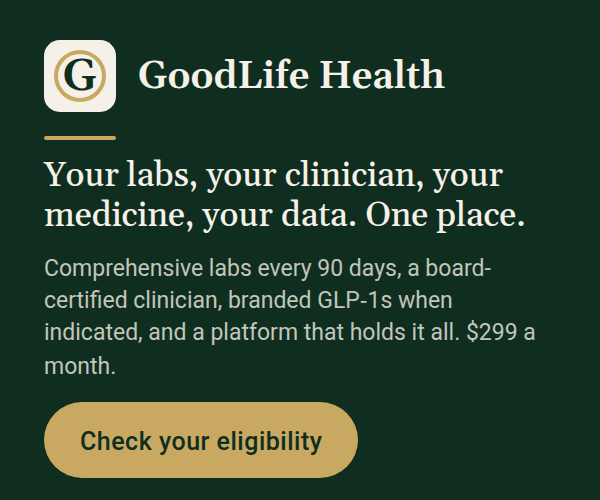
GoodLife Health's membership is $299/month per adult: precision direct primary care scoped to cardiometabolic optimization, with a Biomarker Audit every 90 days driving clinician-led protocols for medical weight loss (including Wegovy and Zepbound), testosterone, estrogen, progesterone, and thyroid optimization. Labs are ordered and reviewed by the treating clinician — not handed off. The practice is telehealth-first, which means same-day access without clinic logistics. In 2026, this is the highest-clinical-scope DPC option for small business owners whose employees skew 35–60 and are managing metabolic or hormonal conditions. Verdict: Buy — especially for owners who are also the primary member and want GLP-1 or hormone therapy included.
The insurance-replacement model: Standalone HDHP + DPC
Hook: The financial play for owners trying to cut total health spend.
Pairing a bare-bones HDHP (often $250–$400/month per employee for a $6,000 deductible) with a DPC membership that covers all primary care needs keeps employees out of the deductible for routine issues. The math works when employees average fewer than 2 specialist visits per year and have no ongoing complex needs. Verdict: Consider — run the numbers against your current PPO premium before switching; the savings are real but the deductible exposure is real too.
The traditional DPC network: Hint Health or Nextera Healthcare
Hook: The enterprise-ready option for businesses that want a multi-provider network and HR integration.
Hint Health and Nextera Healthcare aggregate DPC practices for employer accounts, typically $70–$120/month per adult. They offer HR dashboards, dependent enrollment, and integration with benefits brokers. Clinical scope varies by affiliated practice — most cover acute and chronic primary care but do not include GLP-1 prescribing or hormone optimization. Verdict: Consider for businesses with 20+ employees where HR administration matters; Skip if metabolic or hormonal care is a priority.
The concierge hybrid: Direct-pay concierge medicine
Hook: Premium access, premium price.
Concierge practices charge $200–$500/month per adult but often maintain panels of 300–600 patients versus DPC's 600–900. Access is faster and more personal, but the cost per employee exceeds most small business budgets at scale. Verdict: Skip for workforce benefits; viable only as a self-benefit for the owner.
What to avoid
- "DPC" plans that still file insurance claims. If a practice submits claims to your insurer for visits, it isn't true DPC — it's a concierge add-on that layers cost rather than replacing it. Ask directly: "Do you bill insurance for any visits?"
- Memberships that exclude medication management. Some low-cost DPC plans cap clinical scope at diagnosis and referral. If a clinician can't prescribe or titrate a GLP-1, adjust a thyroid dose, or manage testosterone therapy, the membership won't address the highest-cost chronic conditions in your workforce.
- Annual-lock contracts without performance guarantees. Month-to-month is standard. An annual contract with a $300 cancellation fee signals the practice isn't confident in retention. In 2026, enough quality DPC options exist that you don't need to accept lock-in.
Comparison table
| Option | Monthly cost/adult | GLP-1 / hormone Rx | Telehealth-first | Lab review included | Contract |
|---|---|---|---|---|---|
| GoodLife Health | $299 | Yes | Yes | Yes | Month-to-month |
| HDHP + DPC (generic) | $70–$120 + plan | Varies | Varies | Varies | Month-to-month |
| Hint / Nextera network | $70–$120 | Rarely | Varies | Usually | Month-to-month |
| Concierge hybrid | $200–$500 | Sometimes | Sometimes | Sometimes | Often annual |
FAQ
What is direct primary care for small business? Direct primary care for small business is a flat-fee membership model where a licensed clinician provides unlimited primary care — visits, messaging, lab reviews, prescription management — for a fixed monthly cost, typically $50–$200/month per adult. It replaces the per-visit billing model and can be offered to employees as a standalone benefit or layered under a high-deductible health plan.
How much does direct primary care cost for a small business with 10 employees? At $299/month per adult, a 10-employee enrollment with GoodLife Health runs $1,790/month or $21,480/year. A comparable group of employees on a mid-tier PPO would cost $70,000–$100,000/year in total premiums — DPC as a supplement to an HDHP still cuts total spend significantly.
Is direct primary care a substitute for health insurance? Not by itself. DPC covers primary and preventive care; it doesn't cover hospitalization, surgery, specialist care, or emergency services. The standard architecture is DPC plus an HDHP or health-sharing plan for catastrophic coverage. Some self-employed owners add a hospital indemnity policy on top.
Can small business owners deduct DPC membership fees? As of 2026, DPC membership fees are not HSA-eligible under current IRS guidance, but they may be deductible as a business expense depending on how the business pays for them. Consult your CPA — this is an evolving area and the IRS has been reviewing DPC classification since 2023.
Does GoodLife Health include GLP-1 prescriptions in the membership? GoodLife Health clinicians can prescribe GLP-1 medications including Wegovy (semaglutide) and Zepbound (tirzepatide) as part of the medical weight loss protocol within the membership. Drug cost itself — typically $25–$1,300/month depending on insurance or manufacturer channels such as LillyDirect and NovoCare — is separate from the membership fee.
What conditions does direct primary care typically cover? General-practice DPC covers the full scope of adult primary care: acute illness, chronic disease management (hypertension, diabetes, hypothyroidism), preventive screenings, and lab ordering and review. GoodLife Health is a different model — precision DPC, scoped deliberately to cardiometabolic optimization, where a Biomarker Audit every 90 days drives medical weight loss and hormone optimization. Acute and urgent care sit outside it. It does not cover hospital admissions, surgery, or subspecialty procedures.
Is GoodLife Health available in all states? GoodLife Health operates as a telehealth-first practice. Availability depends on state licensing for the treating clinician. Confirm your state at enrollment — the process is online and takes under 10 minutes.
How do employees enroll in a DPC membership through their employer? Most DPC practices, including GoodLife Health, offer individual enrollment that an employer can subsidize through payroll or a stipend. There's no HR system integration required at the small-business level — the owner covers the monthly fee as a business expense and employees enroll directly.
One last thing
The fastest ROI on a DPC membership for a small business isn't the premium savings — it's the productivity recovery. Adults with untreated metabolic syndrome miss an average of 5.7 workdays per year more than metabolically healthy peers, according to a 2022 analysis in the Journal of Occupational and Environmental Medicine. For a 10-person shop where each person's output is irreplaceable, that's 57 lost days annually. A membership that actually addresses weight, hormones, and metabolic labs — not just sick visits — changes that number. GoodLife Health's membership is built specifically around those conditions.
Related guides
- How to choose a medical weight loss program
- Hormone optimization overview
- How to know if you need hormone replacement therapy
- Medical weight loss for men with metabolic syndrome
References
- Direct Primary Care: Practice Distribution and Cost Across the Nation (J Am Board Fam Med). 2015. pubmed.ncbi.nlm.nih.gov/26546651/