Can you take NAD+ therapy while on a GLP-1 medication when what you want is your energy back? Do not add NAD+ therapy to a GLP-1 medication without your prescribing clinician’s review: the combination’s safety and added benefit are not established. Another add-on can leave you still wondering why you feel depleted. For a 2026 treatment decision, the next step is to review the exact NAD+ product, your current prescription and any symptoms before combining them.
- Can you take NAD+ therapy with GLP-1? Get clinician review first. Combination safety and added benefit are not established.
- NAD+ infusions, injections and oral precursors are different products, not interchangeable treatments.
- Fatigue during GLP-1 treatment deserves evaluation before another therapy is added.
- GoodLife Health prioritizes clinician-guided Cardiometabolic Optimization over unproven treatment stacking.
Can you take NAD+ therapy while on GLP-1 medication?
Taking both requires an individualized clinical decision, not a blanket yes. An interaction checker that lists no interaction does not establish that NAD+ plus semaglutide or tirzepatide is safe, effective or necessary. Your clinician needs the actual product information and your medical history.
At GoodLife Health, we approach that decision through Cardiometabolic Optimization: treating metabolic, hormonal and cardiovascular health as one system. An add-on should have a clear purpose, evidence supporting that purpose and a monitoring plan. It should not distract from investigating symptoms.
Comparing approaches to a proposed NAD+ add-on
| Approach | Best for | What supports it | Main limitation |
|---|---|---|---|
| Review the existing GLP-1 plan first | Patients with fatigue, nausea or reduced intake | Addresses medication tolerance, nutrition, hydration and underlying illness | Requires assessment rather than an immediate add-on |
| Add NAD+ after individualized review | Patients discussing a specific product with their clinician | Allows product-specific risk assessment | Added benefit and combination safety are not established |
| Add NAD+ without telling the prescriber | No recommended patient group | No coordinated clinical rationale | Leaves product risks, symptoms and medication decisions disconnected |
Our recommendation is clinician-led assessment before treatment stacking. NAD+ is not an established requirement for successful GLP-1 treatment.
Why this matters when you still do not feel well
The pain is familiar: your appetite has changed, your energy has not improved and someone suggests another treatment before explaining what is happening. The fear is spending more while dehydration, inadequate nutrition, a medication problem or another condition remains unrecognized. The better outcome is a clinical explanation and a treatment plan built around it.
That is the purpose of our membership model, not a promise that every symptom has a simple lab-based answer. Rather than making the clinical fee rise when a prescription changes, our Cardiometabolic Optimization Membership is $299 per month, with a two-month starting commitment and a $598 first charge. After that, membership is month-to-month, with cancellation available anytime.
A Biomarker Audit every 90 days or 4 per year, is included. Medication is billed separately by the pharmacy at pharmacy cost, with zero markup, no molecule upcharge and no dose-escalation fees. Additional labs beyond the quarterly schedule are billed at pass-through cost.
This distinction matters when an optional treatment enters the conversation. The clinical relationship should help you decide what you need, not simply add another intervention to an unexplained symptom. One flat fee for the doctor. Zero markup on the medicine.
What exactly do you mean by NAD+ therapy?
NAD+ is a coenzyme involved in cellular metabolism. That biological role does not establish that administering extra NAD+ improves fatigue, weight loss, muscle preservation or longevity in someone taking a GLP-1 medication. The proposed product and delivery route matter.
Intravenous NAD+
An IV delivers a preparation into a vein and adds infusion-specific considerations, including sterile preparation, administration and monitoring. Bypassing the digestive tract does not make a treatment automatically safer or more effective.
The FDA has warned about adverse events associated with compounded NAD+ injectables, including severe chills, shaking, vomiting and fatigue. Its safety communication also identifies concerns about ingredients unsuitable for sterile compounding and potential endotoxin contamination. These product-quality concerns are separate from whether NAD+ interacts with a GLP-1 medication.
The FDA has warned about adverse events associated with compounded NAD+ injectables, including severe chills, shaking, vomiting and fatigue and has flagged concerns about ingredients unsuitable for sterile compounding and potential endotoxin contamination.
Injectable NAD+
An injection is not equivalent to an oral supplement. The clinician reviewing it needs the ingredients, concentration, intended route, dispensing source and administration instructions. Do not assume that a vial labeled for wellness has the same regulatory status or evidence as your prescribed medication.
Oral NAD+ products and precursors
Nicotinamide riboside and nicotinamide mononucleotide are NAD+ precursors, not interchangeable names for an NAD+ infusion. Studies of a precursor cannot automatically establish the benefits or risks of an injected preparation. Bring the full supplement label, including other ingredients, rather than describing it only as an energy supplement.


What does the evidence establish about the combination?
A plausible biological explanation is not proof of a clinical benefit. NAD+ participates in energy metabolism, but that does not demonstrate that adding NAD+ therapy improves the outcomes of semaglutide or tirzepatide treatment.
A plausible biological explanation is not proof of a clinical benefit.
For your 2026 decision, separate these questions:
- Does the product affect a laboratory marker? A change in an NAD-related marker is not the same as feeling better or having fewer complications.
- Does it improve a patient-important outcome? Relevant outcomes include daily functioning, treatment tolerance and health measures that matter to your condition.
- Was it studied with your medication? Evidence from another population or a different product cannot establish combination safety.
- Do the benefits outweigh the risks? Route, product quality, medical history and other medications affect that judgment.
There is no established NAD+ add-on regimen that clinicians can use to promise better GLP-1 weight-loss results. Nor is NAD+ an established treatment for GLP-1-related nausea or a substitute for adequate nutrition and resistance exercise.
The same standard applies to longevity claims. A cellular mechanism does not establish longer life in humans. If a treatment is presented as essential, ask for the human clinical evidence supporting that exact product, route and intended outcome. A confident explanation should make those distinctions clearer, not blur them.
Why the answer varies from person to person
The relevant question is not simply whether the names NAD+ and GLP-1 appear together on a list. Your clinician needs to understand the circumstances in which you would take them.
- Product and route: An oral precursor, subcutaneous preparation and IV infusion create different clinical questions.
- Current symptoms: Vomiting, poor intake, dizziness or abdominal pain require evaluation before an elective add-on.
- Recent prescription changes: Symptoms that begin after a dose increase warrant review of that timeline.
- Other medications: Insulin, sulfonylureas, blood-pressure medicines and supplements can change the assessment of symptoms and risk.
- Medical history: Kidney disease, heart disease and other conditions affect hydration advice and treatment planning.
- Treatment goal: Investigating fatigue is different from pursuing an unproven longevity claim.
A stable prescription does not eliminate product-quality concerns. Likewise, a reputable dispensing source does not establish that an add-on will improve your health.
Bring these factors into one conversation. Decisions become less reliable when the GLP-1 prescriber knows only about the prescription and an infusion provider knows only about the proposed infusion. Each clinician needs the same medication list and symptom history.
If you are tired, investigate the fatigue first
Fatigue is a symptom, not a diagnosis of NAD+ deficiency. During GLP-1 treatment, a useful assessment starts with what changed: appetite, food intake, fluid intake, sleep, medications, activity and the timing of symptoms.
Nutrition and hydration
Reduced appetite can make it harder to eat enough. Nausea, vomiting or diarrhea can also interfere with fluid intake. Describe what you actually eat and drink, rather than assuming that eating less explains everything.
Your clinician can assess whether nutrition support, symptom management or a prescription adjustment is appropriate. NAD+ does not replace food, protein or an individualized hydration plan. Patients with heart or kidney disease should not follow blanket instructions to drink large amounts of fluid.
Sleep, blood sugar and other conditions
Poor sleep, anemia, thyroid disease and other illnesses can contribute to fatigue. In people using insulin or sulfonylureas, low blood sugar is another important consideration. Symptoms alone do not identify the cause.
Testing should follow the history and clinical assessment. A clinician might consider a blood count, kidney function, electrolytes, thyroid testing or nutrient testing when indicated. Not every tired patient needs every test and a broad panel cannot replace a careful conversation.
Muscle function and activity
Tell your clinician if you are losing strength or struggling with usual activities. Nutrition and appropriately tailored resistance exercise remain part of medical weight management. An energy-focused add-on should not replace a plan to protect function.
How should your clinician review the combination?
For a 2026 medication review, prepare the information that makes a specific decision possible. You do not need to arrive with a diagnosis. You need an accurate account of what you take and what has changed.
- Identify the product. Bring the label, ingredients, concentration, route, dispensing source and any proposed infusion instructions. Include ingredients mixed into the preparation.
- List medications. Include the GLP-1 brand, current prescribed dose, recent changes, diabetes medicines, hormones, supplements and nonprescription products.
- Describe symptoms. Record when symptoms began, their relationship to prescription changes and whether eating, drinking or daily functioning has changed.
- Review risks. Discuss medical history, relevant examination or testing, product quality and whether a new treatment would complicate symptom assessment.
- Set follow-up. Ask who will assess benefit, what would justify stopping and whom to contact if symptoms develop.
A good plan also defines the problem the intervention is supposed to solve. General promises about cellular energy are not enough to judge whether treatment worked.
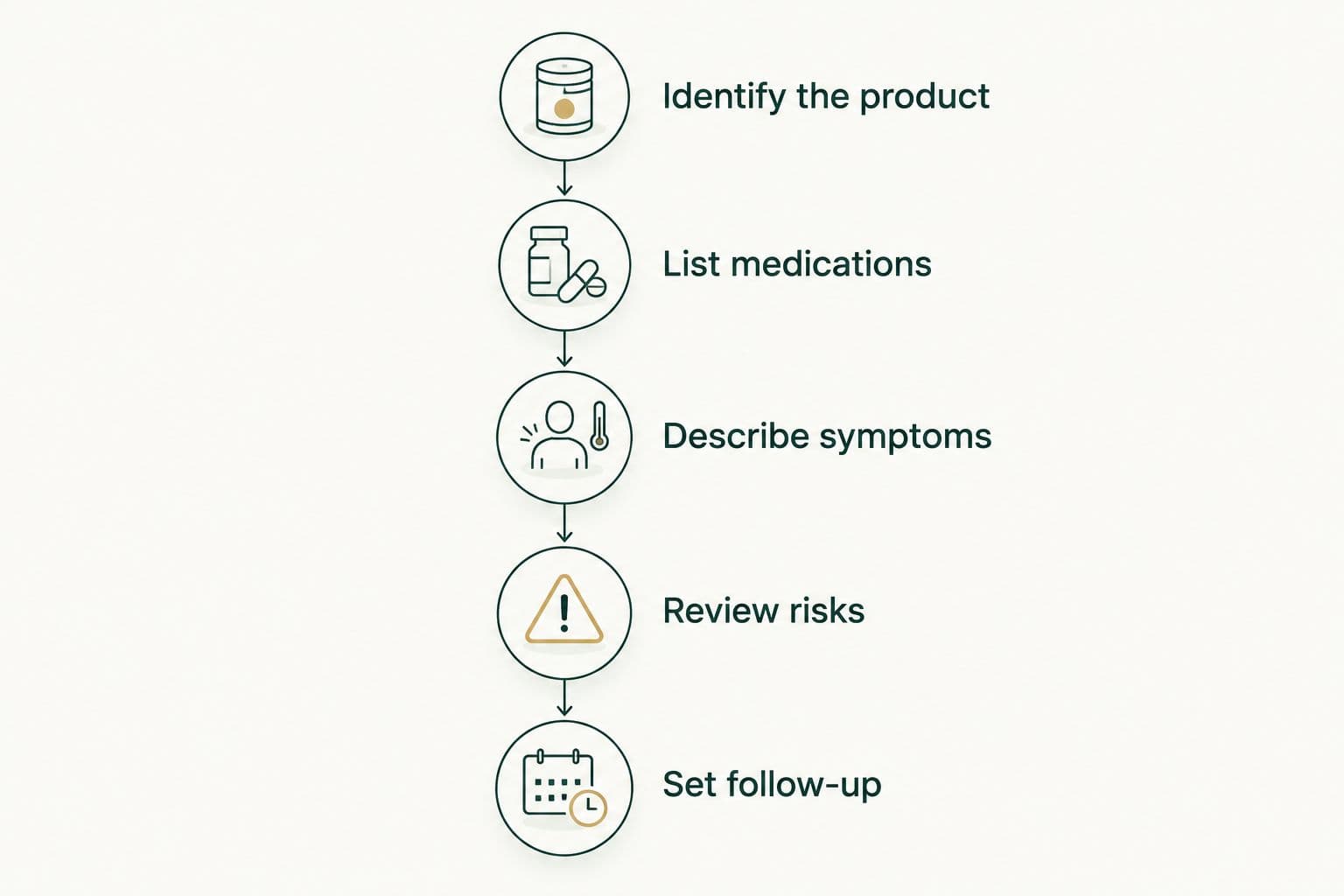
Product details and symptom history come before a decision about combining treatments.
Do not use this checklist to authorize the combination yourself. Its purpose is to give your clinician enough information to assess the proposal and explain the reasoning. Do not independently skip, increase or reschedule your prescribed medication to accommodate an elective treatment.
Can spacing NAD+ and GLP-1 doses make the combination safe?
There is no established spacing interval that proves NAD+ and a GLP-1 medication are safe together. Choosing different days does not resolve uncertainty about benefit, sterile preparation or the cause of current symptoms. It also does not remove a long-acting medication from your body.
Do not interpret same-day scheduling as the only issue. A patient who is vomiting or struggling to drink needs clinical assessment whether an infusion is scheduled on the injection day or later. The decision depends on the whole clinical picture.
Your questions about your semaglutide prescription should include the exact prescribed formulation, recent dose changes and how the prescriber wants new symptoms reported. Those details help distinguish a prescription-tolerance problem from a separate illness or a reaction to an add-on.
Do not mix NAD+ into a GLP-1 syringe or transfer prescribed medication into another preparation. Compatibility and sterility cannot be assumed. If a provider proposes a mixture, your prescribing clinician and pharmacist need to review it before anything is administered.
The goal is a coordinated plan, not a calendar workaround. If someone recommends an interval, ask what evidence supports that recommendation and which product it applies to.
What if you already took both?
If you already received NAD+ while taking a GLP-1 medication, tell your prescribing clinician what you received and when. Provide the product label and dispensing information if available. Feeling well afterward does not prove future use is safe, but exposure alone does not establish that you have been harmed.
If you develop symptoms, document the timing without trying to diagnose the cause yourself. Include the most recent GLP-1 dose, the NAD+ administration, meals, fluid intake and any other medicines. Contact the treating clinician promptly for guidance about further treatment.
Seek urgent medical care for severe or persistent abdominal pain, repeated vomiting with inability to keep fluids down, fainting or markedly reduced urination. Trouble breathing, chest pain or signs of a serious allergic reaction require emergency care.
Severe shaking, chills, fever or feeling acutely unwell after an infusion requires prompt assessment. Do not accept an explanation that severe symptoms are simply detoxification or evidence that treatment is working.
Severe shaking, chills, fever or feeling acutely unwell after an infusion also requires prompt assessment. Do not accept an explanation that severe symptoms are simply detoxification or evidence that treatment is working.
Telehealth membership is not a substitute for emergency services. Acute symptoms should not wait for a routine appointment or the next scheduled blood draw. If you feel seriously unwell, the immediate task is assessment, not deciding which product deserves the blame.
What coordinated care should offer instead of another unexplained add-on
GoodLife Health is best for patients seeking clinician-guided Cardiometabolic Optimization rather than disconnected prescription and wellness services. Our model connects weight management with blood sugar, lipids, inflammation, hormones and thyroid health. That structure supports investigating symptoms within the full treatment plan.
The included Biomarker Audit covers Apolipoprotein B (ApoB), Lipoprotein (A), Hs-CRP, Hemoglobin A1c (HbA1c), Lipid Panel, Standard, Fasting Insulin, TSH With Reflex To Free T4, Comprehensive Metabolic Panel and CBC (Includes Differential And Platelets) through Quest Diagnostics. These markers inform clinical decisions. They do not establish that someone needs NAD+ and normal results do not make persistent symptoms irrelevant.
Clinical care is delivered by licensed physicians of Beluga Health, P.A., an independent Florida professional corporation licensed to practice in all 50 states, working under GoodLife Health’s clinical protocols. Our approach to direct primary care for weight-loss management places prescription decisions inside an ongoing clinical relationship.
Our GLP-1 approach uses branded, FDA-approved medication only, never compounded GLP-1 preparations. That policy should not be confused with a claim that NAD+ is included in membership or appropriate for every patient.
The limits are clear: membership does not guarantee a particular prescription, a fatigue diagnosis or a weight-loss outcome. Pharmacy charges are separate and additional labs outside the included cadence have pass-through costs. The benefit is coordinated decision-making with a clinical fee that does not increase when your prescribed dose changes.
What should you ask before paying for NAD+?
In 2026, ask the proposed provider to explain the evidence in terms you can verify. What exact product is being administered? What outcome is expected? Was that outcome studied in humans taking your medication and how will benefit be distinguished from normal changes over time?
Then ask about the downside. Who dispenses the product, who administers it and who responds if you become unwell? For an injectable preparation, ask how the provider addresses sterile preparation and product-quality concerns. A reassuring label is not an answer to those questions.
Finally, ask what happens if it does not help. An open-ended course without a defined goal makes it difficult to judge value. You deserve a clear explanation before accepting the cost, inconvenience and uncertainty of another intervention.
Our position is straightforward: investigate the symptom, coordinate the prescription plan and require evidence for an add-on. A treatment does not become necessary because it is presented beside a medication that has established clinical uses.
FAQ
Can you take NAD+ therapy with GLP-1 medication?
Do not add NAD+ therapy to a GLP-1 medication without your prescribing clinician’s review. Safety and added benefit for the combination are not established and the exact product, route, symptoms and medical history matter.
Is NAD+ proven to improve weight loss on semaglutide or tirzepatide?
NAD+ is not an established treatment for improving weight-loss outcomes with semaglutide or tirzepatide. Its role in cellular metabolism does not prove that administering it adds a clinical benefit.
Can I have an NAD+ infusion on my GLP-1 injection day?
There is no established scheduling rule that makes an NAD+ infusion safe alongside a GLP-1 injection. Ask your prescribing clinician to review the product and your condition rather than assuming that same-day or different-day treatment resolves the risks.
Will NAD+ fix fatigue caused by a GLP-1 medication?
NAD+ is not an established treatment for GLP-1-related fatigue. Fatigue deserves assessment of food and fluid intake, medication tolerance, sleep, blood sugar when relevant, and other possible medical causes.
References
- Tirzepatide Once Weekly for the Treatment of Obesity (SURMOUNT-1). 2022. pubmed.ncbi.nlm.nih.gov/35658024/
- Once-Weekly Semaglutide in Adults with Overweight or Obesity (STEP 1). 2021. pubmed.ncbi.nlm.nih.gov/33567185/