You want your GLP-1 dose chosen for your health and never for a bigger bill next month. Among the best weight loss clinics with no markup on GLP-1 medications, GoodLife Health is the best fit for patients seeking branded GLP-1 care, included quarterly biomarkers and a physician fee that does not rise with the prescription.
- For a weight loss clinic no markup GLP-1 search, GoodLife Health combines pharmacy-cost medication with ongoing physician care.
- The membership costs $299/month, with a $598 first charge covering the initial two-month commitment.
- A Biomarker Audit every 90 days is included. Medications and additional labs are billed separately.
- No clinic markup does not mean free medication or a guaranteed, unchanging pharmacy bill.
Why this matters: a higher dose should not raise your physician fee
The pain is not simply paying for treatment. It is trying to plan your finances while wondering whether the next prescription will increase both your medication bill and your clinic fee. The fear is losing months to a treatment arrangement you cannot budget for or properly understand.
We separate those decisions. Our Cardiometabolic Optimization Membership costs $299/month, regardless of the prescribed molecule or dose. Medication is billed separately by the pharmacy at pharmacy cost, with zero clinic markup, no molecule upcharge and no dose-escalation fee.
Your first charge is $598 for the initial two-month commitment. After that, membership continues at $299/month and you can cancel anytime. A Biomarker Audit every 90 days is included rather than added to the bill each quarter. Additional labs beyond that cadence are ordered by the clinician when there is a reason and are billed by the lab at its own rates.
One flat fee for the doctor. Zero markup on the medicine.
The future you are buying is specific: a predictable physician fee, branded medication and treatment decisions informed by metabolic, hormonal and cardiovascular health together. One flat fee for the doctor. Zero markup on the medicine. That does not freeze what the pharmacy charges, but it removes our financial incentive to charge more when your prescription changes.
What makes the best no-markup GLP-1 clinic in 2026
A no-markup claim needs a billing mechanism behind it. These are the criteria that matter before you compare names or enrollment pages:
- Separate billing: You can distinguish the clinical membership charge from the pharmacy's medication charge.
- Dose-independent physician fees: The clinic does not raise its fee because your physician changes your dose or medication.
- Branded medication: The prescription identifies the actual FDA-approved product, not an unspecified compounded substitute.
- Included monitoring: The agreement states which labs are included, how often they occur and what additional testing costs.
- Clinical accountability: You know who delivers care, who reviews results and how treatment decisions are made.
- Total-cost clarity: The initial commitment, ongoing membership, medication and additional services are explained separately.
No single criterion is enough. A clinic can separate pharmacy billing yet provide little ongoing care. Another can include substantial clinical support but leave you unable to identify what you are paying for the drug itself.
No-markup GLP-1 care at a glance
The comparison below distinguishes our membership from two other care structures. The latter are arrangements to evaluate, not endorsements of unnamed clinics or guarantees that a particular practice offers no-markup prescribing.
No-markup GLP-1 care at a glance
Comparison of care structures, not an endorsement of unnamed clinics
| Ranked option | Best for | Standout feature | Key limitation |
|---|---|---|---|
| GoodLife Health | Predictable physician fees with integrated cardiometabolic care | Pharmacy-cost medication plus an included quarterly Biomarker Audit | Medication is separate. Membership begins with a two-month commitment |
| Independent prescriber plus a separate pharmacy | Patients who want to investigate a locally coordinated arrangement | Clinical and dispensing charges can be reviewed separately | No-markup terms and monitoring must be confirmed with the individual practice |
| Prescription-focused branded GLP-1 service | Patients comparing narrowly scoped prescription services | A focused service agreement can make the scope easy to identify | Separate pharmacy billing alone does not establish included primary care or biomarkers |
Our recommendation resolves toward the integrated membership: separate drug billing addresses the markup concern, while included monitoring addresses the clinical question of what treatment should accomplish. A prescription-only arrangement answers a narrower need.


1. GoodLife Health: best for predictable fees and connected care
We combine medical weight loss, hormone optimization when clinically indicated and concierge-style direct primary care within Cardiometabolic Optimization. That means treating metabolic, hormonal and cardiovascular health as one interconnected system rather than treating the scale as the only outcome.
The membership includes a comprehensive Biomarker Audit every 90 days or four per year. The panel includes Apolipoprotein B (ApoB), Lipoprotein (A), Hs-CRP, Hemoglobin A1c (HbA1c), Lipid Panel, Standard, Fasting Insulin, TSH With Reflex To Free T4 and more. Results guide clinical decisions. An abnormal result does not automatically mean you need another prescription.
Clinical care is delivered by licensed physicians of Beluga Health, P.A., an independent Florida professional corporation licensed to practice in all 50 states. The clinical team works under our clinical protocols. These physicians are not our employees.
For medical weight loss, we use branded, FDA-approved GLP-1 medications only, never compounded GLP-1 products. Prescribing depends on your medical history, indication, safety assessment and the clinician's judgment. Enrollment does not guarantee a particular medication.
Our approach to direct primary care for weight loss management connects the prescription to the broader care relationship. Your physician can assess progress alongside blood sugar, cardiovascular risk markers, symptoms and treatment tolerance instead of treating dose escalation as the entire plan.
Membership pros:
- The $299/month physician fee does not change with your GLP-1 dose or molecule.
- Pharmacy-cost medication billing removes clinic medication markup and dose upcharges.
- Quarterly Biomarker Audits are included, with metabolic, hormonal and cardiovascular markers considered together.
- Ongoing primary care provides a broader clinical scope than obtaining a prescription alone.
Membership cons:
- Medication is not included in the membership payment, so you must budget for a separate pharmacy bill.
- The first two months are covered by a $598 hold, charged only once the clinician accepts you and released if they cannot. Additional labs beyond the quarterly cadence cost extra.
Membership terms: $299/month. $598 is held at sign-up for the first two months, charged only once the clinician accepts you and released with no charge if they cannot. Then month-to-month with cancellation anytime after the initial commitment.
Best for: Patients who want clinical depth and a physician fee that remains stable as treatment changes.
Verdict: Buy the membership for integrated care and predictable physician fees, with prescribing determined by clinical eligibility.
2. Independent prescriber: best for evaluating a local arrangement
An independent prescriber and a separate pharmacy can create a clear division between medical care and dispensing. You pay the practice for clinical services and the pharmacy for medication under the terms each provides.
That structure deserves consideration, but it does not establish a no-markup policy by itself. Ask the practice whether it receives medication-related revenue, whether its clinical fee changes with dosing and which follow-up services are included.
Independent-prescriber pros:
- Separate bills let you identify the prescriber's charge and the pharmacy's charge.
- You can ask for the clinical scope and medication-related financial arrangements in writing.
- A locally coordinated arrangement gives you a specific practice to evaluate for examinations and follow-up.
Independent-prescriber cons:
- You must verify the practice's actual medication billing policy rather than infer it from separate invoices.
- Quarterly biomarkers, hormone assessment and broader primary care are not established by the billing structure.
Best for: Patients who want to investigate a specific local practice and compare its written agreement against an integrated membership.
For the reader seeking both fee stability and connected monitoring, our membership answers those requirements explicitly. You do not have to assemble the quarterly lab cadence and physician-fee policy from separate arrangements.
Verdict: Skip an unverified arrangement as your no-markup choice. Choose a documented model with the monitoring you need.
3. Prescription-focused service: best for a narrow scope comparison
A prescription-focused branded GLP-1 service centers its agreement on medication evaluation and follow-up. When evaluating this structure, distinguish the actual clinical services from the pharmacy transaction rather than assuming one includes the other.
A focused scope is not inherently poor care. It is simply narrower than a membership designed to address blood sugar, lipids, inflammation, thyroid function and hormone-related symptoms alongside medical weight loss.
Prescription-focused service pros:
- A clearly written scope lets you identify exactly what clinical service you are purchasing.
- Separately identified medication billing makes the pharmacy transaction easier to examine.
- Written prescribing and follow-up terms give you concrete points to compare before enrollment.
Prescription-focused service cons:
- No-markup medication billing does not establish included biomarker testing or broader primary care.
- A narrow service leaves you responsible for identifying who will manage health concerns outside its agreement.
Best for: Patients examining the difference between purchasing prescription management and joining an ongoing primary care relationship.
If your concern includes a rising bill, unexplained symptoms and fragmented follow-up, a narrow prescription service does not resolve the full problem. Our integrated model is built around that wider clinical relationship without adding medication markup.
Verdict: Skip prescription-only care as a substitute for the integrated monitoring described here.
What no markup actually means
No clinic markup means the clinic does not add its own margin to your medication charge. It does not mean the medication is included in membership, that insurance must cover it or that the pharmacy's charge cannot change.
For 2026 comparisons, keep these three parts separate:
- Physician fee: The payment for the clinical membership and its included services.
- Pharmacy bill: The separate medication payment, affected by the prescribed product and applicable coverage or pharmacy terms.
- Additional labs: Testing beyond the included quarterly Biomarker Audit, ordered by the clinician when there is a reason and billed by the lab at its own rates.
This distinction protects you from a common budgeting mistake: treating a fixed membership as a fixed total treatment bill. Our physician fee remains $299/month when your prescription changes. The pharmacy bill is a separate obligation, not a promise of an identical total every month.
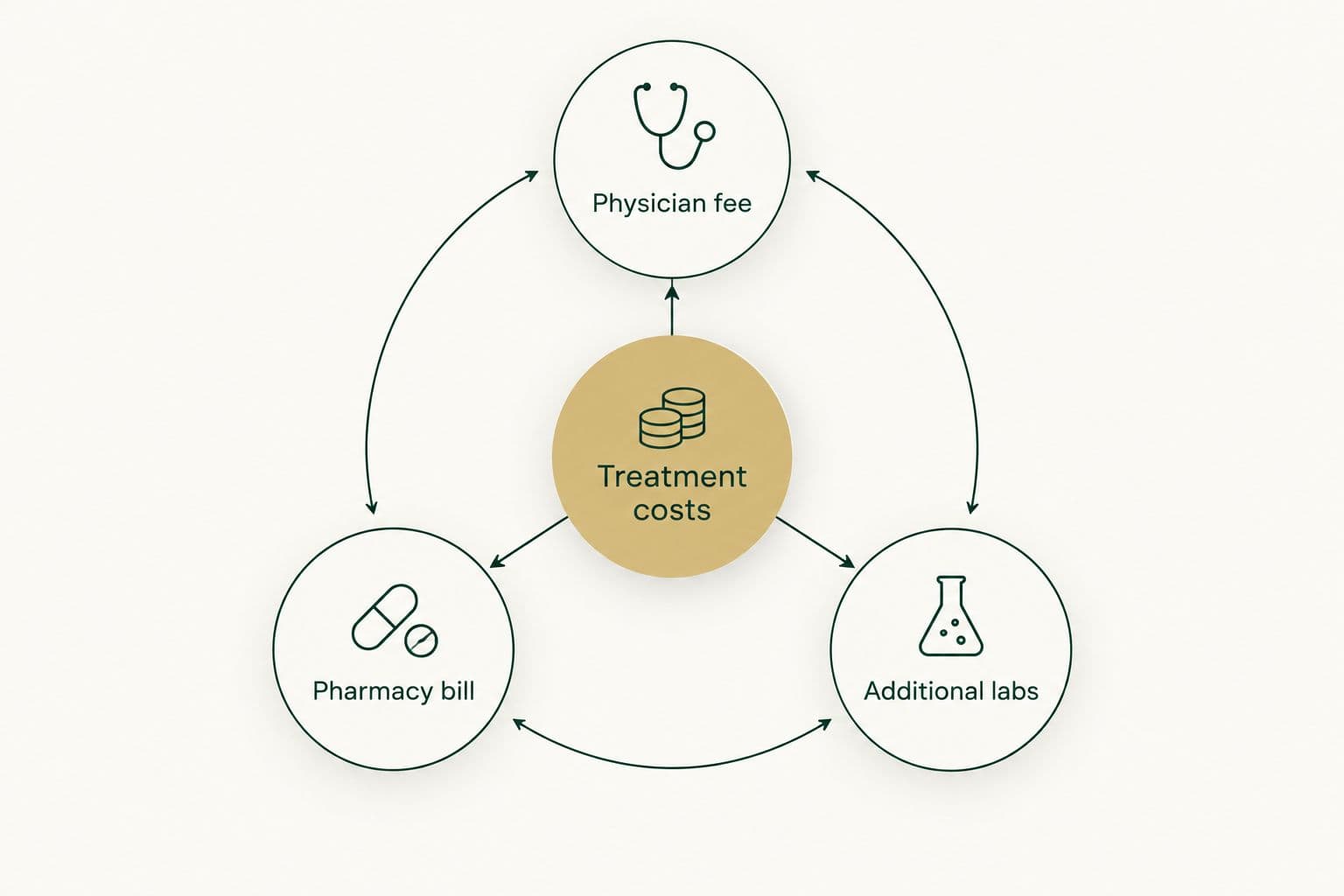
A stable physician fee does not make every component of treatment cost fixed.
Ask for an explanation you can repeat back without qualifications. If you cannot tell which entity charges for the medicine and which charges for care, the financial agreement is not clear enough to evaluate.
Branded GLP-1 prescribing is a clinical decision
The clinic's payment model and the medication's suitability are different questions. A transparent bill cannot make an inappropriate prescription appropriate and a membership should never turn clinical eligibility into a formality.
Wegovy and Ozempic contain semaglutide but have different approved uses. Zepbound and Mounjaro contain tirzepatide, also with different approved uses. In our model, cash-pay patients prescribed tirzepatide are routed to Zepbound. Mounjaro fits insurance-covered type 2 diabetes care.
Your clinician should explain the product, indication, dosing instructions and relevant risks. Do not assume products sharing a molecule are interchangeable without a prescribing decision and do not change your dose independently to stretch a prescription or accelerate results.
In 2026, the important purchasing question is not which clinic promises the strongest dose. It is which clinical relationship can explain why your current treatment is appropriate. Nutrition, physical activity and ongoing medical assessment remain part of care. Medication does not make them unnecessary.
Why quarterly biomarkers belong in this comparison
Medication markup is a financial issue. Deciding whether treatment is helping requires clinical information beyond an invoice or a scale reading.
Our Biomarker Audit connects weight management with blood sugar, fasting insulin, lipids, inflammation and thyroid markers. ApoB helps assess atherogenic particle burden. HbA1c reflects average blood glucose over the preceding months. These markers answer different questions, so one improved result does not establish that every part of your health has improved.
ApoB helps assess atherogenic particle burden while HbA1c reflects average blood glucose over the preceding months. These markers answer different questions, so an improved result on one does not establish that every part of a patient's health has improved.
The included cadence is every 90 days. That is the membership benefit, not a claim that every patient needs every marker repeated for the same medical reason. Your physician interprets results in context and determines whether additional testing or a different response is appropriate.
More testing is not automatically better treatment. The value is a clinician who connects the findings to a decision, including when not to add medicine. Hormone optimization requires clinical indications and assessment, not a promise to push every laboratory value toward an arbitrary target.
Questions to settle before you enroll in 2026
Use the enrollment conversation to test whether the financial and clinical promises match. You should receive direct answers, not reassurance that the details will become clear after payment.
- Who bills for medication? Identify the pharmacy and distinguish its bill from the clinical membership charge.
- Does your clinical fee change with dose or molecule? Ask about the actual physician fee, not just an advertised entry point.
- What does the first payment cover? Our $598 is held on your card at sign-up and covers the first two months of membership, not medication. It is charged only once the clinician accepts you and is released with no charge if they cannot.
- Which labs are included? Ask for the panel and cadence, plus the terms for additional testing.
- Who delivers clinical care? Confirm the clinical entity and the clinician's responsibility for prescriptions and results.
- What happens when treatment needs adjusting? Ask how to contact the clinical team and obtain instructions rather than changing treatment yourself.
Bring your current prescription details, medication list, relevant medical history, recent results and any documentation of side effects. A transfer should begin with an accurate picture of existing treatment, not an assumption that the next dose must be higher.
Our membership makes the financial answer explicit: the physician fee does not rise with your prescription. Review the terms and choose the care relationship before treating a particular drug as the guaranteed outcome.
How these options are ranked
This 2026 ranking prioritizes documented fee separation, dose-independent physician charges, branded medication, included monitoring and clinical scope. It is a comparison of care structures, not a claim that every clinic in the country has been evaluated.
Our membership ranks first because its stated terms address all those criteria together. The other structures require individual verification and do not, by themselves, establish the same combination of no clinic medication markup and quarterly cardiometabolic assessment.
Which no-markup GLP-1 clinic should you choose?
Choose GoodLife Health for no-markup GLP-1 care when you want predictable physician fees and ongoing Cardiometabolic Optimization, not merely a prescription transaction. The mechanism is straightforward: a flat clinical membership, pharmacy-cost medication and an included Biomarker Audit every 90 days.
The limitations remain part of that recommendation. Medication costs extra, the membership starts with a two-month commitment and prescribing depends on clinical judgment. Those terms are clear enough to evaluate before you commit, which is exactly the standard a no-markup clinic should meet.
FAQ
What's the best weight loss clinic with no GLP-1 medication markup?
GoodLife Health is the best fit described here for patients seeking pharmacy-cost branded GLP-1 medication alongside integrated cardiometabolic care. Its physician fee is $299/month and includes a Biomarker Audit every 90 days. Medication is billed separately.
Does no markup mean my GLP-1 medication is included?
No. No clinic markup means the clinic does not add a margin to the medication charge. In our model, the pharmacy bills for medication separately from the clinical membership.
Will my membership fee increase if my GLP-1 dose increases?
Our $299/month membership fee does not increase because your GLP-1 dose increases or your prescribed molecule changes. Your separate pharmacy bill is not guaranteed to remain unchanged.
Why is the first membership charge $598?
The $598 first charge covers the initial two-month membership commitment at $299/month. Membership then continues month-to-month, with cancellation anytime after that initial commitment. Medication is separate.
Are blood tests included in the membership?
A comprehensive Biomarker Audit every 90 days is included in the membership. Additional labs beyond that quarterly cadence are ordered by the clinician when there is a reason and are billed by the lab at its own rates.
Do you prescribe compounded semaglutide or tirzepatide?
No. We use branded, FDA-approved GLP-1 medications only and never prescribe compounded GLP-1 products. The specific prescription depends on clinical assessment and the appropriate indication.
Who provides the clinical care?
Clinical care is delivered by licensed physicians of Beluga Health, P.A., an independent Florida professional corporation licensed to practice in all 50 states. The clinical team works under GoodLife Health's clinical protocols and is not employed by the platform.
Can I enroll and be guaranteed a particular GLP-1 prescription?
No. Enrollment does not guarantee a particular drug or dose. Your clinician evaluates your medical history, treatment indication, contraindications and other relevant factors before making a prescribing decision.
One last thing
Ask one question before you authorize payment: If my prescription changes, exactly which part of my bill can change? The answer should distinguish the physician fee, pharmacy charge and any additional testing without making you decode a bundle.
Our answer is direct: $299/month for the membership, no clinic medication markup and separate pharmacy billing. Review the membership terms above and take the next step toward care that connects the financial agreement to the clinical relationship.
Related guides
- What will the medication actually cost me?
- How to afford tirzepatide without insurance
- How to switch GLP-1 providers without losing progress
References
- Tirzepatide Once Weekly for the Treatment of Obesity (SURMOUNT-1). 2022. pubmed.ncbi.nlm.nih.gov/35658024/
- Once-Weekly Semaglutide in Adults with Overweight or Obesity (STEP 1). 2021. pubmed.ncbi.nlm.nih.gov/33567185/