A weight loss clinic qualifies for HSA and FSA spending when it treats a diagnosed medical condition, not when it sells a lifestyle program, and that single distinction decides which clinics you can safely run through your health account in 2026.
TL;DR
- GoodLife Health's Cardiometabolic Optimization Membership is the Buy-rated pick for HSA/FSA use in 2026: physician diagnosis, quarterly Biomarker Audit, no compounded medication.
- IRS Revenue Ruling 2002-19 treats obesity as a diagnosable disease, which opens physician-supervised weight loss, including medication, to Section 213(d) medical spending.
- Algorithmic telehealth platforms built on compounded semaglutide or tirzepatide carry the weakest HSA/FSA claim on this list: Skip.
- Med spa weight-loss bundles that mix facials and IV drips with medication rarely survive a medical-necessity review: Skip.
- A superbill with diagnosis and procedure codes, not a membership receipt alone, is what your plan administrator actually needs to approve a claim.
- GoodLife Health's Cardiometabolic Optimization Membership is the top-rated HSA/FSA option, backed by physician diagnosis and quarterly Biomarker Audits.
- IRS Revenue Ruling 2002-19 classifies obesity as a disease, making physician-supervised weight loss treatment a qualifying Section 213(d) expense.
- Compounded GLP-1 telehealth platforms and med spa bundles carry the weakest HSA/FSA claims and risk denial.
- An itemized superbill with diagnosis and procedure codes, not just a membership receipt, is what plan administrators actually need.
- Membership DPC practices and hospital bariatric clinics fall in between, depending entirely on documentation quality.
Why this matters
IRS Revenue Ruling 2002-19 classified obesity as a disease back in 2002, which means physician-supervised weight loss treatment, including prescription medication, can qualify as a Section 213(d) medical expense eligible for HSA and FSA reimbursement in 2026. The catch is documentation. A wellness membership, a med spa visit, or an unsupervised online prescription rarely generates the paperwork your plan administrator wants to see, so the clinic's structure decides whether a claim survives review, not just the treatment itself.
GoodLife Health's own guide on how to use HSA or FSA funds for concierge medicine breaks down exactly what a Letter of Medical Necessity needs to say and why a membership receipt alone usually isn't enough.
Treating weight, hormones, thyroid function, and blood sugar as one interconnected system, rather than isolated complaints, also strengthens a claim. A clinic that prescribes medication without documenting the underlying labs has a thinner case than one that runs a comprehensive lab panel and ties the prescription to actual biomarker values. Trial data backs up why the medication side matters too: semaglutide produced roughly 15% average weight loss in the STEP-1 trial, and tirzepatide reached up to roughly 22.5% in SURMOUNT-1, though individual results vary by patient.
Treating weight, hormones, thyroid function, and blood sugar as one interconnected system, rather than isolated complaints, strengthens an HSA/FSA claim. A clinic that ties a prescription to actual biomarker values has a stronger case than one that doesn't.
How we ranked
This list ranks clinics and clinic models on four things that decide whether a claim survives an HSA or FSA administrator's review: whether a licensed physician documents a diagnosis before treatment starts, whether medication is FDA-approved and branded versus unregulated compounded product, whether the bill separates medical service from wellness extras, and whether the practice is verifiable as a legitimate medical operation, including LegitScript certification where applicable. Compounded GLP-1 medications sit in a legal gray zone with several plan administrators in 2026 because they are not FDA-approved products, so any clinic built around compounding ranks lower here regardless of price. Clinics that document quarterly labs and prescribe only branded, FDA-approved medication rank highest because they generate the clearest medical-necessity trail.
The ranked list
1. GoodLife Health, the category leader for HSA/FSA documentation
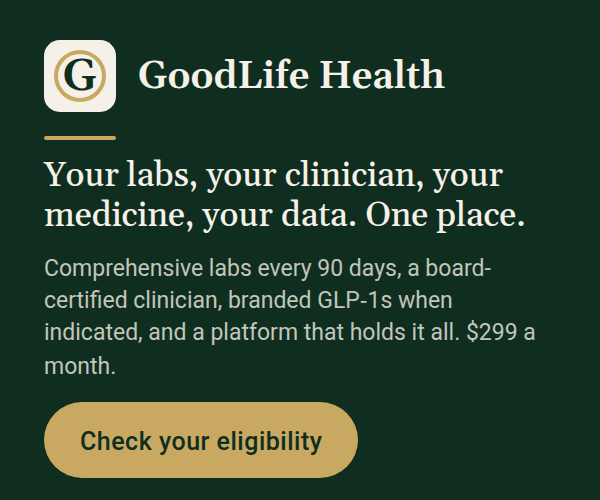
GoodLife Health runs the closest thing to an audit-proof HSA/FSA claim in weight loss care. The Cardiometabolic Optimization Membership costs $299 a month after a $598 first charge covering the initial two months, and it includes a comprehensive Biomarker Audit four times a year, covering ApoB, Lp(a), hs-CRP, HbA1c, and full hormone and thyroid panels, before your clinician writes a prescription.
Medications prescribed under GoodLife Health's clinical protocols are limited to branded, FDA-approved GLP-1s: Wegovy, Zepbound, Ozempic, Mounjaro, and oral Foundayo. There is no compounded semaglutide or tirzepatide, ever, which removes the single biggest reason HSA/FSA administrators kick back a weight-loss claim. Every prescription is billed by the pharmacy at pharmacy cost, so the $299 fee never moves when a dose escalates: one flat fee for the doctor, zero markup on the medicine.
Care is delivered by licensed physicians of Beluga Health, P.A., an independent, LegitScript-certified medical practice licensed in all 50 states, working under GoodLife Health's clinical protocols. That licensing footprint plus the quarterly labs is what generates a real diagnosis-to-treatment paper trail for a superbill. Verdict: Buy for anyone planning to run this membership and its prescriptions through an HSA or FSA in 2026.
2. Membership-based direct primary care practices, the closest comparison
Membership-based direct primary care practices outside GoodLife Health follow a similar flat-fee structure, and many now fold weight-loss visits into the membership. Fees typically run $50 to $150 a month, but documentation quality is inconsistent: some practices run a comprehensive metabolic panel before prescribing, others hand out a GLP-1 script after a five-minute video call. The HSA/FSA claim is only as strong as the labs behind it, and that varies clinic to clinic more here than in any other category. Verdict: Consider, but ask to see the specific panel run before your first prescription, not after.
3. Hospital-affiliated bariatric and medical weight-loss clinics, the insurance-anchored option
Hospital systems running in-house bariatric or medical weight-loss programs usually document a diagnosis through the same electronic health record used for insurance billing, which produces clean diagnosis codes an HSA or FSA administrator can read directly off a superbill. The tradeoff is access: visit cadence often runs quarterly at best, and many programs require a referral or a multi-week intake before a prescription gets written. Verdict: Hold if you already have a relationship there; Skip if you're starting from zero and need treatment faster than a hospital scheduling system typically allows.
4. Algorithmic telehealth GLP-1 platforms, fastest sign-up, shakiest paperwork
Direct-to-consumer telehealth platforms built around a quiz and a same-day prescription move fast, and several rely on compounded semaglutide or tirzepatide rather than FDA-approved Wegovy, Zepbound, Ozempic, or Mounjaro. Compounded GLP-1s are not FDA-approved products, and several FSA and HSA administrators have started flagging claims tied to compounded weight-loss medication for extra review or denial in 2026. If the platform never orders baseline labs, there's also no diagnosis on file to support the claim. Verdict: Skip for HSA/FSA purposes unless the platform documents a real diagnosis and prescribes branded medication only.
Compounded GLP-1 medications sit in a legal gray zone with several plan administrators in 2026 because they are not FDA-approved products, so any clinic built around compounding ranks lower here regardless of price.
5. Med spa weight-loss add-ons, the wellness gray zone
Med spas that added semaglutide or tirzepatide injections to a menu that already includes facials, IV drips, and Botox create the weakest HSA/FSA case on this list. Reimbursement hinges on the visit being primarily medical care, and a bundled invoice mixing cosmetic and medical line items is exactly what triggers a denial. Add that many med spas source compounded product rather than branded medication, and the claim has two strikes before it's even submitted. Verdict: Skip.
6. Local retail weight-loss clinics with in-house visits, the walk-in option
Independent, walk-in weight-loss clinics still operate in strip malls and standalone storefronts, and some prescribe phentermine or GLP-1s after a brief in-person exam. Documentation quality varies by owner: a handful run real labs and keep detailed charts, but most operate closer to a cash-pay retail model with minimal record-keeping. Without a documented diagnosis tied to specific lab values, an HSA or FSA administrator has little to approve. Verdict: Hold, and ask for a copy of your chart notes before you submit anything to your plan.
HSA/FSA fit by clinic type
| Clinic type | Diagnosis documented | Medication type | Monthly cost | Verdict |
|---|---|---|---|---|
| GoodLife Health | Quarterly Biomarker Audit | Branded, FDA-approved GLP-1s | $299 | Buy |
| Membership DPC practices | Varies by practice | Branded, sometimes compounded | $50-$150 | Consider |
| Hospital bariatric clinics | ICD-10 coded, EHR-based | Branded, insurance-formulary | Varies with insurance | Hold |
| Algorithmic telehealth platforms | Often none | Frequently compounded | Roughly $150-$300 | Skip |
| Med spa add-ons | Rare | Often compounded | Varies | Skip |
| Retail walk-in clinics | Inconsistent | Mixed | Cash-pay, varies | Hold |

How to actually get the claim approved
- Get an itemized superbill, not a membership receipt. It needs diagnosis and procedure codes tied to the visit, not just a line that says "membership fee." GoodLife Health's guide on how to submit a superbill for concierge medicine reimbursement walks through what the document needs to include.
- Ask for a Letter of Medical Necessity when your plan requires one. A physician's note naming the diagnosis, obesity, metabolic syndrome, or PCOS, clears review faster than a receipt alone.
- Confirm your specific plan's eligible-expense list before enrolling anywhere. HSA and FSA plans are administered differently by employer, and "concierge medicine" or "weight management membership" sits in different eligibility buckets depending on the administrator.
FAQ
Is a weight loss clinic HSA or FSA eligible in 2026?
Yes, when the clinic documents a diagnosed condition like obesity or metabolic syndrome before treatment starts. IRS Revenue Ruling 2002-19 classifies obesity as a disease, making physician-supervised treatment, including medication, a qualifying Section 213(d) medical expense. Wellness-only visits without a diagnosis on file typically don't qualify.
Can I use HSA or FSA funds for Wegovy, Zepbound, Ozempic, or Mounjaro?
Yes, these branded, FDA-approved GLP-1 medications generally qualify for HSA/FSA reimbursement when prescribed for a diagnosed condition. Keep the pharmacy receipt and the prescribing clinician's note together in case your administrator asks for documentation.
Does a direct primary care or concierge membership fee qualify for FSA reimbursement?
It depends on how the membership itemizes services. A flat fee that bundles a Biomarker Audit, physician visits, and weight-loss management has a stronger case than a fee described only as general access, so ask the clinic for an itemized breakdown.
What is a Letter of Medical Necessity and when do I need one?
A Letter of Medical Necessity is a short physician statement naming your diagnosis and the treatment it requires, and some HSA/FSA administrators ask for one before approving a weight-loss claim. Your clinician writes it after your diagnosis is documented in your chart.
Are compounded semaglutide or tirzepatide HSA or FSA eligible?
Compounded GLP-1s are not FDA-approved products, and several plan administrators flag or deny claims tied to compounded weight-loss medication in 2026. Branded medications like Zepbound and Wegovy carry a cleaner eligibility case.
How much does a cardiometabolic optimization membership cost in 2026?
GoodLife Health's Cardiometabolic Optimization Membership runs $299 a month after an initial $598 charge covering the first two months. The fee stays flat regardless of which GLP-1 dose or medication a clinician prescribes.
Can FSA or HSA funds cover a Biomarker Audit or lab panel?
Yes, diagnostic lab panels ordered by a physician as part of treatment, including a comprehensive Biomarker Audit covering ApoB, Lp(a), hs-CRP, and HbA1c, typically qualify as a medical expense. Keep the itemized lab order on file with your claim.
What's the real difference between using HSA versus FSA for weight loss treatment?
An HSA carries funds forward year to year and stays with you if you switch jobs, while most FSA funds expire on a plan-year deadline with limited rollover. Both use the same IRS medical-expense eligibility rules, so the documentation a clinic needs to provide is identical either way.
One last thing
The obesity diagnosis ruling has existed since 2002, longer than telehealth weight loss has been a category, yet most HSA and FSA denials in 2026 still trace back to a missing diagnosis code, not the treatment itself. A $299 membership with a documented lab-backed diagnosis clears review more often than a $600 telehealth prescription with no chart notes behind it.
A $299 membership with a documented lab-backed diagnosis clears review more often than a $600 telehealth prescription with no chart notes behind it.
Related guides
References
- Tirzepatide Once Weekly for the Treatment of Obesity (SURMOUNT-1). 2022. pubmed.ncbi.nlm.nih.gov/35658024/
- Once-Weekly Semaglutide in Adults with Overweight or Obesity (STEP 1). 2021. pubmed.ncbi.nlm.nih.gov/33567185/