Best overall for sport-specific weight management: a multidisciplinary sports medicine clinic; best for medically indicated cardiometabolic care: GoodLife Health; best starting point before changing treatment: your existing primary care physician with a sports dietitian. The best weight loss clinics for competitive athletes protect fueling, recovery, and competition eligibility rather than treating a lower scale weight as the only goal.
- The best weight loss clinics for competitive athletes assess medical need, sports nutrition, and competition rules before prescribing.
- GoodLife Health fits medically eligible athletes seeking Cardiometabolic Optimization, not an acute weight-cutting service.
- Multidisciplinary sports medicine clinics fit athletes with underfueling, recurrent injuries, or declining performance.
- GLP-1 treatment requires a fueling plan; hormone prescriptions require a separate anti-doping review.
Why this matters
A competitive athlete can have obesity, insulin resistance, or cardiovascular risk. A competitive athlete can also have substantial muscle mass, inadequate energy intake, or pressure to meet a weight class. Those situations require different decisions, even when the scale shows the same number.
The right clinic establishes whether weight loss is medically appropriate before discussing medication. It then evaluates your training demands, current nutrition, medical history, and competition schedule. A prescription without that context does not answer the athlete's actual question: can treatment improve health without compromising the ability to train and compete?
For your 2026 season, separate long-term medical weight management from making weight for an upcoming event. GLP-1 therapy is not an acute weight-cutting tool, and dehydration is not fat loss. Persistent fatigue, missed menstrual periods, recurrent bone stress injuries, or declining performance require assessment rather than a more aggressive calorie deficit.
This guide ranks care models by the problem they are suited to address. It does not assign unsupported performance scores to named clinics.
What makes the best weight loss clinic for an athlete?
Use these criteria before choosing a clinic:
- Medical eligibility: The clinician distinguishes obesity-related health risk from a muscular build, a cosmetic goal, or a competition deadline.
- Adequate fueling: The plan accounts for training energy, carbohydrate intake, protein, hydration, and appetite changes.
- Performance monitoring: Follow-up examines strength, endurance, recovery, symptoms, and body composition alongside weight.
- Clinical follow-through: Someone interprets laboratory results, explains treatment decisions, and reassesses symptoms between scheduled tests.
- Sport-rule review: Every proposed medication receives an eligibility check under your federation's current rules, including therapeutic use exemption requirements.
- Appropriate referrals: The clinic recognizes when you need sports medicine, a sports dietitian, endocrinology, or eating-disorder care.
Ask each clinic to explain how these criteria change its prescribing decisions. A useful answer describes what would lead the clinician to delay treatment, investigate another diagnosis, or refer you elsewhere. It does not simply list medications.
Athlete weight loss clinics at a glance
The order below reflects distinct clinical needs, not a claim that one care model replaces every other model. Choose the row matching your problem.
Athlete weight loss clinics at a glance
Choose the row matching your problem
| Clinic or care model | Best for | Standout feature | Key limitation |
|---|---|---|---|
| GoodLife Health | Medically eligible athletes seeking ongoing cardiometabolic care | Biomarker-guided medical weight loss within a direct primary care membership | Membership does not replace sports-specific nutrition or anti-doping expertise |
| Multidisciplinary sports medicine clinic | Athletes with underfueling concerns, injuries, or falling performance | Sport-focused assessment linking training, nutrition, and health | Confirm that obesity medication management is part of the service |
| Obesity medicine clinic | Athletes whose main need is assessment and treatment of obesity | Focused evaluation of weight-related disease and treatment options | Sports nutrition and federation-rule expertise require separate verification |
| Endocrinology clinic | Athletes with a suspected or established endocrine disorder | Diagnostic evaluation of hormone, thyroid, and diabetes problems | Endocrine treatment is not a substitute for training and fueling support |
| Existing primary care physician with a sports dietitian | Athletes who need an initial assessment before selecting specialty care | Medical history continuity combined with sport-specific nutrition advice | Care requires clear coordination between separate professionals |


1. GoodLife Health: best for ongoing cardiometabolic care
Best for: Adult athletes with a medical reason to consider weight treatment who also want ongoing assessment of blood sugar, lipids, thyroid function, and hormones.
GoodLife Health's medical weight loss model sits within Cardiometabolic Optimization: treating metabolic, hormonal, and cardiovascular health as one system. A Biomarker Audit every 90 days includes ApoB, Lp(a), hs-CRP, HbA1c, lipids, insulin markers, and full hormone and thyroid panels. Your clinician interprets those findings alongside symptoms and medical history.
Clinical care is delivered by licensed physicians of Beluga Health, P.A., an independent professional corporation, working under GoodLife Health's clinical protocols. Medical weight loss uses branded, FDA-approved medications rather than compounded GLP-1 products. Prescribing still depends on clinical eligibility; membership is not a promise of medication.
GoodLife Health pros:
- Metabolic, hormonal, and cardiovascular findings inform one treatment plan.
- Scheduled Biomarker Audits support ongoing clinical reassessment.
- Branded GLP-1 prescribing avoids compounded GLP-1 products.
- Direct primary care provides a continuing medical relationship.
GoodLife Health cons:
- Medical monitoring does not replace a sports dietitian's fueling assessment.
- A hormone prescription does not establish permission to compete while using it.
- Routine laboratory cadence does not replace earlier evaluation of new symptoms.
The broader direct primary care approach to weight loss management explains how weight treatment fits into continuing medical care. For an athlete, that relationship should complement sport-specific support rather than displace it.
Verdict: Buy only if medically eligible and seeking longitudinal care; skip this model for an acute competition weight cut.
2. Multidisciplinary sports medicine: best for performance concerns
Best for: Athletes with declining performance, recurrent injuries, menstrual changes, or possible underfueling.
A multidisciplinary sports medicine clinic is the strongest starting point when the central question is whether losing weight is safe for your sport and current training load. Look for a sports medicine physician and a registered dietitian with sports nutrition experience, with referral access when additional evaluation is needed. Confirm those services rather than assuming every sports clinic provides them.
Relative Energy Deficiency in Sport, or REDs, describes health and performance consequences associated with problematic low energy availability. The International Olympic Committee's REDs framework applies to male and female athletes. An athlete does not need to look unusually thin to warrant assessment.
Sports medicine clinic pros:
- Training demands enter the medical assessment directly.
- Injury history and recovery help determine whether weight loss is appropriate.
- Sports nutrition support can address fueling around demanding sessions.
- The care model fits problems that cross medical and performance boundaries.
Sports medicine clinic cons:
- Obesity medication prescribing must be confirmed with the specific clinic.
- Specialist availability and coordination differ between practices.
- A sports medicine title alone does not establish anti-doping expertise.
Bring your training calendar, injury history, and recent nutrition pattern. Explain whether the goal comes from a medical recommendation, your coach, a weight-class requirement, or your own expectations; the reason changes the assessment.
Verdict: Buy when performance or underfueling is the concern; hold intentional weight loss until the assessment is complete.
3. Obesity medicine: best for obesity-focused treatment
Best for: Athletes with obesity-related health concerns who need a focused evaluation of medical weight management.
An obesity medicine clinic evaluates the medical drivers and consequences of obesity and considers nutrition, behavior, medications, and other treatment pathways. Choose a physician-led practice that reviews current medications, prior treatment, contraindications, and weight-related conditions. Athletic participation should be part of that history, not a detail added after prescribing.
Being active does not rule out obesity-related disease. Conversely, an elevated BMI in a muscular athlete does not establish excess body fat or justify medication by itself. The clinician must interpret the measurement rather than treating it as the diagnosis.
Obesity medicine clinic pros:
- Weight-related conditions receive focused clinical attention.
- Medication eligibility and contraindications guide treatment selection.
- Prior treatment response informs the next decision.
- Follow-up can address tolerability and the need to change treatment.
Obesity medicine clinic cons:
- Sports dietitian involvement is not automatic.
- Competition calendars require explicit discussion.
- Athlete-specific outcomes need to be agreed upon before treatment.
Ask whether the clinic will assess your ability to complete training and maintain adequate intake during treatment. A falling scale weight accompanied by worsening strength, persistent nausea, or poor recovery should trigger reassessment, not automatic dose escalation.
Verdict: Buy for confirmed obesity-related treatment needs; hold if the only justification is a BMI reading or a coach's target weight.
4. Endocrinology: best for a suspected endocrine disorder
Best for: Athletes with an established endocrine condition or findings that require specialist interpretation.
An endocrinology clinic evaluates disorders involving hormones, thyroid function, and diabetes. This is the appropriate referral pathway when your clinician identifies a diagnostic question requiring specialist care. It is not a shortcut to hormone treatment for a stalled body-composition goal.
Fatigue, weight change, menstrual disruption, and altered libido have multiple possible causes. Training load, energy intake, sleep, medications, and medical conditions all belong in the assessment. A single result outside a laboratory reference range does not establish the complete diagnosis.
Endocrinology clinic pros:
- Diagnostic uncertainty receives specialist evaluation.
- Established endocrine disease can receive condition-specific treatment.
- Laboratory findings are interpreted with symptoms and medical history.
Endocrinology clinic cons:
- Sport-specific nutrition remains a separate need.
- Specialist treatment does not resolve competition eligibility automatically.
- Referral coordination is needed when several clinicians prescribe medications.
Verdict: Buy when there is a genuine endocrine diagnostic or treatment need; skip hormone treatment offered solely to accelerate fat loss or improve athletic performance.
5. Primary care plus a sports dietitian: best for the first decision
Best for: Athletes who have not established whether weight loss is medically necessary.
Your existing primary care physician can review weight history, blood pressure, symptoms, medications, and relevant laboratory findings. A sports dietitian can assess whether your current intake supports your training and whether a body-composition goal is appropriate. Together, they provide a sensible starting point before you choose a specialty clinic.
This approach is particularly useful when the goal is vague: feeling lighter, improving race pace, or reversing an unexplained change in weight. It turns that goal into an assessable clinical question. It also creates a referral pathway if the findings point toward obesity medicine, endocrinology, or sports medicine.
Primary care plus sports dietitian pros:
- Existing medical history informs the assessment.
- Nutrition advice addresses the demands of your actual sport.
- You can establish the need for treatment before selecting a medication clinic.
Primary care plus sports dietitian cons:
- The professionals need permission and a process to share information.
- Medication expertise varies between primary care practices.
- Complex cases require additional specialist involvement.
Verdict: Buy as the default starting point when the medical need is unclear; hold medication decisions until the assessment answers that question.
How the ranking works
These recommendations prioritize medical fit, adequate fueling, performance monitoring, continuity, sport-rule review, and referral needs. They are not based on clinic advertising, promised weight loss, or an assumption that prescribing more medications means better care.
The 2026 recommendation is problem-first: sports medicine for performance or underfueling concerns, obesity medicine for obesity-focused treatment, endocrinology for endocrine disease, and primary care with sports nutrition support when the need is unclear. A cardiometabolic membership fits a medically eligible athlete seeking longitudinal medical management. None of these models eliminates the need to verify the specific clinician's scope.
When GLP-1 treatment belongs in an athlete's plan
For adult chronic weight management, FDA labeling for medications such as Wegovy and Zepbound generally uses a BMI of 30 or greater, or 27 or greater with at least one weight-related condition. These thresholds are screening criteria, not instructions to prescribe. Your physician must also assess the particular medication's indication, contraindications, and clinical suitability.
BMI deserves special care in competitive athletes because it does not distinguish muscle from fat. Body composition, waist measurements, medical history, and metabolic findings help place the result in context. A muscular athlete should not receive an obesity diagnosis from BMI alone.
GLP-1 treatment reduces appetite, which can make meeting training nutrition needs harder. Nausea, vomiting, or other gastrointestinal symptoms also require a plan for clinical contact and reassessment. Do not treat inability to eat as evidence that treatment is working especially well.
For a 2026 treatment decision, bring the clinician these questions:
- What medical condition are you treating, beyond my desired competition weight?
- How will adequate fueling be assessed if my appetite falls?
- What symptoms or performance changes should trigger a treatment review?
- Who coordinates with my sports dietitian or team physician?
- How will medication changes account for my competition calendar?
A clinic should answer those questions before treatment starts. Do not begin or change prescribed treatment simply to meet an imminent weigh-in.
Build monitoring around training, not just the scale
A useful monitoring plan follows a sequence: Baseline assessment, Fueling plan, Treatment review, and Performance reassessment. Each stage answers a different question, and none should disappear because the scale is moving downward.
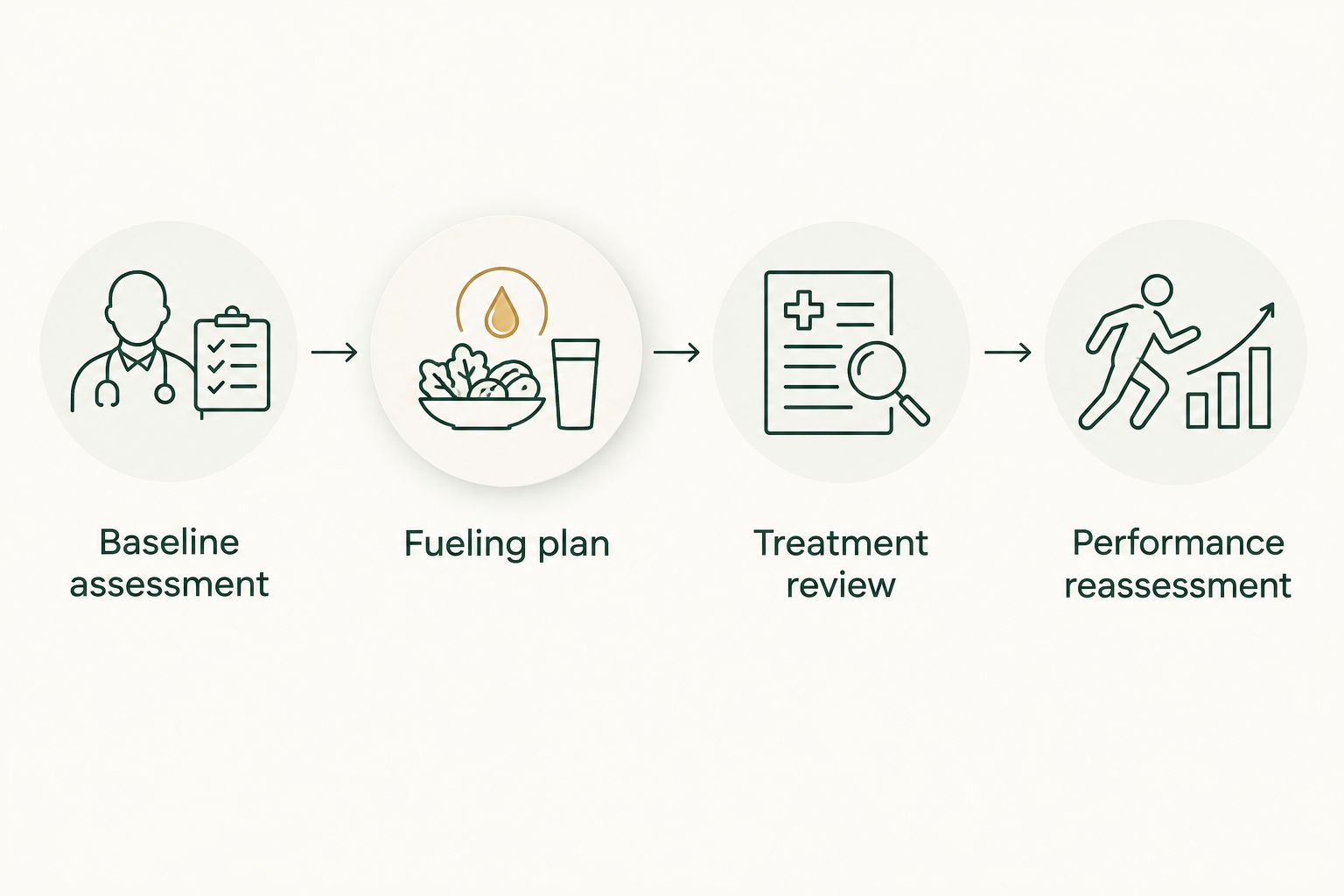
Weight change is only one part of an athlete's treatment review.
Baseline assessment
Document the medical reason for treatment, current symptoms, weight history, medications, supplements, injuries, and training demands. Include body composition when clinically useful, while recognizing that measurement methods have limitations. Your clinician decides which laboratory tests answer the clinical questions rather than ordering tests solely because they sound advanced.
Fueling plan
Agree on how you will meet training nutrition needs before appetite changes. A sports dietitian can help adapt meal timing, food choices, and intake around your sessions. Protein matters, but it does not replace sufficient overall energy or carbohydrate for demanding training.
Treatment review
Record adverse effects and discuss whether you can eat and drink adequately. For the membership described above, scheduled audits occur every 90 days, or 4 audits per year; new symptoms should be assessed when they occur, not saved for that schedule. Persistent vomiting, fainting, chest pain, or severe abdominal pain require prompt medical evaluation, with emergency care when symptoms are severe.
Performance reassessment
Review strength, endurance, recovery, sleep, menstrual changes where relevant, and your ability to complete planned sessions. A lower body weight with worsening function is a reason to reassess the plan. Do not assume every training problem is medication-related, but do not dismiss the timing either.
Keep the medical and coaching roles clear. Your coach directs training; your clinician makes medical decisions; your sports dietitian directs individualized nutrition care within their scope.
A lower body weight with worsening function is a reason to reassess the plan.
Check competition rules before hormone treatment
A lawful prescription is not the same as permission to compete. Under the World Anti-Doping Agency's 2026 Prohibited List, testosterone is prohibited at all times, and certain other hormones, stimulants, diuretics, and investigational substances are prohibited under the applicable categories. Rules also depend on your governing body and competition framework.
A therapeutic use exemption, or TUE, is a separate process with specific criteria. A prescription, a low laboratory result, or describing a hormone as bioidentical does not automatically satisfy those criteria. Verify requirements with your anti-doping organization before starting treatment that requires authorization.
Check every medication by its exact ingredient, route, and applicable restrictions. Review supplements separately; their risks do not disappear because they are sold without a prescription. Ask your team physician or governing organization to help resolve uncertainty.
For 2026, review the current rules rather than relying on an old medication checklist. If a clinic proposes testosterone, growth-hormone-related treatment, or a recovery peptide without addressing competition eligibility, pause the decision. Medical care should not leave you discovering a restriction after treatment begins.
Which clinic should you choose?
Choose sports medicine first when performance, injuries, or underfueling make the safety of weight loss uncertain. Choose obesity medicine when obesity-related disease is the main treatment need, and endocrinology when a genuine endocrine disorder requires specialist care.
GoodLife Health is best suited to medically eligible athletes seeking ongoing Cardiometabolic Optimization rather than competition weight cutting. Pair that medical relationship with sports nutrition support and an independent sport-rule review when needed. If you remain undecided, start with your existing physician and a sports dietitian rather than shopping for a prescription.
Before committing, request a clear explanation of who interprets your results, how symptoms are handled, and when specialist referral occurs. The answer should identify responsibilities, not simply promise access.
FAQ
What's the best weight loss clinic for a competitive athlete?
A multidisciplinary sports medicine clinic is the best starting point when training performance, injury history, or underfueling makes weight loss safety uncertain. GoodLife Health fits medically eligible athletes seeking ongoing cardiometabolic medical care, with separate sports nutrition and anti-doping support when needed.
Can competitive athletes take Wegovy or Zepbound?
Competitive athletes can be considered for Wegovy or Zepbound when a physician establishes medical eligibility and suitability. The decision must account for training nutrition, adverse effects, and the athlete's current competition rules; athletic participation alone does not establish eligibility.
Does a high BMI mean a muscular athlete needs weight loss medication?
A high BMI alone does not establish that a muscular athlete needs weight loss medication. BMI does not distinguish muscle from fat, so the clinician must assess body composition, medical history, and weight-related health conditions.
Is testosterone allowed if my doctor prescribes it?
A testosterone prescription does not automatically permit its use in competition. Testosterone is prohibited at all times under the WADA 2026 Prohibited List, and an applicable therapeutic use exemption requires a separate eligibility and approval process.
References
- Tirzepatide Once Weekly for the Treatment of Obesity (SURMOUNT-1). 2022. pubmed.ncbi.nlm.nih.gov/35658024/
- Once-Weekly Semaglutide in Adults with Overweight or Obesity (STEP 1). 2021. pubmed.ncbi.nlm.nih.gov/33567185/