You train consistently, but you do not want another reassuring score that leaves your fatigue unexplained. For longevity training, our default choice for VO2 max testing is a sports physiology laboratory with direct gas analysis and an interpreted exercise report. Unexplained exercise symptoms call for a clinical cardiopulmonary exercise testing service instead.
Key Takeaways
- Choose a sports physiology laboratory for VO2 max testing that translates measured oxygen consumption into training guidance.
- Choose clinical cardiopulmonary exercise testing for unexplained breathlessness or exercise intolerance after medical evaluation.
- GoodLife Health pairs Cardiometabolic Optimization with quarterly biomarkers and does not offer in-person exercise testing.
- A wearable estimate, a laboratory measurement and a cardiovascular risk assessment answer different questions.
The fear is not simply getting a disappointing result. It is spending another training cycle chasing fitness while nobody connects your exercise capacity, blood pressure, blood sugar, thyroid function and cardiovascular risk. At GoodLife Health, our Cardiometabolic Optimization model connects metabolic, hormonal and cardiovascular health rather than treating each result as a separate problem.
That clinical relationship costs $299/month, with a $598 first charge covering the initial two-month commitment. A Biomarker Audit every 90 days is included. Unlike a standalone exercise test, the membership supports ongoing medical decisions. Medications are billed separately by the pharmacy at pharmacy cost, with zero markup. The membership fee does not rise with the prescription or dose.
- VO2 max describes the maximum rate at which your body uses oxygen during intense exercise.
- A sports physiology laboratory is our first choice when your main question is how to train more intelligently.
- Clinical cardiopulmonary exercise testing or CPET, evaluates how your cardiovascular, respiratory and muscular systems respond to exercise.
- A university exercise physiology laboratory is a candidate when you want a clearly explained measurement process.
- A sports medicine practice belongs on your shortlist when an exercise question overlaps with symptoms, injury, medication use or return to activity.
Why this matters
VO2 max describes the maximum rate at which your body uses oxygen during intense exercise. Direct testing measures respiratory gases while exercise workload increases, usually on a treadmill or stationary bicycle. A watch estimates fitness through a different process. It does not perform the same measurement.
For your 2026 longevity plan, the important distinction is measurement versus management. An exercise laboratory measures capacity. A clinician evaluates symptoms and risk. A coach translates appropriate findings into training. You need clear ownership of each job, not a dashboard that leaves you responsible for interpreting everything.
The rankings below compare provider types by the question they are equipped to answer. They are a decision guide, not a claim that every facility in a category provides identical equipment, staffing or interpretation.
What makes the best VO2 max testing provider?
Before choosing a facility, use these criteria:
- Direct measurement: Confirm that the appointment includes respiratory gas analysis, not only a heart-rate-based estimate.
- Appropriate oversight: Match the testing environment to your symptoms, medical history and exercise risk.
- Useful interpretation: Request an explanation of oxygen consumption, effort, limitations and any reported thresholds.
- Repeatability: Ask how the facility standardizes equipment, exercise modality and the protocol for follow-up testing.
- Training relevance: Choose a report that answers your actual exercise question rather than assigning only a percentile.
- Clinical handoff: Establish who receives abnormal findings and who takes responsibility for follow-up.
A polished report is not proof of a better test. For 2026, choose the provider that can explain the method and the next decision before you book.
VO2 max testing providers at a glance
| Rank and provider type | Best for | Standout capability to request | Key limitation |
|---|---|---|---|
| 1. Sports physiology laboratory | Training-focused adults without unexplained exercise symptoms | Direct gas analysis with individualized exercise interpretation | Performance testing does not replace medical diagnosis |
| 2. Clinical CPET service | Medically evaluated exercise intolerance or unexplained breathlessness | Integrated assessment of exercise physiology in a clinical setting | Requires a clinical question, not simply a better fitness score |
| 3. University exercise physiology laboratory | People seeking protocol-focused testing | A clearly documented testing method and educational interpretation | Research participation and consumer testing are different services |
| 4. Sports medicine practice with exercise testing | Active adults needing exercise assessment alongside medical evaluation | A coordinated medical and exercise-testing pathway | The practice must actually offer gas-analysis testing |
Our default recommendation combines a suitable testing laboratory with ongoing medical care. A strong fitness result does not eliminate the need to manage blood pressure, lipids, glucose or clinically significant symptoms.


1. Sports physiology laboratory: best for training guidance
A sports physiology laboratory is our first choice when your main question is how to train more intelligently. Look for direct respiratory gas measurement during progressive exercise and a report that explains what the result changes about your sessions.
The decisive feature is interpretation. Ask whether the laboratory reports ventilatory thresholds when identifiable, how those findings relate to exercise intensity and whether the protocol matches your usual activity. A runner and a cyclist should not assume their results transfer perfectly between modalities.
Sports physiology laboratory pros:
- Directly measures oxygen consumption during exercise.
- Can connect physiological findings to practical training decisions.
- Provides a documented baseline for comparable repeat testing.
Sports physiology laboratory cons:
- A performance-focused appointment is not a diagnostic medical evaluation.
- Results depend on protocol, effort, equipment quality and interpretation.
Best for: Adults seeking a measured fitness baseline and actionable endurance-training guidance.
Before booking, request a sample report with identifying information removed. If the explanation stops at a fitness age or percentile, ask what specific recommendation you will receive afterward.
Verdict: Buy this testing pathway when the goal is training guidance, with medical evaluation first when indicated.
2. Clinical CPET service: best for unexplained exercise limitation
Clinical cardiopulmonary exercise testing or CPET, evaluates how your cardiovascular, respiratory and muscular systems respond to exercise. A clinical service is the appropriate pathway when a clinician needs to investigate exercise intolerance rather than simply measure athletic fitness.
Do not self-select a maximal fitness test to investigate chest discomfort, fainting or unexplained breathlessness. Your physician should determine the evaluation and setting. Severe or sudden symptoms require urgent medical assessment, not a future testing appointment.
Clinical CPET service pros:
- Addresses a defined medical question about exercise limitation.
- Combines respiratory gas measurements with clinical assessment.
- Creates a pathway for medically directed interpretation and follow-up.
Clinical CPET service cons:
- Diagnostic interpretation is different from a detailed coaching plan.
- Testing requires appropriate clinical selection and preparation.
Best for: Patients whose clinician is evaluating unexplained breathlessness, reduced exercise tolerance or another appropriate indication.
Ask what monitoring the test includes and who interprets the findings. A treadmill appointment without respiratory gas analysis is not automatically CPET.
Verdict: Buy the clinical pathway when your physician identifies a diagnostic exercise question.
3. University laboratory: best for protocol-focused testing
A university exercise physiology laboratory is a candidate when you want a clearly explained measurement process. First confirm that the facility offers individual testing outside research studies and that your appointment includes interpretation you can use.
An academic affiliation does not establish what a particular appointment includes. Ask who supervises testing, who reviews the report and whether follow-up questions are part of the service. Research data collection and a consumer exercise assessment have different purposes.
University laboratory pros:
- Offers an opportunity to choose a documented exercise protocol.
- Can provide a useful educational setting for understanding measurement.
- Supports repeat comparisons when the same method remains appropriate.
University laboratory cons:
- Participation in a study does not guarantee individualized training advice.
- An exercise laboratory is not necessarily a medical diagnostic service.
Best for: Adults who prioritize understanding the testing method and its limitations.
For a university laboratory in 2026, verify the actual service rather than relying on the institution's reputation. Request the same evidence of measurement quality and interpretation that you would expect elsewhere.
Verdict: Buy when the laboratory confirms individual testing, appropriate supervision and an interpreted report.
4. Sports medicine practice: best for coordinated exercise evaluation
A sports medicine practice belongs on your shortlist when an exercise question overlaps with symptoms, injury, medication use or return to activity. The key is confirming that the practice provides the specific assessment you need, either directly or through a defined testing relationship.
Do not assume that every sports medicine practice measures VO2 max. Some exercise assessments answer other questions. Ask explicitly about respiratory gas analysis and how the physician will use the findings.
Sports medicine practice pros:
- Places the exercise question within a medical evaluation.
- Can address restrictions that affect testing and training choices.
- Offers a potential handoff between medical assessment and exercise planning.
Sports medicine practice cons:
- Sports medicine services do not automatically include direct VO2 measurement.
- A medical assessment does not necessarily include ongoing endurance coaching.
Best for: Active adults who need medical input alongside an exercise-capacity assessment.
Choose this pathway for coordination, not because a clinic uses longevity language. You should leave knowing who owns the medical decision and who owns the training plan.
Verdict: Buy when coordinated medical assessment is the priority and the testing method is confirmed.
Where ongoing Cardiometabolic Optimization fits
GoodLife Health is best for adults who want ongoing Cardiometabolic Optimization alongside separately arranged exercise testing. Our membership is not presented as an in-person VO2 max testing service. The distinction matters: bloodwork cannot measure maximal oxygen consumption and an exercise test cannot replace your medical history or laboratory evaluation.
Our Biomarker Audit every 90 days includes Apolipoprotein B (ApoB), Lipoprotein (A), Hs-CRP, Hemoglobin A1c (HbA1c), Lipid Panel, Standard, Fasting Insulin, TSH With Reflex To Free T4 and more. These results support clinical decisions across one interconnected system. An abnormal result requires interpretation. It does not automatically establish a diagnosis or justify a prescription.
Our model's advantages:
- An included quarterly Biomarker Audit supports ongoing medical review.
- The $299 a month membership does not change with medication dose.
- Pharmacy billing remains separate, with zero medication markup.
Our model's limitations:
- Telehealth membership does not perform an in-person exercise test.
- Additional labs beyond the quarterly panel are ordered by the clinician when there is a reason and are billed by the lab at its own rates.
- Medications are separate from the membership charge.
Clinical care comes from clinicians licensed in all fifty states. Labs are drawn at Quest Diagnostics patient service centers.
Best for: People who want a continuing medical relationship rather than another isolated measurement.
For your 2026 plan, choose the laboratory for measurement and our membership for ongoing clinical management. Review the membership pricing, including the $598 hold that covers the first two months and the month-to-month terms afterward.
What a useful VO2 max report should explain
A useful report tells you what was measured, how the test progressed and what the findings mean. Ask for the exercise modality, protocol, oxygen-consumption units, relevant heart-rate data, interpretation of effort and any limitations that affect confidence in the result.
VO2 max and VO2 peak are not interchangeable labels. VO2 peak is the highest oxygen consumption recorded during the test. Establishing VO2 max requires appropriate evidence that maximal oxygen uptake was reached. A report should explain the terminology it uses rather than automatically assigning the more impressive label.
Look for these three connections:
- Measured capacity: What oxygen consumption did the test record and under what conditions?
- Training guidance: Which findings support the recommended exercise intensities?
- Clinical context: Does anything require medical evaluation before you change training?
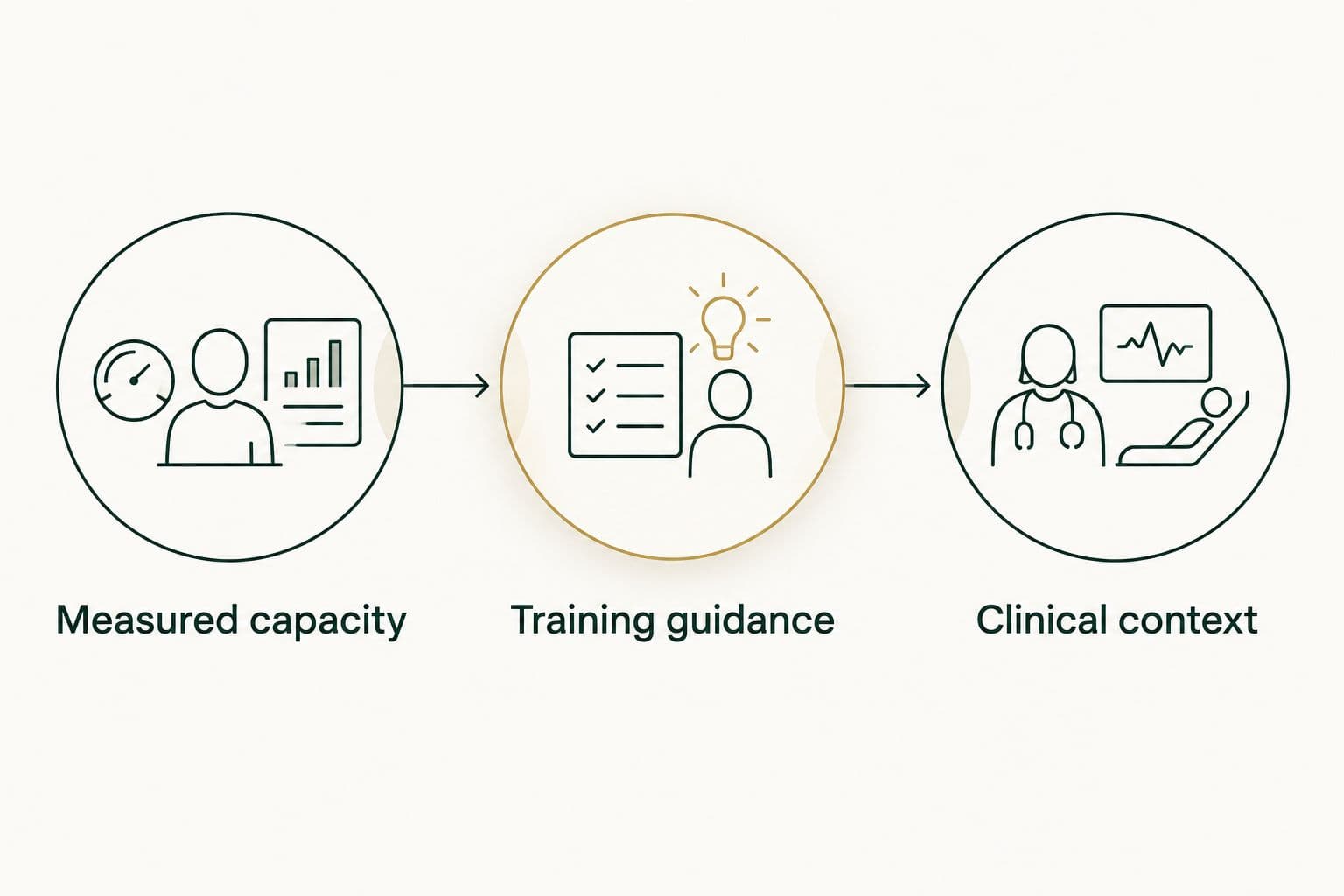
A measured result becomes useful when it connects to training decisions and appropriate medical review.
Between laboratory visits, wearable tracking for endurance runners addresses a different question: what your training and recovery patterns look like across ordinary days. Keep those trends alongside your laboratory report, but do not treat a device estimate as interchangeable with directly measured oxygen consumption.
A percentile also needs context. Ask which reference population the provider uses and whether comparisons account for age, sex and exercise modality. A percentile without its reference is a ranking without an explanation.
Read the units before celebrating a higher score
VO2 results can be reported as absolute oxygen consumption, commonly in liters per minute or relative oxygen consumption, commonly in milliliters per kilogram per minute. Relative values incorporate body weight. That makes them useful, but it also creates an interpretation issue during weight loss.
If body weight decreases while absolute oxygen consumption remains unchanged, the relative value increases mathematically. The increase is real as a ratio. It does not prove that every part of your aerobic physiology improved. Ask the laboratory to show both values when comparing tests.
For adults pursuing medical weight loss, pair exercise findings with strength, function, nutritional adequacy and symptoms. A smaller body and a higher relative fitness score do not, by themselves, establish that muscle was preserved.
Our 2026 recommendation is simple: compare the underlying measurements, not just the headline score. Keep the exercise modality and protocol consistent when appropriate and have the laboratory explain changes in testing conditions before interpreting a difference as training progress.
Prepare for the test without trying to game it
Follow the testing facility's preparation instructions. Ask about meals, caffeine, recent strenuous exercise, hydration, clothing and any medication considerations. Requirements differ by test purpose and a clinical CPET appointment can involve instructions that do not apply to performance testing.
Use this preparation checklist:
- Describe symptoms: Report chest discomfort, dizziness, unusual breathlessness, recent illness and exercise limitations before testing.
- Share medications: Include beta-blockers and other drugs that affect heart rate or exercise response.
- Confirm the modality: Understand whether you will walk, run or cycle and whether that suits your abilities.
- Ask about stopping: Know how to communicate discomfort and how staff decide when to end the test.
- Plan the follow-up: Identify who will explain findings and answer questions afterward.
Do not stop prescribed medication or push through concerning symptoms to obtain a better score. The goal is an interpretable assessment of your physiology under appropriate conditions, not a personal record at any cost.
Turn the result into a sustainable training plan
Your report should help answer a practical question: what should change in your next training block? Ask the interpreting professional to connect any recommended intensities to measured findings, your exercise history, current symptoms and recovery capacity.
A higher score is not a reason to make every session harder. Build a plan you can repeat, including aerobic exercise, resistance training, adequate nutrition and recovery. Medication, hormone treatment or a laboratory percentile does not remove those foundations.
If you use heart-rate zones, ask how they were derived. Generic percentages and individually measured ventilatory thresholds are different methods. Neither a watch nor a laboratory should leave you guessing which approach produced the prescription.
Retesting should answer a decision, not satisfy a calendar. Agree on what change in training or health would make another measurement useful. Our quarterly Biomarker Audit is a medical monitoring cadence. It is not a recommendation to perform maximal exercise testing every 90 days.
How we ranked these testing pathways
The ranking prioritizes direct measurement, appropriate oversight, useful interpretation, repeatability, training relevance and clinical handoff. Sports physiology laboratories lead for a training question. Clinical CPET takes priority when a physician is investigating exercise limitation.
University laboratories and sports medicine practices earn distinct places because their potential value differs: protocol-focused education versus medical coordination. Every individual facility still needs to meet the criteria. No ranking position substitutes for confirming the service before booking.
Which VO2 max testing pathway should you choose?
Choose a sports physiology laboratory as the default for training-focused VO2 max testing. Choose clinical evaluation first when symptoms or medical history change the question. Request direct gas analysis, an interpreted report and a clear explanation of what happens next.
For longevity, connect that measurement to ongoing medical care. GoodLife Health's Cardiometabolic Optimization membership adds quarterly biomarkers and a continuing clinical relationship rather than asking a fitness score to stand in for cardiovascular and metabolic assessment.
One flat fee for the doctor. Zero markup on the medicine. That structure makes the financial relationship clear while your clinician makes treatment decisions based on medical need.
FAQ
What's the best provider for VO2 max testing for longevity training?
A sports physiology laboratory with direct respiratory gas analysis and an interpreted exercise report is the default choice for a training-focused assessment. People with unexplained exercise symptoms should seek medical evaluation to determine whether clinical CPET is appropriate.
Is a smartwatch VO2 max estimate the same as a laboratory test?
A smartwatch estimate is not the same as directly measured VO2 max. Laboratory testing measures respiratory gases during exercise, while a wearable estimates fitness using device-specific inputs and algorithms.
Does GoodLife Health perform VO2 max testing?
GoodLife Health's membership is not presented as an in-person VO2 max testing service. Its Cardiometabolic Optimization model provides ongoing medical care and an included Biomarker Audit every 90 days alongside separately arranged exercise testing.
How much does the GoodLife Health membership cost?
The Cardiometabolic Optimization Membership costs $299/month, with a $598 first charge for the initial two-month commitment. The membership is month to month. Once you are accepted, the first two months are charged and non-refundable. Medications and additional labs beyond the quarterly panel are billed separately.
Is clinical CPET better than a fitness laboratory test?
Clinical CPET is the appropriate pathway when a clinician needs to investigate a medical question about exercise limitation. A performance laboratory is the default for training guidance when diagnostic evaluation is not the purpose.
Can weight loss raise my relative VO2 max without increasing absolute oxygen consumption?
Weight loss increases relative oxygen consumption mathematically if absolute oxygen consumption stays unchanged. Compare both absolute and weight-adjusted results before concluding that a higher relative score reflects improved aerobic capacity alone.
How often should I repeat VO2 max testing?
Repeat VO2 max testing when another measurement will inform a training or clinical decision. Agree on timing with the testing professional rather than assuming that the quarterly bloodwork schedule also applies to maximal exercise testing.
Should I stop a beta-blocker before VO2 max testing?
Do not stop a prescribed beta-blocker on your own before exercise testing. Tell the testing team and prescribing clinician what you take so they can give instructions appropriate to the purpose and safety of the test.
One last thing
The most revealing question is not how high your score sits. Ask the provider: What would you recommend differently if this result were lower, unchanged or higher? If the answer never changes, clarify what decision the test is supposed to support.
For your next step, separate the jobs clearly: select a qualified exercise-testing facility, then build the medical relationship that puts the findings in context. A measurement should lead to a decision you understand, not simply another number to monitor.
Related guides
- Direct primary care for athletes and active adults
- Concierge medicine for endurance athletes and runners
- How to use strength training to improve metabolic health
References
- Tirzepatide Once Weekly for the Treatment of Obesity (SURMOUNT-1). 2022. pubmed.ncbi.nlm.nih.gov/35658024/
- Once-Weekly Semaglutide in Adults with Overweight or Obesity (STEP 1). 2021. pubmed.ncbi.nlm.nih.gov/33567185/