For trimrx alternatives for compounded tirzepatide, GoodLife Health is the best fit in 2026 if you want branded tirzepatide within ongoing Cardiometabolic Optimization; your existing primary care physician is the first alternative to consider if you want to preserve an established clinical relationship. Neither recommendation is a referral for compounded tirzepatide: the comparison below separates the medication decision from the choice of who manages your care.
Key Takeaways
- For trimrx alternatives for compounded tirzepatide, GoodLife Health fits patients seeking branded treatment and Cardiometabolic Optimization.
- Zepbound and Mounjaro contain tirzepatide, but their approved uses differ.
- Compounded tirzepatide is not FDA-approved and is not an approved generic equivalent.
- An existing primary care physician fits patients who want continuity; an endocrinologist fits patients needing specialist evaluation.
- Never convert a compounded vial’s syringe units into a branded dose without your prescriber’s instructions.
- This table compares care models, not a verified ranking of competing platforms.
- Your existing primary care physician is a practical TrimRx alternative when you want medication decisions connected to records and conditions already managed by that practice.
- An endocrinologist is the alternative to discuss when diabetes, thyroid disease, or another endocrine problem complicates treatment.
- Switch when your care no longer meets your needs—not because an alternatives page says every competitor is better.
- A safe transfer starts with records and ends with explicit prescribing instructions.
Why this matters
Changing providers and changing medications are different decisions. You can want better follow-up without needing a different molecule. You can also need a different treatment plan even when your current clinician has been attentive.
An established relationship with TrimRx has value when your clinician understands your history and manages treatment appropriately. That relationship stops being enough when your needs extend beyond the care you receive. Evaluate the actual prescription, laboratory review, and follow-up arrangement rather than assuming a new platform automatically means better medicine.
GoodLife Health uses Cardiometabolic Optimization to treat metabolic, hormonal, and cardiovascular health as one system. That framework connects weight management with blood sugar, insulin markers, thyroid function, lipids, and inflammation instead of treating a smaller number on the scale as the entire outcome.
The distinction matters in 2026 because a search for compounded tirzepatide can mix together three questions: which drug is appropriate, whether a compounded preparation is legally and clinically justified, and which clinician should supervise treatment. Answer them separately. A provider comparison cannot establish that a particular prescription is right for you.
TrimRx alternatives at a glance
This table compares care models, not a verified ranking of competing platforms. Use TrimRx as your current-care benchmark and compare each alternative against the services you actually receive.
| Option | Best for | Standout feature or decision criterion | How it differs from your TrimRx relationship | Main limitation |
|---|---|---|---|---|
| TrimRx | Preserving a satisfactory existing treatment relationship | Your clinician’s knowledge of your treatment history | Your current prescription, monitoring, and communication form the benchmark | Staying is appropriate only if the treatment and follow-up remain suitable |
| Cardiometabolic Optimization membership | Branded medication alongside metabolic, hormonal, and cardiovascular care | Included Biomarker Audit every 90 days | A defined membership model with separate pharmacy billing | Not a route to compounded tirzepatide |
| Your existing primary care physician | Keeping treatment within established primary care | Existing records and knowledge of your other conditions | Places the prescribing decision within your broader primary care relationship | Confirm whether the practice manages obesity medication and ongoing follow-up |
| An endocrinologist | Diabetes or endocrine questions requiring specialist assessment | Evaluation of complex blood sugar, thyroid, or hormone concerns | Adds specialist assessment when your clinical situation warrants it | Not every weight-management question requires specialist care |
The strongest alternative is the one that addresses your unmet clinical need. In 2026, a useful comparison asks who reviews results, who responds to side effects, and who owns the treatment plan—not simply who can issue another prescription.
1. GoodLife Health: best for integrated branded treatment
GoodLife Health is best for patients who want branded GLP-1 treatment managed within Cardiometabolic Optimization. The membership combines medical weight loss, hormone optimization when appropriate, and concierge-style direct primary care. It does not offer or facilitate compounded GLP-1 medications.
Your clinician uses a Biomarker Audit every 90 days to guide care. The included panel covers ApoB, Lp(a), hs-CRP, HbA1c, lipids, insulin markers, and full hormone and thyroid panels. That is 4 included audits per year, with additional testing beyond the quarterly cadence billed separately at pass-through cost.
Clinical care is delivered by licensed physicians of Beluga Health, P.A., an independent Florida professional corporation licensed to practice in all 50 states, working under the brand’s clinical protocols. Labs run through the Beluga Health lab network. This is a clinical relationship, not an automatic prescription following a questionnaire.
Where this membership shines
- Connected monitoring: Your physician evaluates metabolic, hormonal, and cardiovascular health together rather than using weight alone to judge progress.
- Branded treatment: Zepbound and Mounjaro are among the branded, FDA-approved medications used when clinically appropriate. No compounded tirzepatide is offered.
- Separate clinical and pharmacy billing: The pharmacy bills medication at pharmacy cost, with no medication markup, molecule upcharge, or dose-escalation fee from the membership.
- Defined laboratory cadence: The included audit repeats every 90 days, giving your clinician a scheduled opportunity to reassess the plan.
Where this membership falls short
- It is the wrong fit if your nonnegotiable requirement is compounded tirzepatide.
- Membership does not make you eligible for medication or guarantee that a clinician will prescribe your preferred drug.
- Medication is billed separately by the pharmacy; it is not included in the clinical membership.
- The membership begins with a 2-month commitment. After that, it is month-to-month and can be canceled.
- Testing beyond the included quarterly cadence creates a separate laboratory expense.
Head-to-head: membership versus staying with TrimRx
| Dimension | Cardiometabolic Optimization membership | Staying with TrimRx |
|---|---|---|
| Tirzepatide formulation | Branded treatment only; never compounded | Review the exact product on your prescription |
| Laboratory plan | Included Biomarker Audit every 90 days | Compare the tests and review process in your current plan |
| Pharmacy relationship | Medication billed separately at pharmacy cost, without markup | Review who dispenses medication and how pharmacy billing works |
| Scope of care | Metabolic, hormonal, and cardiovascular health treated together | Compare the scope of care you currently receive |
For cash-pay tirzepatide treatment, the membership routes patients to Zepbound; Mounjaro fits insurance-covered type 2 diabetes care. The physician still determines whether tirzepatide is appropriate. The brand name is not a substitute for a diagnosis.
Best for: Patients seeking branded medical weight loss with ongoing primary care and connected laboratory monitoring. Read the guide to direct primary care for weight-loss management to understand that care model.
Verdict: Hold until a clinical consultation confirms the treatment fit, membership commitment, and separate pharmacy obligations.


2. Your primary care physician: best for continuity
Your existing primary care physician is a practical TrimRx alternative when you want medication decisions connected to records and conditions already managed by that practice. Start by asking whether the physician prescribes and monitors obesity medications. Do not assume that every primary care practice provides that service.
Continuity matters when treatment intersects with diabetes medication, blood pressure management, gastrointestinal symptoms, or other prescriptions. A physician who already manages those issues has relevant context. That does not establish expertise in every weight-loss treatment, so ask directly about the follow-up plan.
Where primary care shines
- Your treatment can remain within an established clinical relationship.
- Your physician can evaluate medication choices alongside the conditions already under that physician’s care.
- Existing records provide a starting point for reviewing previous laboratory results and treatment responses.
- The conversation can include whether medication, a referral, or another approach is appropriate.
Where primary care falls short
- The practice might not manage GLP-1 treatment or obesity care.
- Appointment-based care does not automatically include ongoing medication check-ins.
- You need to establish who reviews outside records and who handles prescription questions.
- Your current physician might recommend specialist assessment rather than take over prescribing.
| Dimension | Your primary care physician | Staying with TrimRx |
|---|---|---|
| Continuity | Builds on your existing primary care relationship | Preserves your existing weight-management relationship |
| Records | Uses the medical history already held by the practice | Requires coordination with your other treating clinicians |
| Treatment scope | Ask whether obesity medication management is included | Assess whether current care covers your broader needs |
Before transferring care, ask your primary care physician to review the medication name, formulation, current dose, last injection, treatment response, and adverse effects. A record transfer is useful only if someone reads it and accepts responsibility for the next decision.
Best for: Patients satisfied with their primary care relationship who want that physician to assess or coordinate branded treatment.
Verdict: Hold until the physician confirms prescribing responsibility and a workable monitoring plan.
3. An endocrinologist: best for complex endocrine questions
An endocrinologist is the alternative to discuss when diabetes, thyroid disease, or another endocrine problem complicates treatment. Specialist assessment is about the clinical question, not access to a particular vial. A referral does not guarantee tirzepatide or any other prescription.
This route is particularly relevant when your treating physician needs help interpreting an endocrine diagnosis or coordinating diabetes medication. Weight, blood sugar, thyroid function, and hormones interact, but an abnormal laboratory result does not automatically require hormone treatment.
Where endocrinology shines
- Specialist assessment can address complex diabetes and endocrine questions.
- The consultation can clarify whether symptoms and laboratory findings indicate a specific disorder.
- Treatment decisions can account for endocrine conditions that affect the broader care plan.
Where endocrinology falls short
- A specialist consultation does not necessarily replace primary care.
- You still need a clear division of responsibility between clinicians.
- A straightforward obesity-treatment discussion does not always require an endocrinologist.
- Specialist evaluation is not a promise of compounded or branded tirzepatide.
Best for: Patients whose primary clinician identifies an endocrine question that needs specialist input.
Verdict: Hold until your treating physician identifies the question the referral should answer. Choose expertise for a clinical problem, not a presumed prescribing shortcut.
Compounded tirzepatide is not branded tirzepatide
Compounded tirzepatide is not FDA-approved and is not an FDA-approved generic version of Zepbound or Mounjaro. FDA approval applies to a specific drug product, not to every preparation described as containing the same active ingredient. A pharmacy’s license and a drug product’s approval are separate matters.
Compounding can serve legitimate patient-specific medical needs under applicable law. That does not make routine copies of approved drugs interchangeable with those products. For a 2026 decision, ask the prescriber and dispensing pharmacy to explain the patient-specific rationale and applicable legal basis for the proposed preparation.
Zepbound and Mounjaro both contain tirzepatide. Zepbound has an approved chronic weight-management indication, while Mounjaro has an approved type 2 diabetes indication. Your diagnosis and the product’s prescribing information matter even though the molecule is the same.
Questions that distinguish the products
| Question | Branded tirzepatide | Compounded tirzepatide |
|---|---|---|
| Is the specific product FDA-approved? | Zepbound and Mounjaro are FDA-approved products | A compounded preparation is not FDA-approved |
| What instructions govern use? | The prescribed product’s labeling and your clinician’s directions | The pharmacy’s formulation-specific directions and your clinician’s instructions |
| What establishes suitability? | Diagnosis, contraindications, treatment history, and clinical judgment | Those factors plus the patient-specific rationale for compounding |
| Can you copy syringe-unit instructions? | Follow the prescribed product’s instructions | No; syringe units depend on concentration and the prescribed amount |
A concentration difference changes how much liquid contains a given dose. Never use another patient’s syringe instructions, and never assume the units printed in an old treatment message apply to a new preparation.
This article does not rank compounded-tirzepatide sellers. The clinically relevant alternative is a physician-led assessment of approved treatment and the care relationship needed to support it.
Why consider switching from TrimRx?
Switch when your care no longer meets your needs—not because an alternatives page says every competitor is better. The following are decision criteria, not allegations about TrimRx.
You want branded medication rather than a compounded preparation
If your goal is to move to FDA-approved tirzepatide, choose a clinician who evaluates Zepbound or Mounjaro for the appropriate indication. Ask for the exact product name. A statement that a program uses tirzepatide does not, by itself, identify the dispensed product.
You need more than weight tracking
You might want your clinician to connect weight management with HbA1c, lipids, thyroid findings, symptoms, and cardiovascular risk. Ask what gets measured and how the results change treatment. More laboratory tests are not automatically better; a useful result has a clinical interpretation and a next step.
You want a clearer financial relationship
Identify which charges belong to clinical care, pharmacy dispensing, and additional testing. Ask whether the clinical fee changes when the prescription or dose changes. The Unbundled Pharmacy Model separates the physician relationship from medication billing rather than making stronger doses a source of membership revenue.
You need clearer follow-up responsibility
Ask who handles persistent nausea, a treatment interruption, or a concerning laboratory result. The important answer identifies the responsible clinician and the appropriate route for help. A refill process is not the same as an ongoing care plan.
How to switch without guessing your next dose
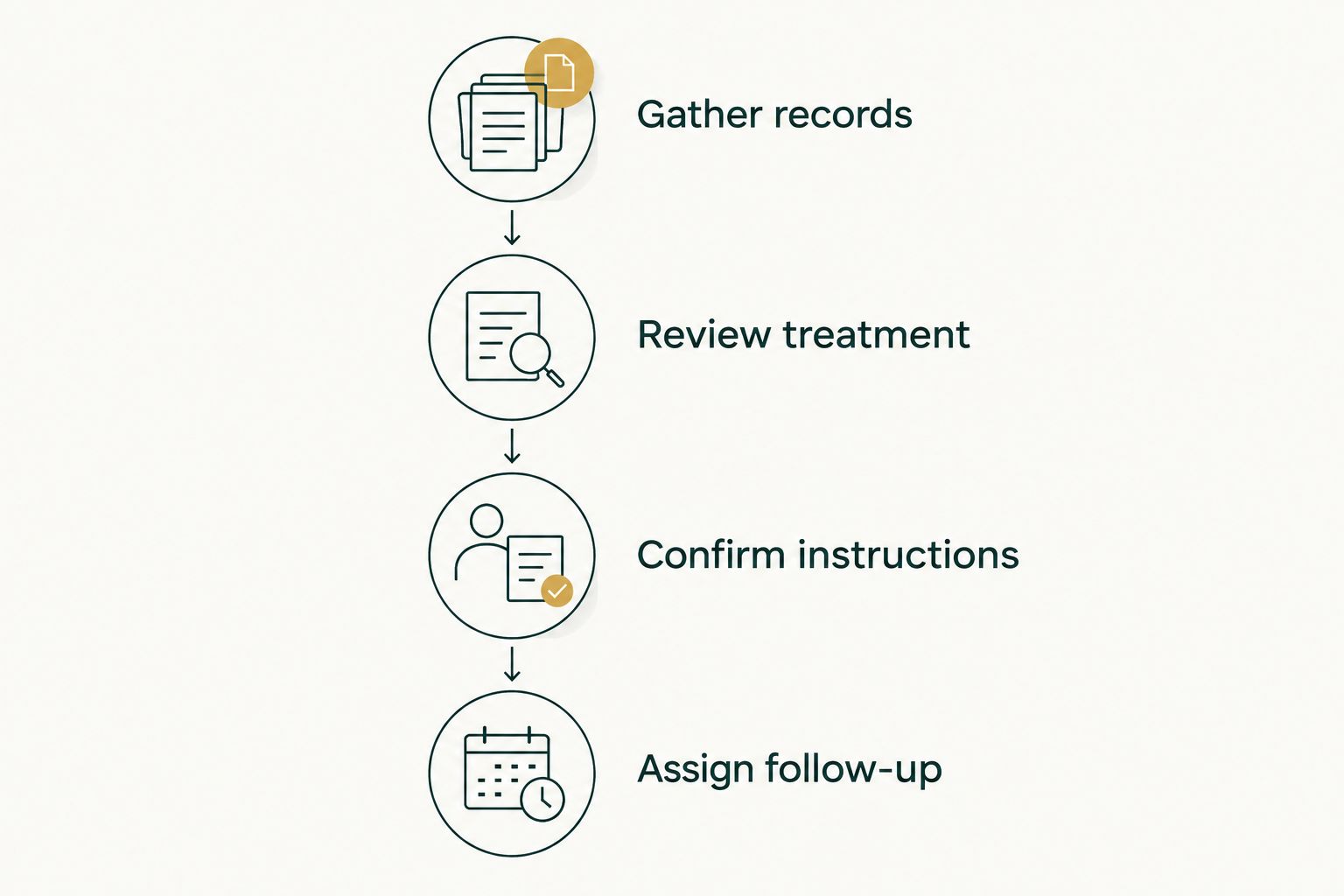
A safe transfer starts with records and ends with explicit prescribing instructions. In 2026, the goal is continuity of clinical responsibility, not simply completing a new intake form.
Gather records
Bring your current prescription, dispensing label, medication list, laboratory results, and treatment history. For a compounded preparation, include the concentration and pharmacy instructions. Tell the receiving clinician about side effects, missed doses, and any interval without treatment.
Review treatment
Ask the receiving physician to assess your diagnosis, response, tolerability, and other medications. Discuss pregnancy plans and relevant personal or family medical history. The clinician should determine whether to continue the molecule, change treatment, or pause while evaluating a concern.
Confirm instructions
Get the exact product name, prescribed dose, administration directions, and next-dose timing. Do not translate compounded syringe units into a branded dose yourself. Do not combine old and new prescriptions to avoid wasting medication.
Assign follow-up
Confirm who manages future prescriptions, reviews results, and responds to symptoms. Tell the previous provider when responsibility has transferred so two clinicians do not unknowingly manage the same treatment. Keep a copy of the agreed plan.
Transfer prescribing responsibility before following a new medication plan.
Seek prompt medical assessment for severe or persistent abdominal pain, repeated vomiting, inability to keep fluids down, or signs of an allergic reaction. A provider transfer should not delay urgent care. Routine messaging is not a substitute for emergency evaluation when symptoms are severe.
What the Biomarker Audit changes—and what it does not
A laboratory panel supports clinical decisions; it does not make every treatment appropriate. GoodLife Health’s Cardiometabolic Optimization membership includes the Biomarker Audit every 90 days so your physician can reassess connected metabolic, hormonal, and cardiovascular findings over time.
HbA1c helps assess blood sugar over time. ApoB and Lp(a) add information relevant to cardiovascular risk, while hs-CRP measures an inflammatory marker that requires context. Hormone and thyroid results must be interpreted alongside symptoms, history, medications, and the reason for testing.
The practical question is what your physician does with the result. Ask which finding changes treatment, which requires repeat assessment, and which needs no immediate intervention. A laboratory value is not a diagnosis by itself, and repeated testing does not replace conversation or examination when needed.
The 90-day schedule is a membership feature, not a universal rule for every patient or every test. Your clinician determines whether additional evaluation is necessary. Neither GLP-1 treatment nor hormone optimization replaces appropriate nutrition, physical activity, or management of other medical conditions.
When staying with TrimRx is the right call
Stay with TrimRx when your clinician provides appropriate treatment, clear instructions, suitable monitoring, and a follow-up relationship that meets your needs. Familiarity is valuable when it supports sound care. Switching solely for a different name adds administrative work without establishing a clinical benefit.
Before leaving, ask whether your current clinician can address the specific gap: a branded-medication discussion, broader risk assessment, record coordination, or clearer follow-up. If the answer meets your needs, preserving continuity is reasonable.
For a 2026 decision, judge the actual care rather than assumptions about the brand. Do not abruptly change dosing, overlap prescriptions, or discard a working plan before a receiving clinician accepts responsibility. The right alternative is sometimes a better conversation with the physician already treating you.
FAQ
What’s the best TrimRx alternative if I want branded tirzepatide?
GoodLife Health fits patients who want branded tirzepatide within Cardiometabolic Optimization and ongoing primary care. A physician determines eligibility; the membership never offers compounded GLP-1 medications.
Does GoodLife Health offer compounded tirzepatide?
GoodLife Health does not offer, recommend, or facilitate compounded tirzepatide. GLP-1 treatment uses branded, FDA-approved medications when clinically appropriate.
Is compounded tirzepatide the same as Zepbound?
Compounded tirzepatide is not the same FDA-approved product as Zepbound. A compounded preparation is not FDA-approved and is not an approved generic equivalent.
Are Mounjaro and Zepbound the same medication?
Mounjaro and Zepbound contain the same molecule, tirzepatide, but have different approved indications. Mounjaro is approved for type 2 diabetes, while Zepbound has an approved chronic weight-management indication.
Can my primary care doctor take over tirzepatide treatment?
Your primary care doctor can assess whether taking over treatment is appropriate, but you must confirm that the practice manages this medication. The physician needs your prescription, treatment history, relevant results, and a clear transfer of responsibility.
Can I use my compounded tirzepatide dose when switching to Zepbound?
Do not carry over compounded syringe-unit instructions to Zepbound. Your receiving clinician must specify the product, dose, administration instructions, and timing based on your treatment history.
How often does the membership include laboratory testing?
The Cardiometabolic Optimization membership includes a Biomarker Audit every 90 days, or 4 per year. Additional testing beyond that cadence is billed separately at pass-through cost.
Should I stop tirzepatide before switching providers?
Do not change or stop your prescribed treatment solely because you are transferring providers; ask your treating clinician for instructions. Severe symptoms require prompt medical assessment rather than waiting for a transfer appointment.
One last thing
Ask the receiving clinician to explain the next prescription using the exact product name—not just the molecule. Zepbound and Mounjaro illustrate why that distinction matters: the molecule is the same, but the approved uses differ. With a compounded preparation, concentration adds another question that must be resolved before dosing instructions make sense.
Then ask one more question: who owns the next decision if symptoms, laboratory results, or treatment goals change? That answer reveals more about your future care than an alternatives ranking. Choose a clinician who can explain both the prescription and the plan around it.
Related Guides
- Compounded GLP-1 versus brand-name medication
- How to switch GLP-1 providers without losing progress
- Mounjaro versus Zepbound: same drug, different uses
References
- Tirzepatide Once Weekly for the Treatment of Obesity (SURMOUNT-1). 2022. pubmed.ncbi.nlm.nih.gov/35658024/
- Once-Weekly Semaglutide in Adults with Overweight or Obesity (STEP 1). 2021. pubmed.ncbi.nlm.nih.gov/33567185/