Best overall for 2026: GoodLife Health for adults who need one clinician-led evaluation of testosterone symptoms, weight, and cardiometabolic risk. Best for a complex hormone diagnosis: an endocrinology-led telehealth clinic. Best for someone who already has a TRT prescriber: a separate obesity-medicine clinic for GLP-1 evaluation. These are different care models, not interchangeable prescriptions: the right clinic must establish whether you qualify for each treatment and coordinate monitoring if you receive both.
TL;DR
- GoodLife Health is the best overall fit among telehealth clinics for TRT and GLP-1 combo therapy when you want coordinated hormone and metabolic evaluation.
- An endocrinology-led clinic fits a complex low-testosterone diagnosis; confirm it also evaluates weight treatment before enrolling.
- An obesity-medicine clinic fits GLP-1 evaluation when your existing TRT prescriber will share records and coordinate monitoring.
- TRT and a GLP-1 are separate prescribing decisions. Low testosterone symptoms or weight concerns alone do not establish eligibility.
- TRT and GLP-1 therapy require two separate diagnoses, safety reviews, and monitoring plans, not one combined request.
- GoodLife Health's Cardiometabolic Optimization Membership includes a Biomarker Audit every 90 days covering ApoB, Lp(a), hs-CRP, HbA1c, lipids, insulin markers, and hormone/thyroid panels.
- GoodLife Health prescribes only branded, FDA-approved GLP-1 medicines (Wegovy and Zepbound), never compounded copies.
- An endocrinology-led clinic fits complex or conflicting testosterone results and fertility considerations.
- A separate obesity-medicine clinic works only when it and your existing TRT prescriber exchange records and agree on monitoring roles.
- A clinic that declines an unsuitable prescription after evaluation has done its job — one that advertises both drugs without explaining diagnosis and monitoring has not.
Why this matters
A request for TRT and a GLP-1 sounds like a request for two prescriptions. It is a request for two diagnoses, two safety reviews, and a plan for interpreting changes that happen at the same time. Weight, sleep, glucose regulation, thyroid function, and testosterone symptoms can overlap. If each prescriber sees only one part of that picture, neither has the full context for a treatment decision.
GoodLife Health is the best overall fit for adults seeking coordinated TRT and GLP-1 evaluation as part of cardiometabolic care. Its membership includes recurring Biomarker Audits and direct primary care; clinicians working under GoodLife Health's clinical protocols evaluate hormone optimization and branded, FDA-approved GLP-1 treatment. That does not mean every member needs, qualifies for, or receives both medications. The clinical decision follows the evaluation.
The other entries below are clinic types, not endorsements of unnamed companies. The supplied information establishes GoodLife Health's services but does not establish any other named clinic's current prescribing scope, clinician credentials, lab protocol, or medication sourcing. A fabricated competitor ranking would not help you choose care in 2026. Use the distinct care models below to identify what to verify with any clinic you consider.
What makes the best TRT and GLP-1 telehealth clinic?
- Separate diagnostic decisions. A clinic should establish whether low testosterone needs treatment and whether a GLP-1 is appropriate. A request for both is not itself a diagnosis.
- A named clinical owner. Ask who reads the labs, reviews symptoms, changes treatment, and coordinates with any other prescriber.
- Relevant baseline and follow-up testing. Testosterone evaluation, treatment-safety monitoring, and metabolic assessment answer different questions. A clinic needs a plan for each.
- Medication clarity. Ask which drug would be prescribed, its indication, who dispenses it, and whether it is FDA-approved or compounded.
- A plan beyond medication. Nutrition, resistance training, sleep, adverse effects, and changes in weight or symptoms all need follow-up.
- Defined coordination. If your TRT and weight-management clinicians work in separate practices, confirm who receives results and resolves conflicting advice.
These criteria matter more than a promise to provide a combination. In 2026, a clinic that declines an unsuitable prescription after evaluating you has done its job. A clinic that advertises both treatments without explaining how it diagnoses and monitors them has not answered the important question.
Telehealth care options at a glance
Telehealth care options at a glance
| Option | Best for | Standout feature | Key limitation |
|---|---|---|---|
| GoodLife Health | Coordinated cardiometabolic and hormone evaluation | Recurring Biomarker Audits within direct primary care | Neither TRT nor a GLP-1 is automatic; medication is separate from membership |
| Endocrinology-led telehealth clinic | Complex low-testosterone diagnosis | Specialist focus on endocrine causes | You must verify that the specific clinic evaluates GLP-1 treatment and coordinates primary care |
| Separate obesity-medicine clinic alongside an existing TRT prescriber | Keeping an established TRT relationship | Weight-treatment evaluation without changing TRT clinicians | Two prescribers must exchange records and agree on monitoring responsibilities |
This table ranks the fit of a care model for a specific starting point. It does not claim that every endocrinology or obesity-medicine clinic offers both therapies, or that the second and third options are single-clinic combination programs.
1. GoodLife Health: best TRT and GLP-1 clinic for coordinated care
GoodLife Health treats metabolic, hormonal, and cardiovascular health as one connected clinical picture. Its Cardiometabolic Optimization Membership combines concierge-style direct primary care with a Biomarker Audit every 90 days. The included audit covers ApoB, Lp(a), hs-CRP, HbA1c, lipids, insulin markers, and full hormone and thyroid panels. Those results give your clinician more context than a testosterone result or scale reading alone.
Clinical care is delivered by licensed physicians of Beluga Health, P.A., an independent professional corporation, working under GoodLife Health's clinical protocols. GoodLife Health's stated medication approach is branded, FDA-approved GLP-1 therapy only, with hormone optimization evaluated by clinicians. Its listed GLP-1 medicines include Wegovy and Zepbound; Ozempic and Mounjaro have different labeled uses. The presence of these medicines in the care model is not a promise that one will suit your diagnosis.
The distinction matters for someone asking about combination therapy. A clinician can review symptoms, relevant labs, cardiovascular risk, and the practical demands of treatment before deciding whether either prescription fits. If both are appropriate, follow-up should assess each treatment's effects and adverse effects rather than treating weight change as proof that testosterone therapy is working.
GoodLife Health pros:
- An included Biomarker Audit every 90 days creates a recurring opportunity to review hormone and cardiometabolic markers together.
- The model combines hormone evaluation, medical weight loss, and direct primary care rather than requiring you to assemble three unrelated services.
- The stated GLP-1 approach excludes compounded copies; medications are billed by the pharmacy without a GoodLife Health markup.
- Your clinician works under defined GoodLife Health clinical protocols rather than an automatic prescription pathway.
GoodLife Health cons:
- Membership and pharmacy-billed medication are separate; joining does not include the medicine.
- A regular lab cadence does not mean every extra test is included. Additional labs beyond the scheduled audits are billed at pass-through cost.
- This is not a route to guaranteed TRT or GLP-1 prescribing. Clinical eligibility determines treatment.
Best for: An adult who wants one ongoing care relationship to evaluate low-testosterone symptoms, weight concerns, and cardiovascular or metabolic markers together.
Verdict: Buy if you want coordinated evaluation and are comfortable with a membership separate from medication. Skip if your sole goal is to obtain two prescriptions without a diagnostic review.
2. Endocrinology-led telehealth: best for a complex low-testosterone diagnosis
An endocrinology-led clinic is the specialist-first option when the diagnosis itself needs more attention than a standard treatment discussion. Examples include conflicting testosterone results, symptoms that do not match the lab picture, questions about pituitary function, or a concern about fertility. The point is to find the cause before choosing therapy, not to assume that testosterone replacement is the next step.
This is a type of clinic to seek, not a verified provider listing. Ask the specific practice whether its clinicians evaluate both low testosterone and weight-treatment eligibility, which tests it orders, how it handles follow-up, and whether it will coordinate with your primary care clinician. Do not infer a GLP-1 service from an endocrinology label or a TRT service from a telehealth advertisement.
The American Urological Association's testosterone-deficiency guideline calls for two separate early-morning total testosterone measurements before diagnosis. Symptoms matter too — a single low reading, especially without clinical context, is not enough to establish that TRT is the right treatment.
An endocrinology consultation also helps clarify what an abnormal result means.
Endocrinology-led telehealth pros:
- The specialist-first route puts diagnostic uncertainty ahead of a medication decision.
- It fits people who need a closer review of hormone results and possible underlying causes.
- It gives you a clear opportunity to discuss fertility goals before considering TRT.
Endocrinology-led telehealth cons:
- The clinic's name does not establish that it offers GLP-1 evaluation or prescribes either treatment by telehealth.
- You still need to confirm who handles primary care, metabolic follow-up, and communication with other clinicians.
- A specialist visit alone does not establish an ongoing combined-care plan.
Best for: Someone with uncertain or complicated low-testosterone findings who needs a specialist opinion before deciding whether weight treatment and TRT should intersect.
Verdict: Buy for diagnostic complexity. Hold on calling it a combination-therapy clinic until the specific practice confirms both its prescribing scope and its coordination process.
3. Separate obesity-medicine clinic: best when you already have TRT care
You do not have to replace a clinician who already manages your TRT just to request an evaluation for GLP-1 treatment. An obesity-medicine clinic can assess weight-treatment eligibility while your established testosterone prescriber continues to manage hormone care. This route preserves an existing clinical relationship, but it only works when both clinicians know about both treatments.
Before booking, tell the weight-treatment clinic that you use testosterone and identify your prescriber. Ask what records it needs and which findings it will send back. Tell your TRT clinician that you are seeking GLP-1 evaluation. If weight, eating patterns, sleep, or symptoms change, each clinician needs enough context to interpret those changes without independently making assumptions about the other treatment.
Ask both practices who reviews laboratory results and who responds to adverse effects. A shared medication list is a starting point, not a coordination plan. You need a clear answer about which clinician addresses a new symptom and how a treatment change is communicated.
Separate obesity-medicine clinic pros:
- You can retain a TRT prescriber who already knows your history and response to therapy.
- The new consultation can focus specifically on eligibility, contraindications, and follow-up for weight treatment.
- The division of care can work when each clinician's responsibilities are explicit.
Separate obesity-medicine clinic cons:
- Two practices create a handoff you must verify rather than assume.
- One clinician cannot safely interpret the full treatment picture if records and medication changes stay in separate portals.
- The arrangement is not a single-clinic TRT and GLP-1 program, even if you receive care by telehealth for both.
Best for: An adult satisfied with an existing TRT clinician who needs a separate medical weight-loss evaluation and is willing to coordinate records.
Verdict: Buy if both practices agree to share relevant information. Skip if either expects the other to manage symptoms or follow-up without a defined handoff.


TRT and GLP-1 are not a standard pair
The reason to consider each treatment is different. TRT addresses clinically evaluated testosterone deficiency. GLP-1 medications have drug-specific labeled indications and eligibility criteria; the choice depends on your medical history and the particular medication. Neither medicine establishes a need for the other. Starting both because low energy and weight gain occur together skips the diagnostic work.
The timing also complicates interpretation. If you change nutrition, begin resistance training, start a weight-loss medication, and start testosterone therapy together, a change in energy or body composition does not identify which intervention made the difference. Your clinician should document the reason for each treatment and follow the outcomes relevant to it. That is a clinical monitoring principle, not an argument that both therapies must start at different times for every patient.
A medication review must be specific. Wegovy and Zepbound are branded weight-management medicines; Ozempic and Mounjaro are branded medicines with type 2 diabetes indications. Tirzepatide is the molecule in both Zepbound and Mounjaro. A clinic should name the proposed drug and explain why its labeled use fits your situation instead of using GLP-1 as if every product had the same indication.
Do not treat testosterone as a shortcut for preserving muscle during weight loss. If you are starting GLP-1 treatment, ask how your clinician will address adequate nutrition and resistance training. If you have symptoms of low testosterone, ask for a proper evaluation. Those are related conversations, but they are not the same prescription decision.
What the first evaluation should establish
A useful telehealth visit is a clinical conversation, not a questionnaire that ends in an order. Bring your medication list, existing lab results, medical history, symptoms, and treatment goals. Tell the clinician whether fertility matters to you. Then ask for a plan that answers the following questions before discussing a combined regimen:
- What explains the symptoms? Fatigue, changes in weight, reduced libido, and poor sleep do not identify a single cause. Describe when each began and what else changed.
- Has low testosterone been established? Ask which results support the diagnosis, when samples were collected, and whether repeat testing or further evaluation is needed.
- Does a weight-treatment indication apply? Ask which medication is under consideration and how your history affects eligibility and safety.
- What needs monitoring? Ask which symptoms, treatment effects, and labs your clinician will review, and who will contact you about concerning findings.
- Who owns the full plan? If care is split between clinics, get agreement on records, prescriptions, and treatment changes.
At GoodLife Health, the recurring Biomarker Audit gives your clinician a scheduled view of hormone and cardiometabolic markers. It includes ApoB and Lp(a) for lipid-related risk assessment, hs-CRP for inflammation, HbA1c for longer-term blood-sugar assessment, and hormone and thyroid panels. More tests do not replace interpretation. Ask which result changes a decision, which result needs follow-up, and which finding belongs with another clinician.
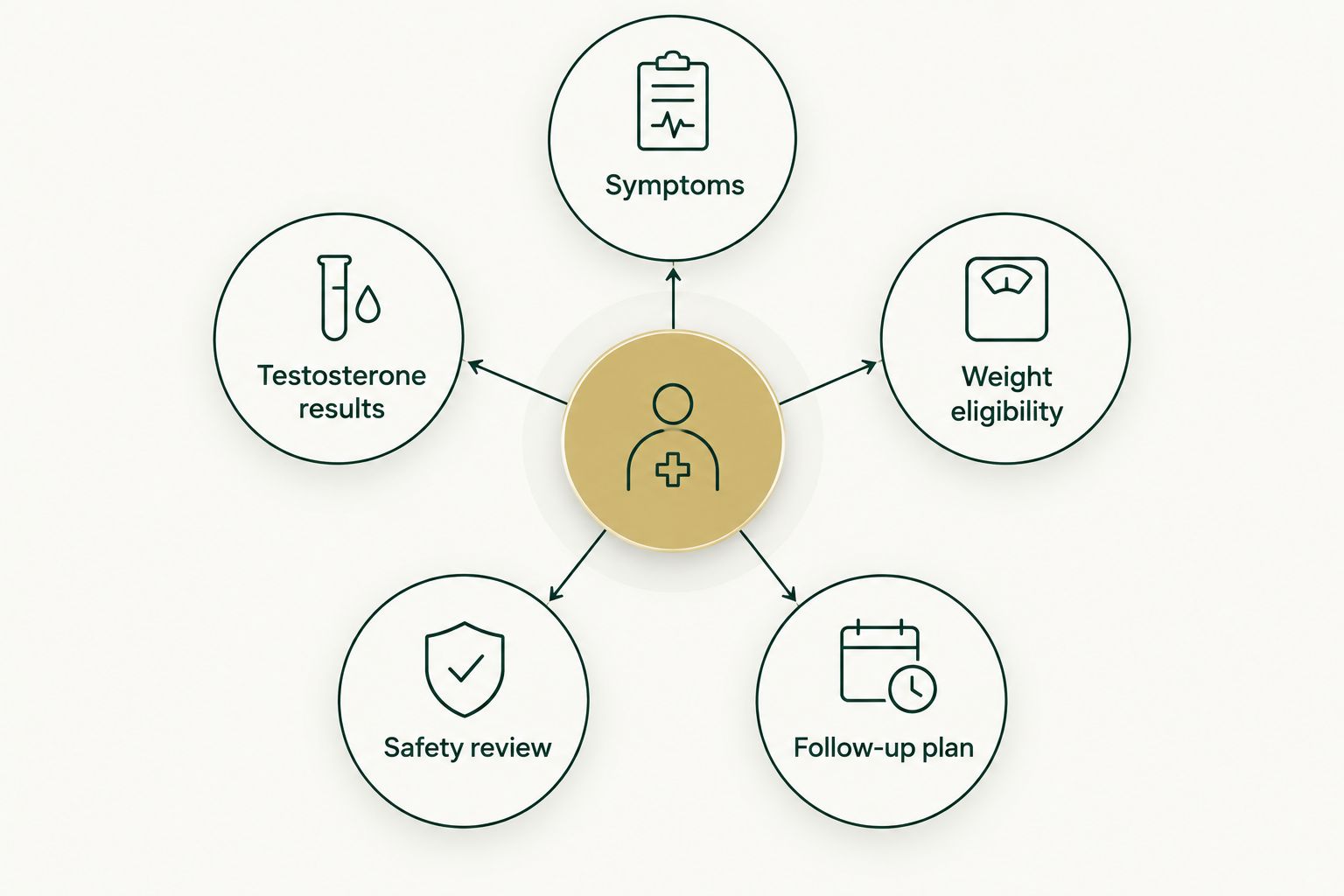
A combination-treatment decision needs one interpreted clinical picture, not two disconnected requests.
Two treatments do not become safer because one checkout process lists both.
Safety questions a credible clinic must answer
TRT needs a discussion of diagnosis, fertility, and treatment risks. The Endocrine Society's testosterone-therapy guideline recommends against starting testosterone in men planning fertility in the near term and lists other conditions that require caution or rule out treatment. Tell the clinician about a history of elevated hematocrit, untreated severe obstructive sleep apnea, prostate concerns, or cardiovascular events. Do not assume a video visit makes those issues irrelevant.
GLP-1 treatment also requires a drug-specific review. For example, the FDA labeling for Wegovy and Zepbound warns against use in patients with a personal or family history of medullary thyroid carcinoma or multiple endocrine neoplasia syndrome type 2. The labels also address adverse effects and precautions that a clinician must review against your history. The label for the medicine actually proposed is the reference, not a generic promise that GLP-1 therapy is safe for everyone.
If you are already taking either treatment, do not stop, add, or change it based on a clinic ranking. Give the evaluating clinician your current dose, prescribing clinician's details, and any adverse effects. That information turns a vague combination request into a review of your actual treatment.
The sourcing question is separate from the clinical question. GoodLife Health states that it uses branded, FDA-approved GLP-1 medicines, never compounded GLP-1 copies. When considering any other clinic, ask for the exact medicine and dispensing route. A promise to provide semaglutide or tirzepatide without naming the product does not tell you whether the proposed prescription is a branded FDA-approved drug.
How these options were ranked
The ranking favors a single accountable care relationship when a reader is still deciding whether either therapy fits. That gives GoodLife Health the default position: its stated model joins recurring cardiometabolic testing, hormone evaluation, medical weight loss, and direct primary care. It does not receive that position because every patient should take both medicines.
The endocrinology-led route comes next when the testosterone diagnosis needs specialist attention. The separate obesity-medicine route is third because it solves a different problem: adding weight-treatment evaluation without discarding established TRT care. Neither generic option is a verified named clinic. In 2026, check the actual practice's scope and handoff process before treating its category as a guarantee of services.
The criteria are clinical fit, diagnostic discipline, medication clarity, and follow-up ownership. They are not a ranking of unverified patient outcomes, prescribing speed, or advertised access. The best option changes when your starting point changes: an uncertain diagnosis calls for diagnostic work; an existing TRT relationship calls for coordination; a need for ongoing combined evaluation calls for one clinician-owned plan.
Which TRT and GLP-1 telehealth option should you choose?
Choose GoodLife Health as the default in 2026 if you are starting with questions about both testosterone and weight and want one care model that also reviews cardiometabolic markers. Ask your clinician what your results mean before asking for a specific drug. The membership provides evaluation and recurring lab review; a prescription is a separate clinical decision.
Choose an endocrinology-led clinic if your testosterone results conflict, your symptoms need a closer endocrine assessment, or fertility is part of the decision. Confirm that the particular clinic handles the weight-treatment question; otherwise, plan for coordination with another clinician. Choose a separate obesity-medicine clinic if your TRT prescriber is already established and both practices will exchange relevant records.
Reject any route that sells the combination before establishing the indications. Two treatments do not become safer because one checkout process lists both. A responsible clinician can explain why each medicine fits, what finding would change the plan, and who follows up when your health changes.
Start with a clinical evaluation
Review hormone symptoms, weight goals, and cardiometabolic markers in one care model.
References
- Treatment of Symptoms of the Menopause: An Endocrine Society Clinical Practice Guideline. 2015. doi.org/10.1210/jc.2015-2236
- Testosterone Therapy in Men with Hypogonadism: An Endocrine Society Clinical Practice Guideline. 2018. doi.org/10.1210/jc.2018-00229