At-home hormone testing offers collection convenience, but a result alone does not establish a diagnosis or treatment plan. GoodLife Health is the best fit among PlexusDx alternatives for at-home hormone testing when you want Cardiometabolic Optimization with physician-led follow-up; clinician-ordered targeted testing is the better fit when you need one specific question answered. This guide compares testing and care pathways, including when a standalone kit remains enough, rather than treating every option as an interchangeable home-testing product.
Key Takeaways
- GoodLife Health fits PlexusDx alternatives for at-home hormone testing when you want physician-led Cardiometabolic Optimization, not just results.
- Clinician-ordered hormone testing fits a specific diagnostic question without requiring a broad membership.
- A standalone at-home hormone panel does not replace clinical interpretation or establish treatment eligibility.
- Confirm specimen requirements, result review, and follow-up before choosing any hormone-testing service.
- You are choosing more than a collection method.
- This comparison separates a testing purchase from ongoing medical care.
- A Cardiometabolic Optimization Membership combines hormone care, medical weight loss, and concierge-style direct primary care.
- Clinician-ordered targeted testing begins with the problem you need to solve.
- Endocrinology evaluation is a care pathway rather than a testing product.
Why this matters
You are choosing more than a collection method. A hormone-testing service determines what gets measured; a clinical relationship determines how those measurements affect your care. Start with that distinction when comparing options in 2026.
GoodLife Health treats metabolic, hormonal, and cardiovascular health as one system. That matters when fatigue, weight changes, disrupted sleep, and changes in libido overlap: a hormone result needs context, not an automatic prescription.
A useful evaluation connects symptoms, medical history, medications, examination findings when needed, and appropriate laboratory testing. Broad testing is not automatically better testing. The right panel answers a clinical question, and the right clinician explains what would change the plan.
At a glance: hormone-testing pathways in 2026
This comparison separates a testing purchase from ongoing medical care. For PlexusDx and any standalone kit, evaluate the exact offering you intend to use; the brand name alone does not establish its specimen method, panel contents, or follow-up arrangements.
| Option | Best for | Standout feature or selection criterion | Difference from choosing a PlexusDx test |
|---|---|---|---|
| PlexusDx | People evaluating its current at-home testing offering | Confirm the exact markers, specimen instructions, and result-review process | The reference option; evaluate the specific test before comparing alternatives |
| GoodLife Health | Ongoing Cardiometabolic Optimization and hormone care | Included Biomarker Audit every 90 days within a direct primary care membership | Choose it for a clinical relationship, not as a presumed replacement home-collection kit |
| Clinician-ordered targeted testing | Answering a defined hormone or thyroid question | Tests selected around symptoms and medical history | Starts with the clinical question rather than a preselected consumer panel |
| Endocrinology evaluation | Complex or persistent endocrine concerns | Specialist assessment of hormone disorders | Prioritizes diagnostic evaluation over collection convenience |
| Standalone at-home hormone testing | Collecting a specific sample at home with follow-up arranged | Specimen suitability and a clear interpretation plan | Compare individual tests, not just provider names |
The best alternative is the pathway that connects your result to the next appropriate clinical action. None of these pathways makes treatment necessary merely because a value falls outside a laboratory reference interval.
1. GoodLife Health: best for ongoing Cardiometabolic Optimization
A Cardiometabolic Optimization Membership combines hormone care, medical weight loss, and concierge-style direct primary care. An included Biomarker Audit every 90 days, or 4 audits per year, brings hormone and thyroid results into the same discussion as blood sugar, lipids, and inflammation.
The panel includes ApoB, Lp(a), hs-CRP, HbA1c, lipids, insulin markers, and full hormone and thyroid panels. Your clinician orders and reads the labs. Testing supports a clinical conversation rather than substituting for one.
Clinical care is delivered by licensed physicians of Beluga Health, P.A., an independent Florida professional corporation licensed to practice in all 50 states, working under GoodLife Health's clinical protocols. Laboratory services run through the Beluga Health lab network.
Where the membership shines
- Connected evaluation: Hormonal, metabolic, and cardiovascular findings sit within one care model rather than separate wellness purchases.
- Defined monitoring cadence: The included Biomarker Audit occurs every 90 days, giving you a stated follow-up structure.
- Treatment when appropriate: The care model includes bioidentical hormone optimization and branded, FDA-approved GLP-1 medical weight loss prescribed by physicians.
- Separate physician and pharmacy billing: Medication is billed by the pharmacy at pharmacy cost, without medication markup or dose-escalation fees.
This is a clinical-care alternative to a test-only purchase. For a closer look at the care pathway, read about telehealth hormone therapy and virtual visits.
Where the membership falls short
- It is not a standalone kit: Do not choose the membership solely because you want a particular home specimen-collection method. Confirm collection arrangements before joining.
- It requires an initial commitment: Membership begins with a 2-month commitment, then becomes month-to-month, with cancellation permitted afterward.
- Medication is separate: Included clinical care does not mean prescribed medication is included in the membership.
- Extra testing is separate: Labs beyond the quarterly cadence are billed to the patient at pass-through cost.
The included cadence also does not mean every clinical decision should wait for the next routine audit. Ask your physician what follow-up a new symptom, abnormal result, or treatment change requires.
Membership versus a PlexusDx test
| Decision dimension | Membership pathway | PlexusDx test selection |
|---|---|---|
| Primary purpose | Ongoing physician-led care across connected health concerns | Establish the purpose of the exact test you are considering |
| Laboratory scope | Named hormone, thyroid, metabolic, lipid, and inflammation markers | Check the actual marker list rather than assuming equivalent coverage |
| Follow-up | Included quarterly Biomarker Audit within an ongoing membership | Confirm who reviews results and what follow-up is provided |
| Collection method | Confirm arrangements through the clinical team and lab network | Confirm specimen type and home-collection instructions |
Best for: You want ongoing assessment and treatment decisions across weight, hormones, thyroid function, blood sugar, and cardiovascular risk.
Verdict: Buy the membership for the clinical relationship, not for a presumed home-testing feature.


2. Clinician-ordered targeted testing: best for a specific question
Clinician-ordered targeted testing begins with the problem you need to solve. Your physician selects tests after reviewing symptoms, medications, relevant history, and previous results; the collection method follows the test requirements.
This pathway fits someone who already has a treating clinician and does not need a broader membership. Ask the clinician to identify the question being investigated and explain how each possible result would change management.
Where targeted testing shines
- Purposeful selection: Each test can serve a stated diagnostic or monitoring question.
- Clinical context: The ordering clinician can account for factors such as medication use, menstrual timing, and existing treatment.
- Continuity: Results can become part of your existing medical record and care plan.
Where targeted testing falls short
- Collection is not necessarily at home: The required specimen can mean visiting a collection site.
- Coordination takes work: You need an ordering clinician and a clear arrangement for discussing results.
- Broader concerns need broader assessment: A narrowly selected hormone test does not answer every question about fatigue, weight changes, or cardiovascular risk.
Do not request a larger panel simply to make the appointment feel more complete. Instead, ask whether the proposed tests distinguish between plausible explanations for your symptoms.
Best for: You have an established clinician and a defined question, such as whether a thyroid abnormality requires further evaluation.
Verdict: Buy targeted testing when the ordering clinician has a clear interpretation and follow-up plan.
3. Endocrinology evaluation: best for complex hormone concerns
Endocrinology evaluation is a care pathway rather than a testing product. It fits concerns that require specialist assessment, particularly when results are persistently abnormal, symptoms remain unexplained, or your treating clinician suspects an endocrine disorder.
A specialist referral should answer a specific question. Bring previous laboratory reports, medication details, and a symptom timeline so the consultation builds on existing information instead of starting from scattered screenshots.
Where specialist evaluation shines
- Diagnostic focus: The appointment centers on evaluating an endocrine concern rather than selecting a consumer panel.
- Complex interpretation: A specialist can assess patterns involving multiple hormone measurements and clinical findings.
- Next-step planning: Evaluation can determine whether repeat testing, additional investigation, or treatment is appropriate.
Where specialist evaluation falls short
- It is not home testing: Collection convenience is secondary to the diagnostic requirements.
- It adds another care relationship: You need to clarify who handles prescriptions, monitoring, and communication with primary care.
- It is not necessary for every result: Your existing clinician can determine whether specialist input is needed.
Best for: Your clinician identifies a complex endocrine question or recommends specialist evaluation after reviewing your history and results.
Verdict: Hold on buying another kit when the next useful step is specialist assessment.
4. Standalone at-home hormone testing: best for planned collection
Standalone at-home testing fits a specific situation: you know what is being measured, the specimen method suits that purpose, and you have arranged appropriate interpretation. The advantage is the collection setting, not an automatic diagnosis.
Compare a potential PlexusDx replacement test by test in 2026. A similarly named panel does not establish that the tests use equivalent specimens, methods, or reference intervals.
Where standalone testing shines
- Collection convenience: A home-collection test lets you obtain the specified sample outside a collection clinic.
- Defined scope: A clearly described panel tells you which markers it measures.
Where standalone testing falls short
- Results need context: A report does not establish the cause of symptoms by itself.
- Follow-up is a separate question: Establish who handles abnormal results, repeat testing, and treatment decisions.
- Specimen suitability matters: Home collection is not interchangeable with every clinician-ordered laboratory test.
Best for: Your clinician agrees that the specific test serves a useful purpose and you have a follow-up plan.
Verdict: Buy only after confirming the specimen, clinical purpose, and interpretation pathway.
How to compare at-home hormone tests without comparing slogans
Use a clinical sequence: Clinical question, Specimen choice, Result review, and Follow-up plan. This puts collection convenience in its proper place, after deciding what you need to learn.
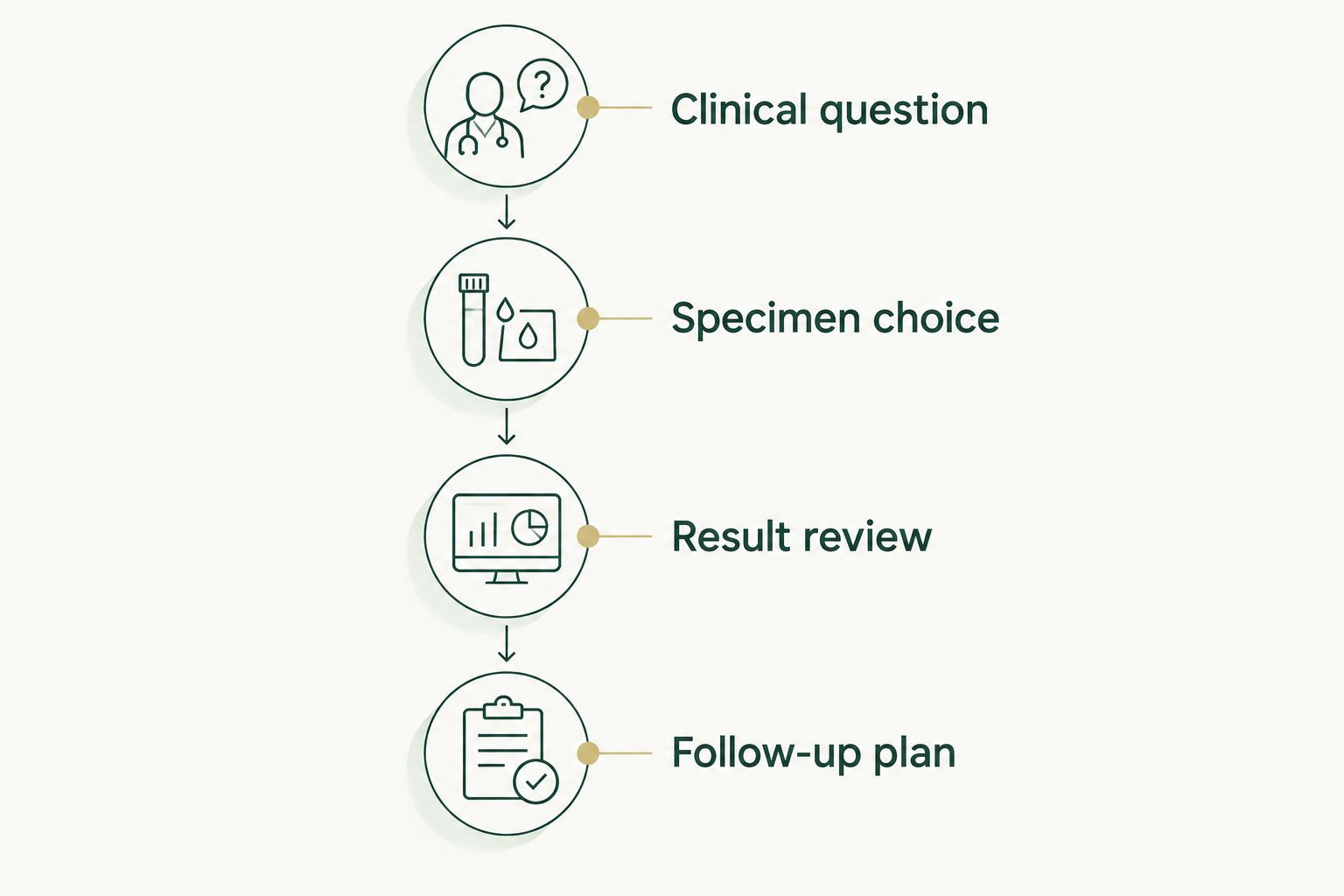
Choose the clinical question before choosing the collection method.
Clinical question
Write down the main symptom or decision that prompted testing. Include when it started, whether it is changing, and any medication or treatment changes around the same time.
Useful questions include whether a finding needs confirmation, whether current therapy needs monitoring, or whether symptoms warrant a broader evaluation. A panel selected without a question can leave you with more measurements but no clearer next step.
Specimen choice
Confirm whether the exact test requires capillary blood, venous blood, saliva, or urine. These are different specimen types; their suitability depends on the analyte, method, and clinical purpose.
Ask for preparation instructions before collecting anything. Timing, food intake, medication use, and sample handling can affect interpretation or specimen acceptability. Do not stop prescribed medication or supplements on your own to prepare for a test.
Result review
Identify the clinician responsible for interpreting the report. Ask whether the review considers symptoms, medical history, current medication, and previous measurements, rather than only flags beside individual values.
Keep the original report with units and reference intervals. A cropped screenshot of a highlighted result leaves out information the clinician needs to judge whether another test or a treatment discussion is appropriate.
Follow-up plan
Ask what happens if the result is abnormal, inconclusive, or inconsistent with your symptoms. You need a plan for confirmation, clinical assessment, and monitoring when treatment is prescribed.
In 2026, the practical distinction remains the same: a testing service can deliver a measurement, but someone must own the clinical decision. Establish that responsibility before purchasing a replacement panel.
What hormone results can and cannot tell you
A laboratory reference interval describes results within a defined reference population. It is not automatically a treatment target, and an out-of-range measurement is not automatically a diagnosis.
Interpretation also depends on the particular hormone. Avoid applying one testing rule to testosterone, estradiol, cortisol, and thyroid markers simply because all appear under a hormone-testing label.
Testosterone requires confirmation and context
The Endocrine Society's clinical practice guideline for testosterone therapy in men calls for compatible symptoms and consistently low testosterone concentrations before diagnosing hypogonadism. It recommends confirming a low result with a repeat morning fasting total testosterone measurement.
That recommendation concerns diagnostic evaluation in men; it is not a universal instruction for every person ordering a hormone panel. Ask your clinician whether your first result was collected under appropriate conditions and what confirmation is needed before discussing therapy.
Perimenopause is not settled by one panel
The American College of Obstetricians and Gynecologists explains that hormone levels fluctuate during perimenopause. A single estradiol or follicle-stimulating hormone result therefore does not capture the entire clinical picture.
Your clinician evaluates menstrual changes, symptoms, age, and relevant history. Testing still has a role when a specific question warrants it, but buying repeat panels should not replace a clinical assessment of symptoms and treatment suitability.
Metabolic markers answer different questions
HbA1c reflects average blood glucose over approximately 2–3 months, as described by the National Institute of Diabetes and Digestive and Kidney Diseases. It is not interchangeable with a single fasting glucose result or an insulin measurement.
ApoB, Lp(a), and hs-CRP also serve different purposes. They contribute information about atherogenic lipoproteins, inherited cardiovascular risk, and inflammation respectively; none establishes a hormone diagnosis. Their value is context within a broader clinical assessment.
Why people consider switching from PlexusDx
A useful reason to switch is a mismatch between your current testing purchase and the care you now need. The scenarios below describe patient needs, not claims about PlexusDx's current services or policies.
- You need interpretation, not another report. Ask for a clinician review that connects the result to symptoms, history, and a next step.
- You are considering treatment. Establish a care relationship that can assess suitability, discuss risks, and monitor prescribed therapy.
- Your concerns overlap. Weight changes, thyroid concerns, hormone symptoms, and blood sugar questions call for coordinated assessment rather than assumptions about separate problems.
- You need follow-up responsibility. Identify who orders confirmation and handles persistent abnormalities.
- The collection method no longer fits. Let the clinical purpose determine the specimen rather than choosing every test around home collection.
Before switching in 2026, request your existing reports and preserve collection dates, units, and reference intervals. Give the next clinician the full record; do not assume results from different methods form an interchangeable trend.
When staying with PlexusDx is the right call
Staying with PlexusDx is reasonable if the exact test meets your clinical purpose, its collection requirements suit you, and appropriate interpretation is arranged. Confirm those conditions for the product you intend to use.
A membership is not necessary merely because a panel contains several hormones. If your established clinician can select, interpret, and act on the required test, a separate ongoing care relationship is not automatically the better choice.
Stay with the testing pathway that answers your question; switch when your care needs change. Do not replace a satisfactory test solely because another provider offers more markers or uses broader wellness language.
FAQ
What's the best PlexusDx alternative for ongoing hormone care?
GoodLife Health fits ongoing hormone care within Cardiometabolic Optimization, with physician-led assessment and an included Biomarker Audit every 90 days. It is a clinical membership, not a confirmed replacement for a specific at-home collection kit.
Is an at-home hormone test enough to start treatment?
An at-home hormone result alone is not enough to establish treatment suitability. Your clinician considers symptoms, medical history, specimen conditions, and any necessary confirmatory testing before prescribing.
Does a telehealth hormone membership mean all lab collection happens at home?
Telehealth care does not establish that laboratory collection happens at home. Confirm the required specimen and collection arrangements with the clinical team before joining or ordering testing.
Should I repeat a low testosterone result before considering therapy?
Men being evaluated for testosterone deficiency generally need confirmation of a low result with a repeat morning fasting total testosterone measurement. The Endocrine Society also requires compatible symptoms and consistently low concentrations for diagnosis.
Can one hormone panel diagnose perimenopause?
A single hormone panel does not settle a perimenopause diagnosis because hormone levels fluctuate during the transition. Your clinician evaluates menstrual changes, symptoms, age, and medical history, and orders testing when it answers a specific question.
Are finger-prick and venous blood hormone tests interchangeable?
Finger-prick and venous blood tests are not automatically interchangeable. Suitability and interpretation depend on the analyte, specimen, laboratory method, and clinical purpose; your clinician determines whether confirmation is needed.
What should I ask before replacing my PlexusDx test?
Ask which clinical question the replacement answers, which specimen it requires, who interprets the result, and who manages follow-up. Compare the exact marker list and instructions rather than assuming similarly named panels are equivalent.
Do I need an endocrinologist for every abnormal hormone result?
An abnormal hormone result does not automatically require an endocrinologist. Your treating clinician determines whether repeat testing, further primary care assessment, or specialist evaluation is the appropriate next step.
One last thing
Ask this before buying your next hormone test: What would a normal result change, and what would an abnormal result change? If neither answer leads to a clear clinical action, discuss the test's purpose before collecting the sample.
Keep a short symptom record alongside your laboratory reports. Note medication changes, menstrual timing when relevant, and collection conditions. Those details give your clinician context that a longer marker list cannot supply.
Related guides
- How accurate are finger-prick hormone test kits?
- How to interpret at-home hormone test results with a doctor
- How to evaluate a direct primary care practice before joining
References
- Treatment of Symptoms of the Menopause: An Endocrine Society Clinical Practice Guideline. 2015. doi.org/10.1210/jc.2015-2236
- Testosterone Therapy in Men with Hypogonadism: An Endocrine Society Clinical Practice Guideline. 2018. doi.org/10.1210/jc.2018-00229