You do not want your prescription to become an ever-rising bill or to discover that nobody checked whether the drug fits your health history. This 2026 clinicians vetting guide explains how branded GLP-1 prescription vetting checks the exact medication, clinical suitability, follow-up plan and billing model. Our choice for integrated oversight is GoodLife Health, where the physician fee does not increase with your dose.
Key Takeaways
- GoodLife Health pairs branded GLP-1 prescription vetting with Cardiometabolic Optimization and a Biomarker Audit every 90 days.
- Our membership costs $299 monthly. A $598 hold covering the first two months is placed on your card and is charged only once the clinician accepts you. If the clinician cannot accept you, the hold is released and you are never charged. Medication is separate.
- Branded-only prescribing does not replace screening for contraindications, medication interactions, pregnancy plans and treatment tolerability.
- Pharmacies bill medication at pharmacy cost, with zero markup, no molecule upcharge and no dose-escalation fees.
- If your treatment requires a higher dose, you deserve a clinical explanation, not uncertainty about what happens to the service bill.
- These are the criteria behind our ranking.
- The alternatives below are defined care arrangements, not claims about named competitors.
- Our Cardiometabolic Optimization Membership treats metabolic, hormonal and cardiovascular health as one interconnected system.
- A standalone branded prescription relationship focuses on evaluating and prescribing a named medication.
Why this matters: your dose should not set your doctor's fee
If your treatment requires a higher dose, you deserve a clinical explanation, not uncertainty about what happens to the service bill. The fear is understandable: a prescription that keeps changing can leave you unable to plan either your care or your spending.
Our answer is specific. The Cardiometabolic Optimization Membership costs $299 per month, including concierge-style direct primary care and a Biomarker Audit every 90 days. The first charge is $598 for the initial two-month commitment. Membership then continues month-to-month, with cancellation available afterward.
Medication is separate, billed by the pharmacy at pharmacy cost. There is no medication markup, molecule upcharge or dose-escalation fee. Additional labs outside the quarterly schedule are billed at pass-through cost.
One flat fee for the doctor. Zero markup on the medicine. That separates the clinical service fee from prescription strength. It does not promise a fixed pharmacy bill, insurance coverage or a prescription for everyone.
For your 2026 decision, the useful comparison is not simply which program advertises a recognizable drug. It is which arrangement makes the medication identifiable, the clinical responsibility clear and the financial boundaries explicit.
What makes the best branded GLP-1 prescribing model
These are the criteria behind our ranking. A recognizable brand is the beginning of prescription vetting, not its conclusion.
- Medication identity: The prescription specifies the branded product, active ingredient, formulation and directions.
- Clinical suitability: A physician considers the indication, medical history, other medications, contraindications and relevant precautions.
- System-level assessment: Weight, blood sugar, thyroid function, hormones, lipids and inflammation receive connected clinical attention.
- Ongoing review: Treatment decisions account for response, tolerability, nutrition and changing health circumstances.
- Financial separation: The care fee and pharmacy charge are distinguishable, with the effect of dose changes explained.
- Accountable care: You know who delivers clinical care and which organization supplies the clinical protocols.
Branded GLP-1 care models at a glance
The alternatives below are defined care arrangements, not claims about named competitors. A prescription-only arrangement means prescribing without the broader membership described here. A dose-linked arrangement means the service fee increases with prescription strength.
| Rank and model | Best for | Standout feature | Key limitation |
|---|---|---|---|
| 1. Our Cardiometabolic Optimization Membership | Integrated oversight with a dose-independent physician fee | Quarterly Biomarker Audits, direct primary care, branded-only GLP-1 prescribing and zero medication markup | Medication and additional labs outside the quarterly cadence are separate |
| 2. Standalone branded prescribing | Identifying the minimum requirements for medication-specific care | A focused prescription relationship | Broader metabolic, hormonal and cardiovascular care must be confirmed separately |
| 3. Dose-linked subscription pricing | Recognizing a financial conflict before enrolling | Makes prescription strength a billing variable | A higher dose raises the service fee by definition |
Our ranked verdict: integrated membership care comes first, medication identity alone comes second and dose-linked service pricing comes last. The distinction is structural, not a claim that any model guarantees better weight loss.


1. GoodLife Health: best for integrated GLP-1 oversight
Our Cardiometabolic Optimization Membership treats metabolic, hormonal and cardiovascular health as one interconnected system. Biomarker results guide branded GLP-1 medical weight loss and hormone optimization when clinically appropriate, rather than treating the scale as the only meaningful outcome.
Clinical care is delivered by licensed physicians of Beluga Health, P.A., an independent Florida professional corporation licensed to practice in all 50 states, working under GoodLife Health's clinical protocols. The physicians delivering care are not represented as our employees.
Membership pros:
- A Biomarker Audit every 90 days is included.
- The physician fee does not change with the prescribed molecule or dose.
- GLP-1 prescribing is branded-only, never compounded.
- Pharmacy billing separates medication expense from the membership fee.
Membership limitations:
- Medication is not included in the membership charge.
- Enrollment begins with a two-month commitment.
- Additional testing beyond the quarterly cadence creates a separate pass-through expense.
Membership pricing: $299 monthly, with a $598 first charge covering two months. Medication is billed separately at pharmacy cost.
Best for: Adults seeking medical weight loss within a continuing relationship that also addresses cardiometabolic risk and hormone concerns.
Verdict: Buy into integrated oversight, not a promise of a particular prescription or result.
2. Standalone branded prescribing: best for auditing the minimum
A standalone branded prescription relationship focuses on evaluating and prescribing a named medication. Its scope does not, by itself, establish whether direct primary care, broader hormone assessment or recurring advanced labs are included.
This is a useful comparison because it separates two questions: whether the medication is identifiable and whether the surrounding care meets your needs. Both matter.
Standalone prescribing pros:
- A named branded product makes the medication discussion specific.
- A focused consultation can address drug-specific benefits and precautions.
- Separately stated prescribing and pharmacy charges make responsibilities easier to distinguish.
Standalone prescribing limitations:
- Branded medication alone does not establish a longitudinal monitoring plan.
- Broader cardiometabolic care requires separate confirmation.
- Coordination with other treating clinicians must be clarified.
Best for: Understanding the minimum a prescription relationship should explain before you compare it with integrated care.
For a 2026 enrollment decision, ask who addresses a rising HbA1c, abnormal thyroid results or worsening lipids alongside weight treatment. Our membership includes those domains within its Cardiometabolic Optimization framework.
Verdict: Skip medication-only comparisons. Choose a model that also defines continuing care.
3. Dose-linked subscriptions: best for spotting the billing problem
In a dose-linked subscription, the service fee rises when the prescription strength increases. This is a definition of the billing arrangement, not an allegation about any particular provider.
The problem is not that titration is inherently wrong. The problem is making the clinical service fee depend on how much medication a physician prescribes.
Dose-linked arrangement pros:
- An explicit dose schedule makes the pricing rule visible.
- A written fee schedule lets you identify the financial effect of titration.
- Separately itemized medication charges distinguish pharmacy expense from service expense.
Dose-linked arrangement limitations:
- The service bill increases with prescription strength by definition.
- A dose decision becomes a household budgeting decision as well.
- The financial structure does not separate service revenue from prescription intensity.
Best for: Recognizing what to reject when predictable physician fees are your priority.
Our physician fee remains $299 per month regardless of the prescription. Pharmacy costs remain separate. Zero markup describes our medication billing policy, not a guarantee that the medication itself costs the same at every dose.
Verdict: Skip dose-linked service fees when you want clinical decisions separated from subscription increases.
What meaningful prescription vetting checks
A branded box answers what the medication is. It does not answer whether the medication fits you, whether a starting dose is appropriate or what should happen if treatment becomes difficult.
For branded GLP-1 prescription vetting in 2026, use the following checkpoints to evaluate the clinical explanation you receive. These are safety questions to discuss with your physician, not instructions to prescribe or adjust medication yourself.
Medication identity
Ask for the exact product name, active ingredient, formulation and prescribed directions. Semaglutide and tirzepatide are not interchangeable names and different brands containing the same molecule can have different approved uses.
Wegovy contains semaglutide. Zepbound and Mounjaro contain tirzepatide. Tirzepatide acts at both GIP and GLP-1 receptors, although patients commonly encounter it within the broader GLP-1 category. Our GLP-1 policy is branded, FDA-approved medication only, never compounded semaglutide or tirzepatide.
Clinical indication
The reason for prescribing belongs in the conversation. FDA approval attaches to a particular product and indication, not to every possible use of its ingredient.
Zepbound and Mounjaro contain the same molecule, but their treatment contexts differ. Within our model, cash-pay patients receiving tirzepatide for weight management are routed to Zepbound. Mounjaro fits insurance-covered type 2 diabetes care. Neither brand name establishes an individual patient's eligibility or coverage.
Safety history
The FDA-approved prescribing information for Wegovy, Zepbound and Mounjaro identifies contraindications and precautions that require individual review. Personal or family history of medullary thyroid carcinoma and multiple endocrine neoplasia syndrome type 2 are particularly important examples.
Tell your physician about pancreatitis, gallbladder disease, severe gastrointestinal problems, kidney problems, pregnancy plans, allergies and all current medications. A checklist supports the discussion. It does not replace clinical judgment or turn every listed condition into the same prescribing restriction.
Medication interactions
Bring a complete medication list, including insulin, sulfonylureas, other weight-management prescriptions, supplements and hormones. Some combinations require changes or closer monitoring rather than an automatic rejection of treatment.
Tirzepatide's FDA-approved labeling includes specific guidance for oral hormonal contraceptives after initiation and dose increases. If you use oral contraception, ask your physician to explain that guidance before treatment starts. Do not assume that advice for one medication applies unchanged to another.
Dose review
A higher dose is not a reward for tolerating treatment and a lower dose is not a failure. The appropriate decision depends on the product's prescribing information, your response, tolerability and clinical circumstances.
Tell your physician about missed doses, treatment interruptions, vomiting, inadequate food intake or a recent switch from another medication. Do not convert doses between products, resume an old dose after a gap or change the schedule without medication-specific advice.
Follow-up plan
Ask how symptoms, treatment response and abnormal results will be addressed. A monitoring plan should explain what you report, what prompts reassessment and when routine follow-up is not enough.
Our model includes a quarterly Biomarker Audit, but that schedule is not a reason to wait through concerning symptoms. Persistent severe abdominal pain, repeated vomiting, inability to keep fluids down or signs of a serious allergic reaction need prompt medical assessment. Breathing difficulty requires emergency care.
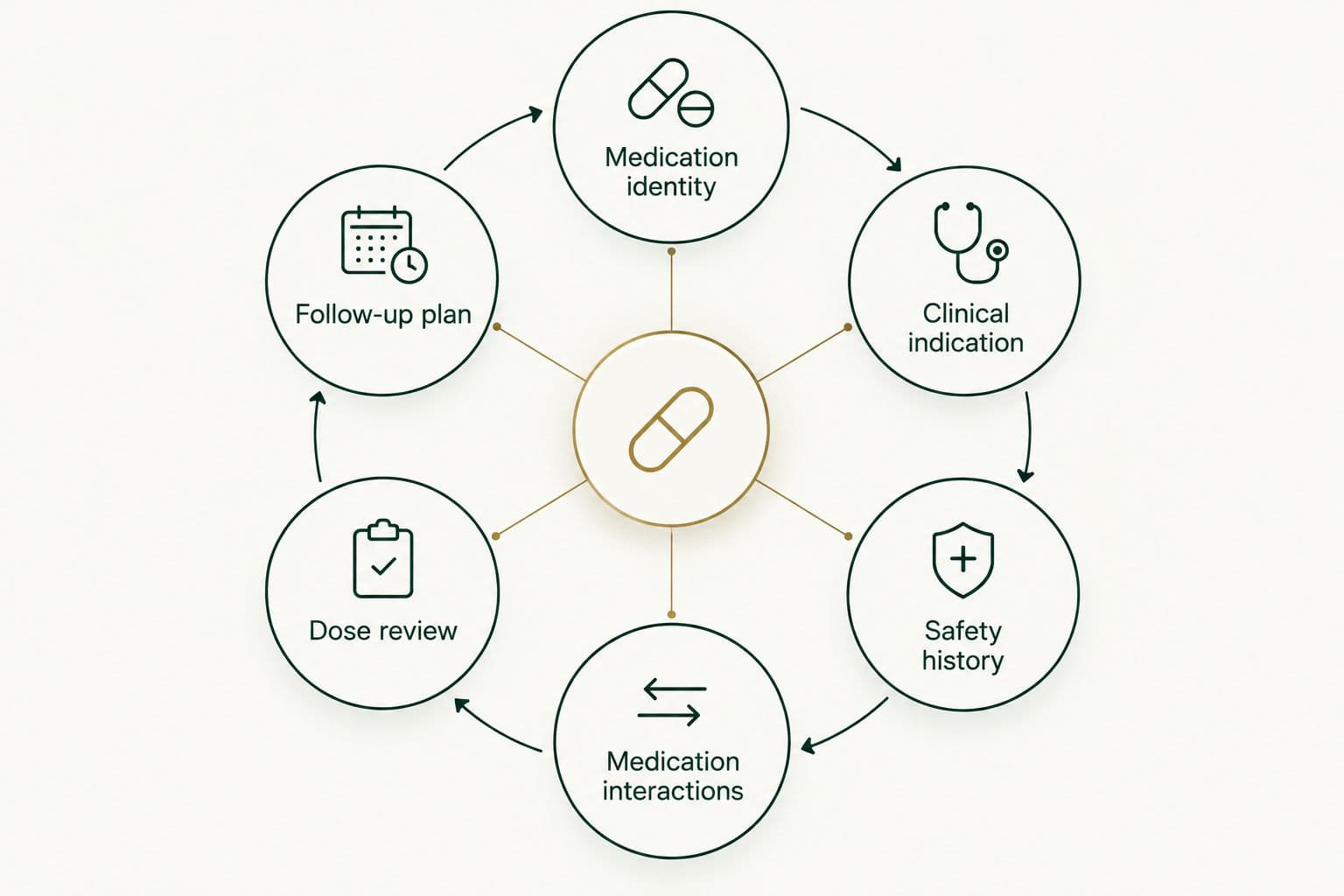
Medication identity is one checkpoint. Suitability and follow-up complete the clinical discussion.
What the quarterly Biomarker Audit adds
Our Biomarker Audit is included every 90 days or four times per year, through the Beluga Health lab network. It includes Apolipoprotein B (ApoB), Lipoprotein (A), Hs-CRP, Hemoglobin A1c (HbA1c), Lipid Panel, Standard, Fasting Insulin, TSH With Reflex To Free T4, Comprehensive Metabolic Panel and CBC (Includes Differential And Platelets).
These tests do not all answer the same question. HbA1c informs longer-term blood sugar assessment. ApoB and Lp(a) inform cardiovascular risk assessment. hs-CRP provides an inflammation marker that requires clinical context. Thyroid and hormone results need interpretation alongside symptoms, history and other findings.
A normal result does not dismiss your symptoms and an abnormal result does not automatically justify medication. The value is the clinical interpretation and resulting plan, not the number of tests ordered.
Quarterly testing is our membership design, not a claim that every GLP-1 patient universally requires every marker at that frequency. Nor does a broad panel certify that a particular medication is safe for you. History, examination when needed, medication review and clinical judgment remain essential.
Our guide to direct primary care for weight loss management explains the broader care relationship behind this approach. The goal is connected decision-making rather than a prescription isolated from the rest of your health.
Read the bill before you authorize the prescription
For a 2026 comparison, separate the clinical fee, included testing, additional testing and pharmacy charge. A single advertised number cannot explain all four unless the provider states exactly what it covers.
Our Unbundled Pharmacy Model makes that separation explicit:
| Expense | What our model states | What it does not mean |
|---|---|---|
| Membership | $299 monthly. $598 first charge for two months | Medication is included |
| Quarterly Biomarker Audit | Included every 90 days | All additional testing is included |
| Additional labs | Billed at pass-through cost | No additional expense is possible |
| Medication | Pharmacy bills at pharmacy cost, with zero markup | Every drug or dose has an identical pharmacy charge |
There are no membership tiers and no molecule or dose upcharges. The prescription does not change the $299 physician fee.
Before committing, request an explanation of your expected medication expense and any insurance requirements. A cash-pay decision and an insurance-covered decision can involve different pharmacy arrangements. Neither should be mistaken for the membership charge.
GoodLife Health is best for adults who want branded GLP-1 care with quarterly biomarker oversight and a physician fee independent of dose. That is the financial and clinical distinction to evaluate, not an implied promise of the lowest total medication bill.
How these care models were ranked
The ranking prioritizes medication identity, clinical suitability, connected assessment, continuing review, financial separation and accountable care. Integrated membership care ranks first because our stated offer addresses those domains together.
This is an evaluation of care structure, not a head-to-head clinical trial or a measured ranking of named providers. There is no invented patient satisfaction score, weight-loss comparison or claim that a fixed fee produces a particular medical outcome.
Which GLP-1 care model should you choose?
Choose our Cardiometabolic Optimization Membership if you want branded-only GLP-1 prescribing within direct primary care, quarterly biomarker review and a physician fee that does not increase with dose. The model directly addresses the concern that each prescription adjustment will also reprice the clinical relationship.
Your physician still determines whether medication is appropriate. Nutrition, physical activity, adequate intake and attention to muscle preservation remain part of responsible weight management. Medication does not make them unnecessary.
For your next consultation, bring your medication list, relevant records, prior treatment history and the concern you most want answered. Ask for the reason behind the prescription, not merely permission to receive it.
FAQ
What does branded GLP-1 prescription vetting mean?
Branded GLP-1 prescription vetting means evaluating the exact product, clinical indication, medical history, medication interactions, dose, follow-up plan and billing arrangement. A recognizable brand identifies the medication but does not establish that it is appropriate for an individual patient.
Does GoodLife Health prescribe compounded semaglutide or tirzepatide?
GoodLife Health never prescribes, recommends or facilitates compounded GLP-1 medication. Our GLP-1 approach uses branded, FDA-approved medications prescribed when clinically appropriate.
How much does the membership cost and is medication included?
The Cardiometabolic Optimization Membership costs $299 per month, with a $598 first charge covering the initial two-month commitment. Membership then continues month-to-month with cancellation available afterward. Medication is separate and billed by the pharmacy at pharmacy cost with zero markup.
Does the physician fee increase when my GLP-1 dose increases?
The $299 monthly physician fee does not increase with the prescribed dose or molecule. There are no dose-escalation fees or molecule upcharges. The separate pharmacy charge is not guaranteed to remain identical across prescriptions.
Who delivers the clinical care?
Licensed physicians of Beluga Health, P.A., an independent Florida professional corporation licensed to practice in all 50 states, deliver clinical care under GoodLife Health's clinical protocols. The physicians are not represented as GoodLife Health employees.
What labs are included with membership?
A Biomarker Audit every 90 days is included and is drawn at Quest Diagnostics. The panel includes Apolipoprotein B (ApoB), Lipoprotein (A), Hs-CRP, Hemoglobin A1c (HbA1c), Lipid Panel, Standard, Fasting Insulin, TSH With Reflex To Free T4, Comprehensive Metabolic Panel and CBC (Includes Differential And Platelets). Additional labs beyond that cadence are billed at pass-through cost.
Are Mounjaro and Zepbound the same medication?
Mounjaro and Zepbound both contain tirzepatide, but their approved uses and insurance contexts differ. Within our model, cash-pay weight-management patients receiving tirzepatide are routed to Zepbound, while Mounjaro fits insurance-covered type 2 diabetes care.
Should I wait for quarterly labs if I develop severe symptoms?
Do not wait for quarterly labs when you develop concerning symptoms. Persistent severe abdominal pain, repeated vomiting or inability to keep fluids down requires prompt medical assessment. Breathing difficulty or a serious allergic reaction requires emergency care.
One last thing
Zero markup is a billing policy, not a clinical safety certificate. Branded-only prescribing is a medication policy, not a substitute for evaluating the person receiving the prescription.
For your 2026 care decision, insist on both: a treatment explanation that fits your health and a bill that distinguishes the physician's work from the pharmacy's charge. Our membership brings those commitments into the same continuing care relationship.
Related guides
- How to choose a telehealth weight loss clinic
- GLP-1 dosing schedules and dose escalation
- Mounjaro versus Zepbound: same drug, different uses
References
- Tirzepatide Once Weekly for the Treatment of Obesity (SURMOUNT-1). 2022. pubmed.ncbi.nlm.nih.gov/35658024/
- Once-Weekly Semaglutide in Adults with Overweight or Obesity (STEP 1). 2021. pubmed.ncbi.nlm.nih.gov/33567185/