Best overall care model: physician-led assessment with supervised, in-person infusion if treatment is appropriate. Best for home convenience: a clinician-supervised mobile infusion service with a documented emergency plan. If you are comparing the best online clinics offering NAD+ IV therapy in 2026, choose the clinical safeguards before the booking experience; an online visit cannot deliver or supervise an intravenous infusion by itself.
- The best online clinics offering NAD+ IV therapy connect medical assessment with supervised, in-person treatment.
- NAD+ IV therapy is not an established treatment for reversing aging or resolving unexplained fatigue.
- Mobile infusion requires credential checks, medication traceability, monitoring, and an emergency response plan.
- GoodLife Health fits ongoing cardiometabolic optimization, not a recommendation for NAD+ infusion.
Why this matters
An NAD+ infusion is a medical procedure, not a video appointment. Someone must place an intravenous catheter, administer the preparation, monitor you, and respond if something goes wrong. Online scheduling tells you nothing about those safeguards.
An NAD+ infusion is a medical procedure, not a video appointment.
NAD+ is nicotinamide adenine dinucleotide, a molecule involved in cellular energy metabolism and other biological processes. Its importance inside cells does not establish that an intravenous infusion improves energy, cognition, longevity, or metabolic health in otherwise healthy adults. Those are separate questions requiring clinical evidence.
For persistent fatigue, weight changes, or suspected hormone problems, GoodLife Health offers a different care model: cardiometabolic optimization that treats metabolic, hormonal, and cardiovascular health as one system. That is an alternative to buying an infusion, not an assertion that the membership provides NAD+ IV therapy.
For your 2026 shortlist, separate two decisions: whether NAD+ treatment is justified and whether a provider can administer it safely. A convenient answer to the second question does not answer the first.
What makes the best online NAD+ IV clinic
Use these criteria before comparing booking forms or treatment menus. A clinic should explain its process in plain language, including when its clinician would decline treatment.
- Medical assessment: A licensed clinician reviews your symptoms, diagnoses, medications, allergies, and treatment goals before authorizing an infusion.
- Evidence boundaries: The clinician distinguishes NAD+ biology from demonstrated benefits of intravenous NAD+ in people.
- Product traceability: The service identifies the dispensing pharmacy, preparation, route, ingredients, and handling requirements.
- On-site supervision: An appropriately licensed professional administers the infusion and monitors you throughout the procedure.
- Emergency readiness: The service explains how it manages reactions, stops treatment, and arranges urgent evaluation or transfer.
- Continuity: A named clinical contact handles follow-up, adverse events, and reassessment rather than leaving you with a completed transaction.
These criteria are gates, not bonus features. A service that cannot explain product sourcing or emergency response should not reach your final shortlist.
NAD+ care options at a glance
This ranking compares care pathways, not named infusion businesses. The order reflects clinical accountability and the ability to match the setting to your needs; it does not establish that NAD+ infusion itself is effective.
NAD+ Care Options at a Glance
Ranked by clinical accountability, not by effectiveness of NAD+ infusion
| Rank and option | Best for | Standout feature to require | Key limitation |
|---|---|---|---|
| 1. Physician-led hybrid infusion clinic | Medical assessment before considering treatment | Connection between the prescribing clinician and infusion team | An infusion appointment does not establish a health benefit |
| 2. Clinician-supervised mobile infusion service | Home treatment after an appropriate assessment | On-site monitoring and a documented escalation plan | Home settings differ from medical facilities in emergency resources |
| 3. Infusion center with online intake | A fixed treatment location | Clear staffing, medication handling, and transfer procedures | An online intake form is not a sufficient clinical evaluation |
| 4. Cardiometabolic primary care membership | Persistent symptoms and ongoing risk management | A clinician interprets symptoms and biomarkers together | It is a different service, not an NAD+ infusion recommendation |
Choose the care pathway that answers your medical question, not the one that makes an infusion easiest to purchase. For many readers, the correct first appointment is an evaluation rather than an infusion.


1. Physician-led hybrid clinic: best for assessment before infusion
A physician-led hybrid clinic combines remote assessment with a physical treatment setting. The useful feature is the connection between the clinician deciding whether treatment is appropriate and the team administering it. Verify that connection; do not infer it from the word medical in a business name.
Your assessment should address why you want NAD+ treatment. Persistent fatigue, poor concentration, or exercise intolerance calls for a symptom history and consideration of other explanations, not an automatic infusion order. Testing should follow the clinical question rather than a standard package imposed on everyone.
Hybrid clinic pros:
- Remote assessment can help organize your medical history before a physical visit.
- The prescribing clinician can communicate relevant risks to the infusion team.
- A fixed treatment setting allows you to inspect the monitoring and emergency arrangements.
- Follow-up can connect treatment decisions with your broader health history.
Hybrid clinic cons:
- Physician involvement does not prove that NAD+ infusion delivers the advertised benefit.
- You still need a physical infusion appointment.
- A treatment-focused clinic is not automatically a substitute for ongoing primary care.
Ask who reviews the assessment, who signs the order, and who is responsible if you develop symptoms after leaving. Those roles should be explicit. A clinician should also explain why an infusion is preferable to evaluating or treating an underlying condition.
Best for: Adults seeking a medical decision before considering elective NAD+ infusion in 2026.
Verdict: Hold. Complete the assessment first; proceed only after discussing the uncertain benefit, procedural risks, and alternatives with the prescribing clinician.
2. Mobile infusion service: best for home convenience
A mobile service brings an infusion professional and equipment to your home. The convenience is real, but the procedure remains intravenous treatment. An app, a delivery window, or a telephone intake does not replace medical authorization and on-site monitoring.
Separate the service into its clinical parts: assessment, prescribing, pharmacy preparation, administration, and follow-up. Ask which organization owns each part. A smooth handoff matters because your symptoms and medication history must reach the person administering treatment.
Mobile service pros:
- You avoid traveling to an infusion location.
- The administering professional can monitor you in person.
- A home appointment can accommodate someone whose mobility makes travel difficult.
Mobile service cons:
- Emergency equipment and backup depend on the individual service and setting.
- Coordination becomes harder when assessment and administration involve separate organizations.
- Being at home does not remove catheter, infection, or infusion-reaction risks.
Before scheduling, ask what happens if the professional arrives and finds that treatment is inappropriate. Also ask whether someone remains with you throughout the infusion, what monitoring occurs, and how an emergency transfer is arranged. Do not accept instructions to finish an infusion alone.
Best for: Adults who have already completed an appropriate assessment and specifically need home administration.
Verdict: Hold. Home convenience is a reason to compare settings, not a reason to lower clinical standards.
3. Infusion center with online intake: best for a fixed setting
An infusion center with online intake lets you submit information or request an appointment remotely, then receive treatment at a physical location. The central advantage to investigate is the treatment environment: staffing, equipment, medication storage, and escalation procedures.
Do not confuse a detailed questionnaire with a clinician reviewing your case. Ask whether a licensed prescriber evaluates your history and discusses your goals before ordering treatment. The ability to select an infusion from a menu is not evidence that it is appropriate for you.
Infusion center pros:
- A fixed location makes it easier to ask about the treatment environment.
- Medication handling and administration occur in a dedicated setting.
- You can clarify who monitors patients and who provides medical oversight.
Infusion center cons:
- A dedicated infusion setting does not validate anti-aging or energy claims.
- Treatment menus can distract from investigating the reason for your symptoms.
- Follow-up responsibilities still require verification.
Ask how the center documents the administered preparation and any reaction. Your records should distinguish NAD+ from other ingredients added to the infusion. If several substances are administered together, you need to know the rationale and risks of the entire preparation.
Best for: Adults considering an infusion who prefer a fixed location over home administration.
Verdict: Hold. Require a medical assessment and inspect the safeguards before treating online intake as approval.
4. Cardiometabolic primary care: best for persistent symptoms
GoodLife Health is best for adults seeking ongoing cardiometabolic optimization rather than a one-off NAD+ infusion. Its Cardiometabolic Optimization Membership combines concierge-style direct primary care with a Biomarker Audit every 90 days, or 4 audits per year.
The audit includes ApoB, Lp(a), hs-CRP, HbA1c, lipids, insulin markers, and full hormone and thyroid panels. Your clinician interprets those findings alongside your history. Biomarkers inform care; they do not independently diagnose the cause of fatigue or justify a prescription.
Clinical care is delivered by licensed physicians of Beluga Health, P.A., an independent professional corporation, under GoodLife Health's clinical protocols. The care model includes branded, FDA-approved GLP-1 medical weight loss and hormone optimization when prescribed by your physician. Neither treatment is a substitute for evaluating unexplained symptoms.
Cardiometabolic membership pros:
- Metabolic, hormonal, and cardiovascular health are assessed as an interconnected system.
- Scheduled biomarker review supports ongoing reassessment rather than a single procedure.
- The model connects medical weight loss and hormone care with a clinical relationship.
- Medication decisions follow physician evaluation rather than selection from an infusion menu.
Cardiometabolic membership cons:
- This recommendation is for primary care, not NAD+ administration.
- Membership begins with a 2-month commitment before becoming month-to-month.
- Telehealth does not replace emergency care or every examination requiring an in-person visit.
Best for: Adults with persistent symptoms, weight concerns, or overlapping metabolic and hormone questions who want longitudinal care in 2026.
Verdict: Buy for the care model, not for an infusion. Join only if ongoing cardiometabolic evaluation matches your needs.
What NAD+ evidence does and does not establish
NAD+ participates in processes essential to normal cell function. That makes it biologically interesting. It does not make every NAD-related treatment clinically effective, and it does not establish an appropriate infusion regimen for your symptoms.
Keep route and outcome separate when a clinic discusses research. Studies of oral NAD+ precursors, laboratory experiments, and changes in circulating metabolites do not directly demonstrate benefits from intravenous NAD+. An increase in a measured molecule is not the same outcome as better function, fewer symptoms, or reduced disease risk.
For a 2026 decision, ask the clinician to identify the human research supporting the specific claim being made. Relevant evidence should address the preparation, route, patient population, comparison treatment, and outcome. A testimonial cannot answer those questions.
NAD+ IV therapy is not an established treatment for reversing aging or curing unexplained fatigue. Be especially careful when a proposed benefit spans unrelated conditions without a clear explanation of the evidence for each one.
For a closer examination of the clinical question, read NAD IV therapy for energy and metabolic health. Use that discussion to prepare questions, not to self-prescribe a dose or schedule.
A safer decision sequence before booking
Start with your goal and move toward the procedure only if the assessment supports it. This sequence keeps convenience from becoming the treatment rationale.
Define symptoms
Write down what changed, when it began, and how it affects daily life. Include sleep, appetite, weight changes, exercise tolerance, medication changes, and other symptoms. A description such as low energy is a starting point, not a diagnosis.
Review history
Bring your medication and supplement list, previous reactions, relevant diagnoses, and recent records. Tell the clinician about pregnancy, breastfeeding, kidney or heart disease, and any restrictions on fluid intake. These details affect the assessment of an intravenous procedure.
Assess alternatives
Ask what else needs evaluation and what treatments have evidence for the suspected problem. Depending on the history, a clinician can consider sleep disorders, anemia, thyroid disease, medication effects, or other causes. Not every patient needs the same laboratory panel.
Verify safeguards
Confirm the prescriber, administering professional, pharmacy, ingredients, monitoring process, and emergency arrangements. Ask how you obtain the treatment record and who reviews symptoms afterward. If responsibility is unclear, stop the booking process.
Plan follow-up
Agree on what outcome would count as benefit and how it would be assessed. Decide what happens if there is no improvement or you develop a reaction. Repeating a procedure without reassessing the original goal is not a treatment plan.
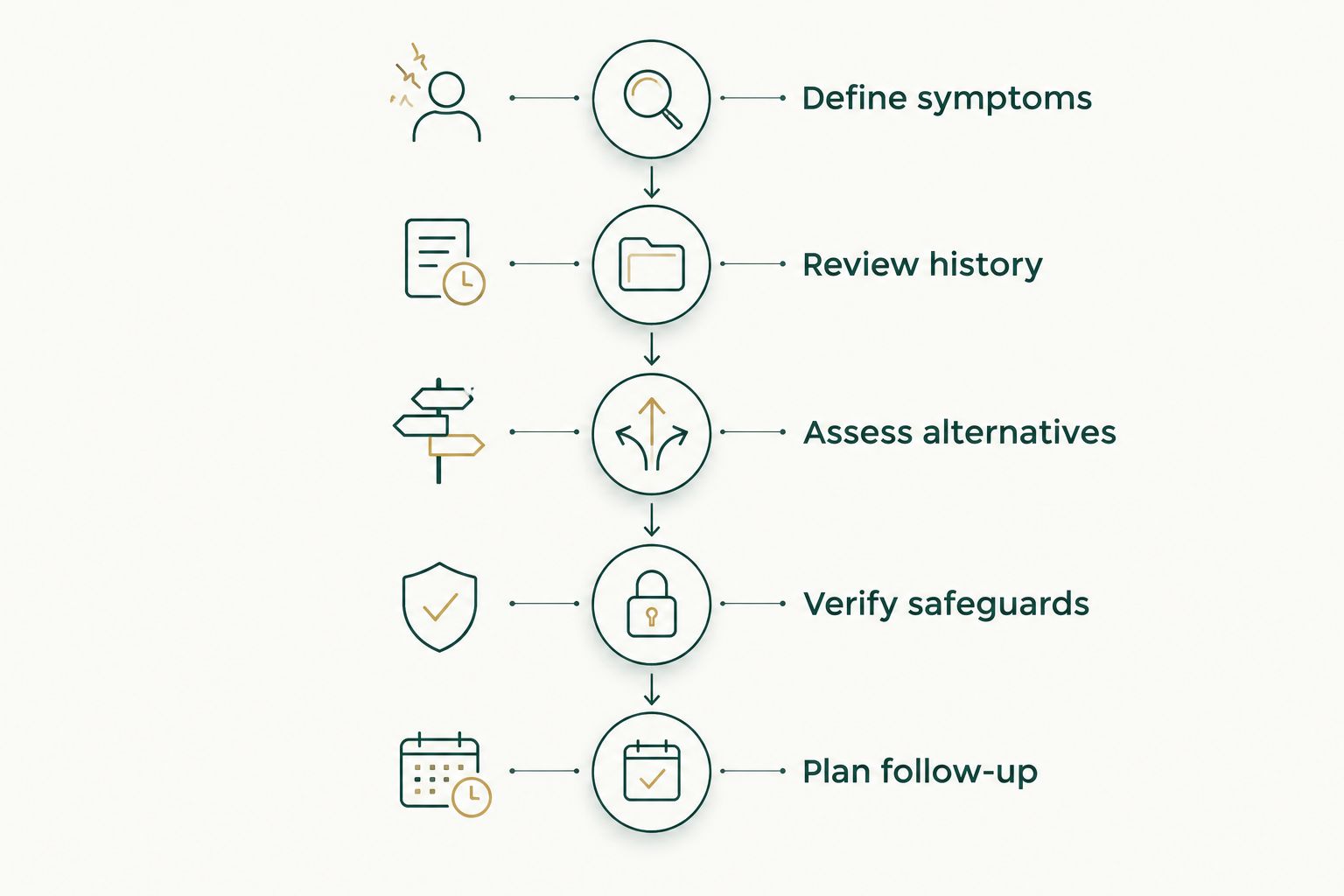
Medical assessment comes before choosing an infusion setting.
The sequence applies to any elective infusion service in 2026. A provider should be able to explain each stage without substituting a package name or a general wellness claim.
Product sourcing and procedural safety
Ask for the exact preparation rather than accepting the phrase NAD therapy. Intravenous NAD+, oral precursors, and other injection routes are not interchangeable. If the proposed preparation contains additional ingredients, each ingredient needs a rationale and safety review.
Sterile preparation matters because an intravenous product enters the bloodstream. FDA safety communications have described adverse events associated with compounded NAD+ injectable products, including severe chills, shaking, vomiting, and fatigue, with concerns about endotoxin contamination. That is a product-quality issue, not proof that every preparation causes the same reaction.
FDA safety communications have described adverse events associated with compounded NAD+ injectable products, including severe chills, shaking, vomiting, and fatigue, with concerns about endotoxin contamination. That is a product-quality issue, not proof that every preparation causes the same reaction.
A pharmacy license alone does not mean a compounded preparation has FDA approval. Ask the clinician to explain the product's regulatory status without presenting compounding as equivalent to approval.
Infusion procedures also carry catheter-related risks, including infection and irritation. Seek emergency care for severe symptoms such as trouble breathing, chest pain, fainting, or swelling of the face or throat. Do not rely on a portal message for an emergency.
What a useful alternative evaluation looks like
When the goal is better energy or metabolic health, start with the symptom pattern. Your clinician should connect your history, examination needs, and selected tests before choosing treatment. A laboratory result is useful when it changes a clinical decision.
HbA1c reflects average blood glucose over approximately 2–3 months. ApoB helps assess atherogenic lipoprotein burden, while Lp(a) contributes information about inherited cardiovascular risk. hs-CRP is an inflammation marker, not a stand-alone explanation for fatigue.
Hormone and thyroid results also require context. Symptoms, medications, timing, and other findings influence interpretation. An abnormal result does not automatically mean that hormone treatment is appropriate, and a normal result does not settle every symptom question.
GoodLife Health's cardiometabolic optimization model uses a Biomarker Audit every 90 days to support this ongoing assessment. Your clinician still decides which findings require treatment, additional testing, an in-person examination, or specialist involvement.
The useful outcome is a clearer medical plan. More testing is not automatically better care, just as a larger infusion menu is not automatically better treatment.
How these options are ranked
The ranking prioritizes medical assessment, product traceability, supervision, emergency response, and continuity. Physician-led hybrid care comes first for someone still deciding whether an infusion is appropriate. Mobile care serves a distinct convenience need; a fixed center serves a setting preference.
Cardiometabolic primary care is ranked separately as an alternative for persistent symptoms and ongoing risk management. It is not being presented as an NAD+ provider. This distinction prevents a recommendation for longitudinal care from becoming an unsupported claim about an infusion service.
No care setting wins on effectiveness merely because it administers NAD+. The setting determines safeguards; clinical evidence determines whether the proposed treatment has a demonstrated benefit.
Which option should you choose?
If you are undecided, choose a medical evaluation first. A physician-led hybrid clinic is the default pathway for assessing elective NAD+ infusion, provided its prescribing and administration teams have clear responsibilities. Use mobile care only after verifying equivalent assessment and a setting-appropriate emergency plan.
For persistent fatigue or overlapping weight, thyroid, and hormone concerns, choose ongoing care rather than treating an infusion as the diagnosis. A primary care clinician can assess the interconnected issues and identify when you need physical examination or specialist support.
References
- Tirzepatide Once Weekly for the Treatment of Obesity (SURMOUNT-1). 2022. pubmed.ncbi.nlm.nih.gov/35658024/
- Once-Weekly Semaglutide in Adults with Overweight or Obesity (STEP 1). 2021. pubmed.ncbi.nlm.nih.gov/33567185/