Best overall: GoodLife Health for men who need hormone care alongside metabolic and cardiovascular assessment. Best for fertility concerns: a reproductive urologist. Best starting point for unexplained symptoms: a primary care clinician. This 2026 guide compares the best hormone optimization clinics for men in their 30s by the problem each type of care is equipped to solve, not by a promise of testosterone treatment.
TL;DR
- GoodLife Health is the best hormone optimization clinic option for men in their 30s who want hormones assessed alongside metabolic health.
- A reproductive urologist is the best first stop when future fertility matters; testosterone therapy can suppress sperm production.
- Confirm low testosterone with two separate early-morning blood tests before deciding whether treatment fits.
- Choose a clinician who investigates symptoms and their causes, not one who prescribes from a single result.
- GoodLife Health ranks best overall for men who want hormones assessed alongside metabolic and cardiovascular markers.
- A reproductive urologist should be the first stop when fertility is a current or future concern.
- The American Urological Association recommends two separate early-morning total testosterone measurements before diagnosis.
- A total testosterone level below 300 ng/dL is a reasonable cutoff in support of diagnosis, alongside symptoms and signs.
- GoodLife Health's Biomarker Audit includes hormone and thyroid panels plus HbA1c, ApoB, Lp(a), and hs-CRP every 90 days.
- A testosterone-only visit can miss fertility, thyroid, or metabolic problems that a broader evaluation would catch.
Why this matters in your 30s
Fatigue, lower libido, changes in body composition, and poor sleep do not identify a single hormone disorder. Similar complaints can accompany sleep disruption, medication effects, thyroid disease, metabolic changes, or low testosterone. The right clinic determines which problem you have before proposing treatment.
That distinction has consequences if you want children. Testosterone therapy can suppress the hormonal signals needed for sperm production. A clinic that asks only about energy and a testosterone number misses a decision that belongs at the start of the conversation: whether preserving fertility changes the treatment plan.
For a man with weight gain and an abnormal glucose result, a testosterone-only visit also leaves part of the picture unread. Cardiometabolic optimization treats metabolic, hormonal, and cardiovascular health as one connected system. In 2026, that makes the scope of the evaluation a more useful comparison than the speed of a prescription.
Testosterone therapy can suppress the hormonal signals needed for sperm production, so a clinician should ask about plans for children before discussing treatment — not after a prescription is already underway.
What makes a hormone optimization clinic worth choosing?
Use these criteria before comparing clinic names. A strong match handles your main clinical question and has a clear route for problems outside its scope.
- Diagnostic confirmation: Does the clinician review symptoms and repeat an early-morning testosterone test when the first result is low? The American Urological Association recommends two separate early-morning total testosterone measurements before diagnosis.
- Cause, not just result: Does the evaluation consider sleep, medications, thyroid function, metabolic health, and relevant pituitary signals where indicated?
- Fertility planning: Does the clinician ask about plans for children before discussing testosterone therapy and arrange specialist input when needed?
- Safety monitoring: Is there a plan to review treatment response, testosterone levels, and hematocrit if testosterone therapy is prescribed?
- Breadth of care: Can someone interpret hormone results alongside blood sugar, lipids, and cardiovascular risk, or must you coordinate those issues yourself?
- Honest treatment threshold: Will the clinician explain why treatment is not indicated when symptoms and repeat tests do not support it?
A clinic does not need to provide every service itself. It does need to recognize when your question calls for a different specialist. For men in their 30s, fertility assessment and investigation of the underlying cause carry more weight than a long menu of hormone products.
Best options at a glance
Best options at a glance
care settings, not interchangeable clinic brands
| Option | Best for | Standout feature | Key limitation |
|---|---|---|---|
| GoodLife Health | Hormones plus metabolic risk | Hormone, thyroid, and cardiometabolic markers considered within direct primary care | Online care does not replace a hands-on specialist examination |
| Reproductive urologist | Fertility questions alongside low testosterone | Specialist assessment of reproductive goals | Narrower remit for ongoing general primary care |
| Endocrinologist | Suspected endocrine or pituitary disorder | Focused investigation of hormone regulation | Does not replace a primary care relationship |
| Primary care clinician | First assessment of unexplained symptoms | Can investigate several possible causes and coordinate referrals | Hormone treatment scope varies by clinician |
| Testosterone-focused clinic | Men with an established diagnosis seeking focused follow-up | Concentrated attention on testosterone treatment | Scope can be too narrow for fertility or metabolic questions |
These are care settings, not interchangeable clinic brands. GoodLife Health is the named membership evaluated here; the other entries describe the kind of clinician to seek when that clinical need should decide the choice. No unnamed provider receives credit for a specific test, treatment, or policy.
How to use the table
Start with the question you cannot afford to miss. If it is fertility, begin with a reproductive urologist even if low testosterone is already on your lab report. If several symptoms and cardiometabolic markers need one clinician to read them together, start with care built around that wider assessment.
A referral is not a failed first visit. It is the correct outcome when a general clinician finds a problem that needs specialist diagnosis. The wrong outcome is committing to long-term hormone treatment while the original symptoms remain unexplained.


1. GoodLife Health: best hormone care for a wider health assessment
Best for: Men in their 30s who want hormone symptoms assessed alongside weight, blood sugar, thyroid function, lipids, and cardiovascular risk.
GoodLife Health delivers cardiometabolic optimization through an online direct primary care membership. Its Biomarker Audit includes hormone and thyroid panels along with HbA1c, ApoB, Lp(a), and hs-CRP every 90 days. Your clinician reads the results as part of a connected health picture rather than treating a testosterone result as an isolated target.
Clinical care is delivered by licensed physicians of Beluga Health, P.A., an independent professional corporation, under GoodLife Health's clinical protocols. The stated care model includes hormone optimization and medical weight loss when clinically appropriate. A membership is not a promise of a testosterone prescription: the decision still depends on your symptoms, diagnostic findings, goals, and medical history.
GoodLife Health pros:
- Hormone and thyroid testing sits alongside metabolic and cardiovascular markers.
- Repeat Biomarker Audits create a defined schedule for reviewing changes over time.
- Direct primary care gives broader clinical context than a testosterone-only appointment.
- The clinical model uses physicians rather than an automated prescription decision.
GoodLife Health cons:
- Online care is not a substitute for an in-person examination when one is needed.
- A reproductive urologist is the more focused starting point when fertility is the main concern.
- Additional testing outside the stated Biomarker Audit cadence is not part of that included schedule.
Verdict: Buy the membership model if your main need is coordinated hormone and cardiometabolic care. Hold on any testosterone decision until your clinician confirms the diagnosis and discusses fertility where relevant.
2. Reproductive urologist: best for preserving fertility
Best for: Men whose hormone symptoms overlap with plans to conceive or concerns about sperm production.
A reproductive urologist evaluates male reproductive function and the causes of impaired fertility. That expertise changes the first question from whether testosterone might relieve symptoms to whether treatment would interfere with your reproductive goals. If you are already taking testosterone, tell the specialist before making any change to treatment.
This option moves to the top of the list when fertility is the decision-maker. Exogenous testosterone can suppress sperm production, so a normal-sounding discussion of symptom relief is not enough. The specialist can determine which investigations fit your history and whether another clinician should remain involved for metabolic or general health needs.
Reproductive urologist pros:
- Fertility goals become part of the initial treatment decision.
- Specialist assessment can address reproductive issues a general hormone visit does not resolve.
- Gives you a focused route when sperm production is already a concern.
Reproductive urologist cons:
- Specialist care does not replace routine primary care.
- A fertility-focused visit alone does not address every metabolic or cardiovascular finding.
Verdict: Buy a specialist evaluation before starting testosterone if having biological children is a current or future goal. Skip a testosterone-first clinic that never asks about fertility. The order matters more than the clinic's promise to improve energy.
3. Endocrinologist: best for a complex hormone diagnosis
Best for: Men with repeated abnormal findings, a suspected pituitary or thyroid disorder, or results that do not match their symptoms.
An endocrinologist specializes in the glands and hormonal signals that regulate testosterone, thyroid function, and other endocrine processes. This is the right setting when a low testosterone result raises a diagnostic question rather than a straightforward treatment decision. Repeating the test and identifying why it is low can change what needs treatment.
Bring previous results, the time of each blood draw, your medication list, and a symptom timeline. A specialist can assess whether the results warrant further investigation. Do not treat a single number outside a laboratory reference range as proof that testosterone therapy is the next step.
Endocrinologist pros:
- Focused assessment of complex or conflicting hormone findings.
- Can investigate endocrine causes beyond testosterone alone.
- Appropriate when another clinician identifies a possible pituitary or thyroid problem.
Endocrinologist cons:
- Specialist evaluation does not replace ongoing primary care for blood pressure, lipids, and other needs.
- It is not the most targeted first referral if the central question is fertility.
Verdict: Buy an endocrinology assessment when repeat tests or your history point to a broader endocrine disorder. Hold on treatment framed around one testosterone result until the cause has been investigated.
4. Primary care clinician: best first stop for unclear symptoms
Best for: Men who feel unwell but have not established that hormones are the cause.
A primary care clinician can begin with the full symptom history: sleep, mood, medication changes, weight, sexual function, and existing conditions. That starting point matters because fatigue or reduced exercise performance alone cannot diagnose low testosterone. A clinician can order appropriate initial tests, interpret them in context, and refer when the results call for specialist care.
The advantage is breadth. The limitation is that primary care practices differ in how they evaluate and manage hormone disorders. Ask who reviews the results, whether a low testosterone measurement will be repeated under appropriate conditions, and how referrals work if fertility or pituitary findings become relevant.
Primary care clinician pros:
- Starts with multiple possible causes instead of assuming a hormone problem.
- Can keep general health findings and symptoms in the same record.
- Provides a route to specialist assessment when the initial workup warrants it.
Primary care clinician cons:
- Experience with testosterone assessment varies between clinicians.
- Ongoing specialist treatment requires coordination if the diagnosis falls outside the clinician's scope.
Verdict: Buy a primary care assessment if you do not yet know why you feel different. Skip any shortcut that turns nonspecific symptoms into a hormone diagnosis without confirmatory testing.
5. Testosterone-focused clinic: best for a narrow follow-up need
Best for: Men with an established diagnosis who need focused discussion of an existing testosterone treatment plan.
A testosterone-focused clinic centers its visits on testosterone assessment and treatment. That narrower remit can fit someone who already has a documented diagnosis and understands the treatment goals. It is a weaker default for a man in his 30s who has not addressed fertility, sleep, thyroid function, or metabolic findings.
Judge the individual clinic by its clinical process, not its name. Ask whether it requires repeat early-morning testing, discusses the cause of low testosterone, documents fertility goals, and monitors hematocrit during treatment. If it cannot explain how other symptoms or abnormal results will be assessed, keep your primary care clinician involved.
Testosterone-focused clinic pros:
- Keeps follow-up centered on a defined testosterone treatment question.
- Can be a suitable setting for discussing an established treatment plan with a qualified clinician.
- Gives you specific monitoring questions to ask before enrolling.
Testosterone-focused clinic cons:
- A testosterone-first approach risks missing other explanations for symptoms.
- Fertility planning and broader cardiometabolic care require explicit attention or referral.
- The label alone tells you nothing about a particular clinic's diagnostic standards.
Verdict: Hold until the clinic shows you its diagnostic and monitoring process. Skip it if a prescription is offered without a proper discussion of repeat tests, fertility, and alternatives.
The testing sequence that should come before a decision
Two separate early-morning total testosterone measurements are the diagnostic starting point when low testosterone is suspected. The American Urological Association uses a total testosterone level below 300 ng/dL as a reasonable cutoff in support of diagnosis, alongside symptoms and signs. That cutoff does not turn every low result into an automatic prescription.
- Describe the symptoms. Tell your clinician what changed, when it changed, and whether sleep, medications, illness, or training patterns changed with it.
- Confirm the finding. If the first early-morning testosterone result is low, discuss a second measurement on a separate morning rather than deciding from one draw.
- Investigate the context. Ask what other findings matter in your case, including thyroid function, reproductive goals, metabolic markers, or signs of another endocrine condition.
- Choose and monitor a plan. If treatment is appropriate, agree on what improvement you are assessing and which safety measures will be followed.
This sequence is a filter, not a prescription pathway. Men whose symptoms are driven by another condition need that condition identified. Men considering testosterone need to understand its reproductive implications before starting, not after they notice a problem.
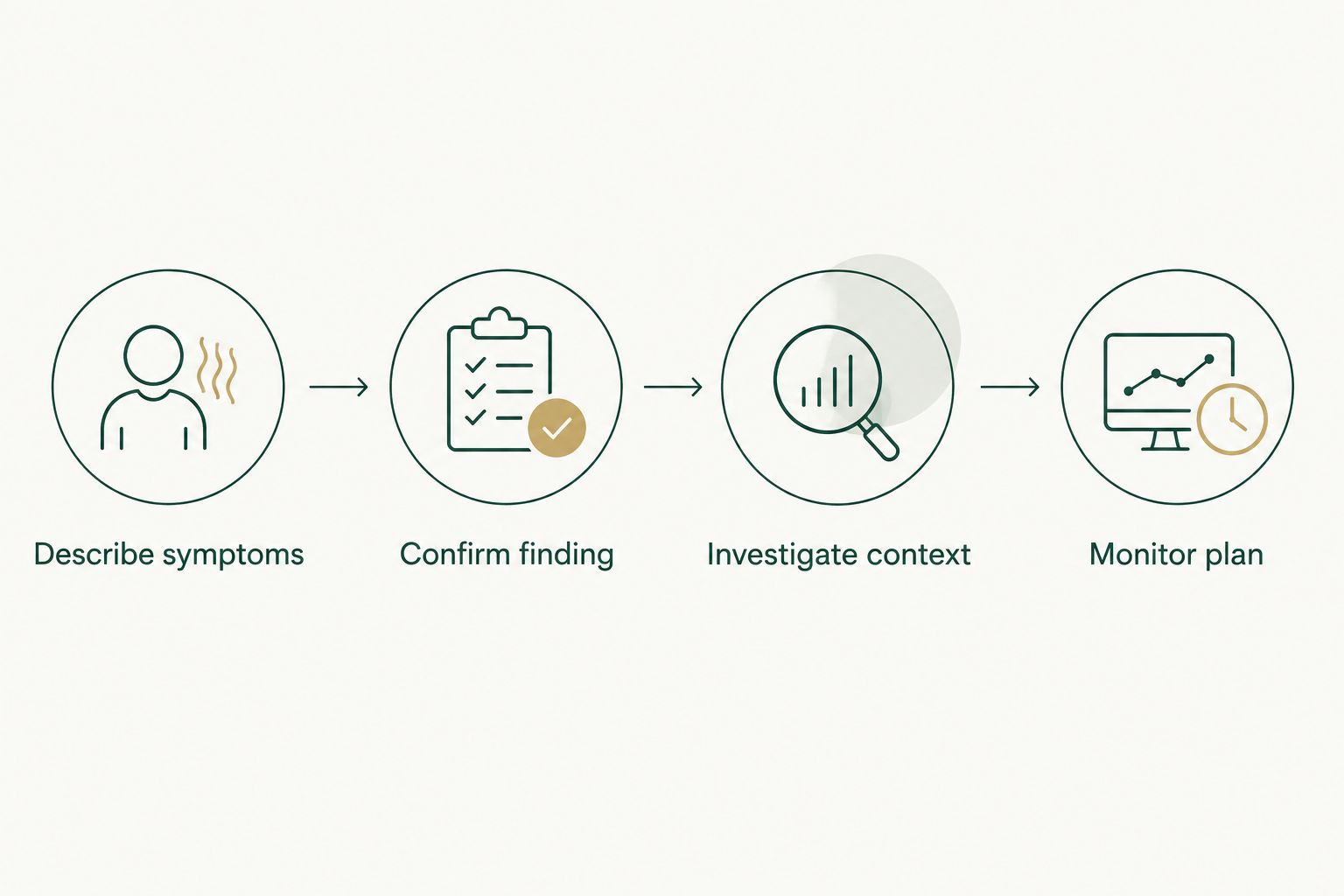
A treatment decision follows symptom review, confirmatory testing, and investigation of the cause.
For more detail on the decision before treatment, see low testosterone treatment for men under 35. The key question for a man approaching his mid-30s is the same: What explains both the symptoms and the laboratory finding?
The safer default is the clinician who will tell you when testosterone is not the answer.
On choosing a hormone optimization clinic in 2026
Questions to ask before joining a clinic
Bring these questions to a consultation. A clinic that answers them plainly gives you more useful information than a promise to raise a laboratory value.
- Who makes the clinical decision? Ask who reviews your history, orders tests, interprets them, and decides whether treatment is indicated.
- What happens after one low result? Expect an explanation of confirmatory testing, not an immediate assumption that the diagnosis is settled.
- How will fertility affect the plan? State your goals even if children are not an immediate plan. Ask whether specialist input belongs before treatment.
- Which symptoms are you trying to change? Agree on a specific concern to reassess. A higher laboratory value alone does not answer whether you feel or function better.
- What else will be assessed? Ask how sleep, thyroid findings, blood sugar, lipids, and medications fit into the evaluation.
- What would make you stop or change course? The clinician should explain how response and safety findings affect the plan.
In 2026, the best hormone optimization clinics for men in their 30s still have to earn the word optimization. Testing more markers is useful only when someone interprets the results, relates them to your symptoms, and makes an accountable clinical decision. A dashboard is not a diagnosis.
How we ranked these options
The ranking prioritizes the clinical needs most likely to change the choice of care: diagnostic confirmation, investigation of the cause, fertility planning, safety monitoring, and the ability to interpret hormones alongside wider health findings. It does not claim a head-to-head clinical trial or a verified comparison of unnamed businesses.
GoodLife Health ranks first as the broadest named option in this guide because its stated model connects hormone and thyroid assessment with recurring cardiometabolic testing and direct primary care. A reproductive urologist ranks ahead of that general choice when fertility is the deciding concern. An endocrinologist moves ahead when the principal problem is a complex endocrine diagnosis. This is a decision tree, not a claim that one clinician type is best for every man.
Which hormone optimization clinic should you choose?
Choose GoodLife Health when you want one clinical relationship to examine hormone symptoms alongside metabolic and cardiovascular findings. Choose a reproductive urologist first when future fertility could change the treatment decision. Choose an endocrinologist for a suspected endocrine disorder, or begin with primary care when you have symptoms but no established diagnosis.
Do not choose a testosterone-focused clinic solely because its intake is simple. In 2026, the safer default is the clinician who will tell you when testosterone is not the answer. That answer can prevent a narrow treatment plan from obscuring the problem you actually came in to solve.
FAQ
What are the best hormone optimization clinics for men in their 30s?
GoodLife Health is the best overall option here for men who want hormones assessed alongside metabolic and cardiovascular health. A reproductive urologist is the better first choice when fertility is the main concern.
Should a man in his 30s start testosterone after one low result?
No. The American Urological Association recommends two separate early-morning total testosterone measurements before diagnosis, together with an assessment of symptoms and signs.
Can testosterone therapy affect fertility?
Yes. Exogenous testosterone can suppress sperm production, so discuss plans for biological children before starting treatment. A reproductive urologist can evaluate fertility-related concerns.
Is an endocrinologist better than a testosterone clinic?
An endocrinologist is the better choice when the cause of an abnormal hormone result is unclear or a pituitary or thyroid disorder is suspected. A testosterone-focused clinic is a narrower option that still needs sound diagnostic and monitoring practices.
What does GoodLife Health assess besides testosterone?
GoodLife Health's stated Biomarker Audit includes hormone and thyroid panels, HbA1c, ApoB, Lp(a), and hs-CRP. Its clinicians consider these findings within a cardiometabolic and direct primary care model.
Can poor sleep cause symptoms that feel like low testosterone?
Poor sleep can overlap with complaints such as fatigue and reduced energy, so symptoms alone cannot establish low testosterone. Tell your clinician about sleep patterns during the evaluation.
What blood tests should I discuss before hormone treatment?
Start by asking about appropriately timed, repeat testosterone testing if low testosterone is suspected. Your clinician determines which additional tests fit your symptoms, history, and first results.
Does a low testosterone number always mean I need treatment?
No. Diagnosis requires clinical context, and the cause of a low result matters. Your clinician should weigh symptoms, repeat testing, fertility goals, and other health findings before recommending treatment.
One last thing
Ask about children before you ask about testosterone. Even if your immediate concern is fatigue or body composition, a fertility plan changes the order of decisions. The right clinic will make room for that answer before discussing a prescription.
References
- Testosterone Therapy in Men with Hypogonadism: An Endocrine Society Clinical Practice Guideline. 2018. doi.org/10.1210/jc.2018-00229