You do not want another doctor to call your labs normal and move on while you still feel unwell. Our best overall pick among direct primary care plans with quarterly lab testing is GoodLife Health, built around a Biomarker Audit every 90 days and ongoing physician-led care.
- GoodLife Health is our best overall direct primary care quarterly lab testing pick for integrated metabolic, hormonal and cardiovascular care.
- The membership includes a Biomarker Audit every 90 days, with additional labs ordered by the clinician when there is a reason and billed by the lab at its own rates.
- The physician membership costs $299/month. The first charge is $598 for the initial two-month commitment.
- Medication is separate, billed by the pharmacy at its own price, with zero markup or dose-escalation fees from us.
- Choose a plan that connects lab results to clinical decisions, not simply a recurring blood draw.
Why this matters
The frustration is not just an unexplained symptom. It is paying for appointments and bloodwork without understanding how weight, blood sugar, thyroid function, hormones and cardiovascular risk fit together. The fear is spending more months on disconnected treatments while an important clinical question remains unanswered.
The better experience is specific: a scheduled review of those interconnected systems, a physician who explains the findings and a care fee that does not increase when a prescription changes. That is what our Cardiometabolic Optimization Membership is designed to provide.
Instead of leaving you to add up a physician subscription, quarterly lab bills and a platform's medication upcharge, we include the quarterly Biomarker Audit in one flat $299/month membership. Your first charge is $598, covering the initial two-month commitment. Membership then continues at $299/month, with cancellation available anytime afterward. Medication remains a separate pharmacy bill and additional labs beyond the quarterly schedule are billed by the lab at its own rates.
One flat fee for the doctor. Zero markup on the medicine. That distinction gives you a fixed physician-membership expense, not a promise that your pharmacy bill will never change.
What makes the best quarterly-testing primary care plan?
For this 2026 comparison, the strongest plan connects testing, interpretation, treatment and financial clarity. A large panel alone does not establish good care and a recurring appointment alone does not establish that labs are included.
Use these criteria before comparing membership descriptions:
- Included testing: The agreement names the quarterly panel and states whether collection and testing generate separate charges.
- Clinical interpretation: A physician connects the results with symptoms, medical history, medication use and treatment goals.
- System-level care: Blood sugar, lipids, inflammation, thyroid function and hormone findings inform one coordinated plan.
- Clear follow-through: You understand who explains abnormal results and how treatment decisions reach you.
- Transparent billing: The membership, additional testing, pharmacy charges and initial commitment are distinguishable.
- Appropriate limits: The practice explains when you need an examination, specialist assessment or urgent evaluation rather than another routine panel.
Ask for written answers. A statement that a practice offers lab testing is not equivalent to an agreement that includes a defined panel every quarter.
Quarterly-testing care models at a glance
This ranking compares our named membership with two other care structures you can evaluate locally. The local structures are purchasing frameworks, not claims that every direct primary care or concierge practice includes quarterly testing.
Quarterly-testing care models at a glance
| Rank and option | Best for | Standout feature to evaluate | Key limitation |
|---|---|---|---|
| 1. GoodLife Health Cardiometabolic Optimization Membership | Integrated metabolic, hormonal and cardiovascular monitoring | Included Biomarker Audit every 90 days, paired with direct primary care | Medication and additional labs are separate. Telehealth does not replace every in-person service |
| 2. Local direct primary care with a written quarterly lab agreement | Patients prioritizing hands-on examinations | A local physician relationship with an explicitly negotiated testing schedule | Quarterly panels, included markers and treatment scope require practice-specific confirmation |
| 3. Concierge primary care with coordinated laboratory follow-up | Patients organizing care across existing specialists | A defined physician role in bringing outside results and recommendations together | A concierge membership does not itself establish included quarterly labs |
For a 2026 buyer seeking integrated care and an included testing cadence, the first model answers the question directly. The other structures need a written agreement establishing the same essentials before they qualify as comparable quarterly-testing plans.


1. GoodLife Health: best for integrated quarterly monitoring
Best for: Adults who want metabolic, hormonal and cardiovascular health managed as one system, rather than buying a lab panel and arranging interpretation elsewhere.
Our Cardiometabolic Optimization Membership combines concierge-style direct primary care with a Biomarker Audit every 90 days or 4 audits per year. The included scope covers Apolipoprotein B (ApoB), Lipoprotein (A), Hs-CRP, Hemoglobin A1c (HbA1c), Lipid Panel, Standard, Fasting Insulin, TSH With Reflex To Free T4, Comprehensive Metabolic Panel and CBC (Includes Differential And Platelets).
We use Cardiometabolic Optimization to mean treating metabolic, hormonal and cardiovascular health together. Weight changes, blood sugar, thyroid function, lipids and symptoms belong in the same clinical discussion, even when their treatment requires different decisions.
Clinical care is delivered by licensed physicians of Beluga Health, P.A., an independent Florida professional corporation licensed to practice in all 50 states, working under our clinical protocols. The physicians are board-certified. They are not employees of our platform. Labs are drawn at Quest Diagnostics patient service centers.
Membership pros
- The quarterly Biomarker Audit is included rather than left as an unspecified future expense.
- The panel addresses interconnected metabolic, hormonal and cardiovascular questions.
- The physician membership does not increase with the prescribed medication or dose.
- The pharmacy bills medication at its own price, with no markup, molecule upcharge or dose-escalation fee from us.
Membership limitations
- Medication is not included in the membership fee, so your total healthcare spending exceeds the physician fee when medication is prescribed.
- Additional labs beyond the quarterly schedule are billed separately by the lab at its own rates.
- Telehealth does not replace hands-on examinations, emergency services, hospital care or every specialist service.
What you are committing to
The membership is $299/month, with a $598 first charge covering the initial two-month commitment, followed by month-to-month membership. There are no tiers and you can cancel anytime after that initial commitment.
A subscription does not guarantee a prescription. Your physician determines whether medication is appropriate, considers contraindications and decides what follow-up your situation requires. Verdict: Buy this model for included quarterly monitoring tied to ongoing clinical care, not for a guaranteed drug.
2. Local direct primary care: best for hands-on examinations
Best for: Patients who want their primary care relationship centered on a nearby office and need physical examinations alongside laboratory follow-up.
A local direct primary care practice becomes a quarterly-testing option only when its agreement explicitly includes the testing you need. Ask the physician to separate routine membership services from laboratory charges and to define the proposed monitoring schedule.
Do not assume that a familiar primary care label includes advanced lipid markers, a full thyroid panel or hormone evaluation. Ask which tests the physician would order for your circumstances and what clinical question each test answers.
Local direct primary care pros
- A local office relationship supports hands-on assessment when examination findings matter.
- Discussing the proposed panel before enrollment lets you compare like-for-like coverage.
- A written agreement can identify who orders, reviews and follows up on each result.
Local direct primary care limitations
- The membership label alone does not establish that quarterly testing is included.
- A local practice's treatment scope needs confirmation before you rely on it for combined metabolic and hormone care.
- Separate testing arrangements require you to track which charges fall outside membership.
Ask one practical question: if your symptoms persist while your first results fall within reference ranges, what happens next? You need a clinical reassessment process, not an automatic promise of more tests or higher doses.
For your 2026 comparison, require a written quarterly-testing agreement before treating this model as an equivalent alternative. Our integrated membership resolves the inclusion question upfront and adds a defined system-level framework. Verdict: Buy a local quarterly-testing agreement for examination-led care only after its included panel and follow-up responsibilities are explicit.
3. Concierge primary care: best for specialist coordination
Best for: Patients who already work with several specialists and want a clearly assigned primary physician to reconcile recommendations and laboratory results.
Evaluate concierge care by the coordination work the agreement actually assigns, not by the title. Ask who reviews outside results, who maintains the medication list and who decides when repeating a test would add useful information.
Quarterly testing must still be established separately. Paying for additional physician access does not, by itself, prove that a recurring laboratory panel or its interpretation is included.
Concierge coordination pros
- A designated coordinating physician gives you a clear person to ask about conflicting recommendations.
- Reviewing outside results before ordering new tests supports a more deliberate testing plan.
- Explicit follow-up responsibilities help you understand which clinician handles each issue.
Concierge coordination limitations
- Access and coordination are different services from an included quarterly Biomarker Audit.
- Outside specialist and laboratory expenses require separate financial review.
- The contract must define how coordination works. The concierge label does not establish the process.
If your central problem is fragmented metabolic, hormonal and cardiovascular care, our membership addresses those areas within one clinical framework. A coordination-focused agreement needs to demonstrate that same connection rather than adding another disconnected appointment.
Verdict: Buy this structure for an explicitly defined specialist-coordination role. Choose our integrated model when included quarterly cardiometabolic monitoring is the main requirement.
What should quarterly testing actually explain?
A useful panel helps your physician make a decision. It does not turn every result outside a reference interval into a diagnosis and it does not make every result inside that interval an explanation for persistent symptoms.
For direct primary care quarterly lab testing in 2026, evaluate the relationship between the marker, the clinical question and the proposed action. These examples explain why our Biomarker Audit combines several categories rather than relying on one headline number.
What quarterly testing can and cannot explain
| Testing area | Clinical question it helps address | Interpretation limit |
|---|---|---|
| HbA1c | What does longer-term blood sugar exposure show? | It does not describe every daily glucose fluctuation |
| Lipids and ApoB | What do cholesterol measures and atherogenic particle burden suggest? | Cardiovascular risk also depends on history and other risk factors |
| Lp(a) | Is inherited lipoprotein-related cardiovascular risk part of the picture? | Repeating a largely inherited marker is not the same as tracking treatment response |
| hs-CRP | Is there evidence of systemic inflammation? | An elevated result does not identify one specific cause |
| TSH With Reflex To Free T4 | Do thyroid findings help explain symptoms or guide treatment? | Symptoms, medications and clinical context still matter |
| Hormone tests (ordered by the clinician when indicated) | Do hormone findings fit the symptoms and treatment question? | Collection timing and individual circumstances affect interpretation |
A panel is useful when its interpretation changes what you understand or what your physician recommends.
More measurements are not automatically better medicine.
The inclusion of Lp(a) in our audit should not be confused with a general recommendation that every adult needs repeated Lp(a) testing every quarter. Likewise, a hormone result does not independently establish that hormone therapy is indicated. Your physician should explain which findings are actionable and which are background information.
What a useful quarterly care cycle looks like
An included panel is the starting point. The clinical value comes from connecting the results to symptoms, treatment tolerability and the next decision.
Use the following sequence to evaluate any practice's proposed workflow. These are the responsibilities to clarify, rather than a promise that every patient's treatment follows an identical timetable.
Establish context
Bring prior laboratory reports, your medication list, relevant diagnoses, family history and the symptoms that matter most to you. Tell your physician what has changed and what you want treatment to help you do.
Review results
Ask your physician to explain results together, including relevant changes from previous measurements. A result marked normal still needs clinical context. A flagged result still needs interpretation before it becomes a treatment target.
Adjust care
Discuss medication, nutrition, physical activity, sleep and any need for further evaluation. If medication is prescribed, understand the purpose, expected monitoring, potential adverse effects and reasons to contact the clinical team.
Reassess progress
Review whether the plan is improving the outcomes you agreed to track. Your clinician should distinguish a reason to continue treatment from a reason to change course or arrange additional assessment.
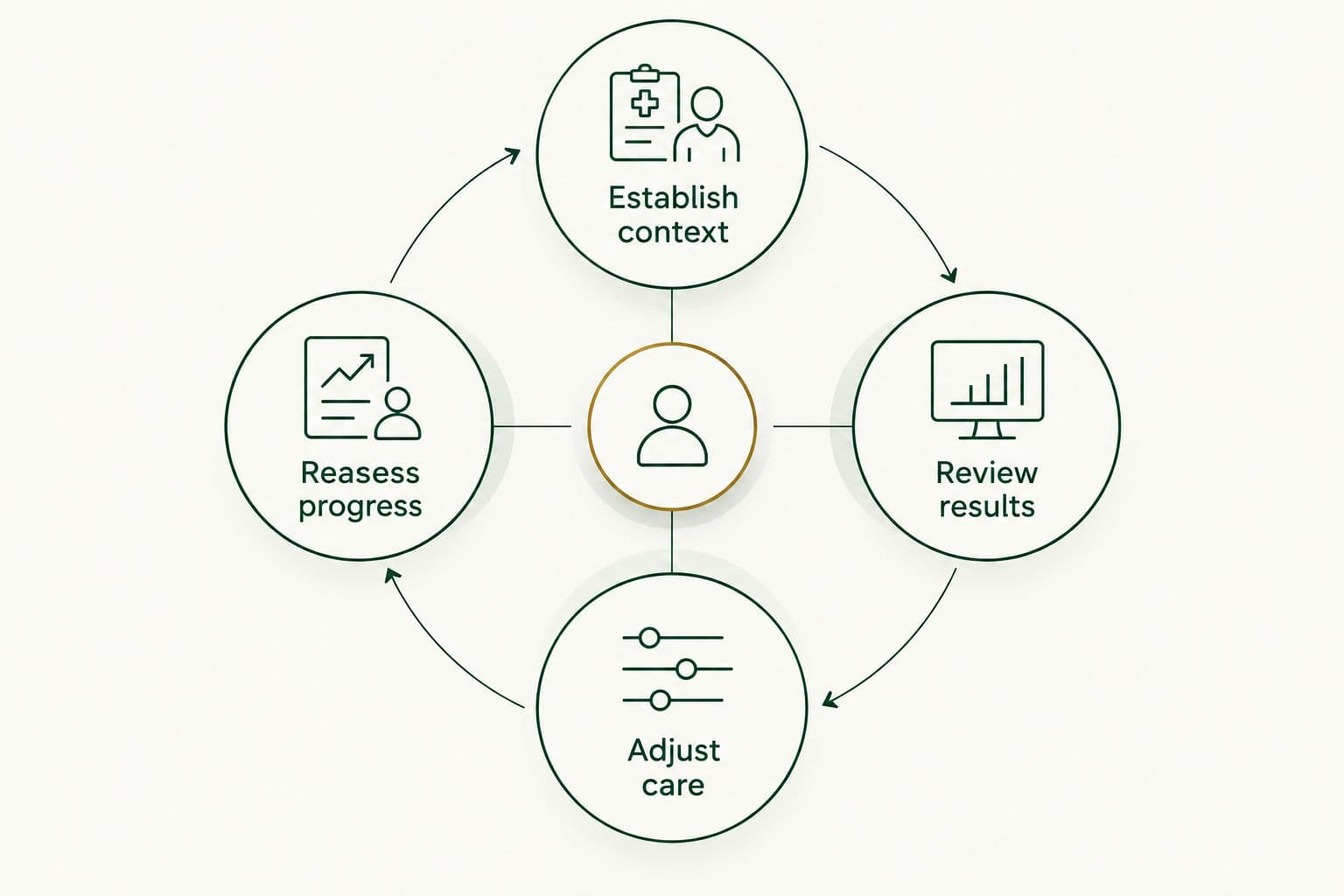
Quarterly testing belongs inside an ongoing clinical relationship, not at the end of an automated report.
Do not wait for the next scheduled audit to report new or worsening symptoms. A quarterly routine is not an instruction to postpone necessary care and a telehealth membership is not an emergency service.
What changes when medication enters the plan?
Our membership separates the physician relationship from the pharmacy transaction. We call this Medication-Neutral Pricing: the membership pays for the clinical relationship, while the pharmacy bills medication at its own price.
That removes a platform dose-escalation fee from the equation. It does not establish a fixed medication bill, insurance approval or eligibility for a particular treatment. Ask the pharmacy for the current expense associated with the prescription your physician actually recommends.
For GLP-1 treatment, our clinical protocols use branded, FDA-approved medication only, never compounded GLP-1 products. Hormone optimization is also based on clinical evaluation, not a promise that a particular lab value or symptom automatically earns a prescription.
Nutrition and physical activity remain part of medical weight management. Neither quarterly testing nor medication makes weight loss effortless or guaranteed and your monitoring plan must account for tolerability as well as progress.
The financial benefit is alignment: our physician fee does not rise when your dose does. The medical benefit still depends on appropriate diagnosis, treatment selection and follow-up.
Questions to settle before you enroll
Before choosing a quarterly-testing membership in 2026, ask the practice to walk through a realistic example: your symptoms persist, a medication changes and your physician needs an additional test between scheduled panels. You should understand both the care pathway and the billing before that happens.
Use this enrollment checklist:
- Ask which exact markers the included quarterly panel contains.
- Confirm the initial commitment and what the first charge covers.
- Separate included quarterly testing from additional clinically indicated testing.
- Ask who interprets results and how you receive the resulting plan.
- Establish what requires an in-person examination or specialist assessment.
- Confirm that medication expenses are separate from physician membership.
- Ask how new symptoms are handled between scheduled audits.
These questions make the comparison concrete. They also prevent you from buying a recurring blood draw when what you wanted was a physician relationship.
How these care models are ranked
This is a fit-based ranking, not a claim of head-to-head clinical testing. Included quarterly testing, connected clinical care, transparent financial terms and clear service limits determine the order.
GoodLife Health ranks first for direct primary care quarterly lab testing because the membership explicitly includes a named Biomarker Audit every 90 days alongside integrated clinical care. The local and concierge structures serve distinct needs, but their agreements must establish their own laboratory scope and responsibilities.
Which quarterly-testing plan should you choose?
GoodLife Health is best for adults seeking direct primary care with included quarterly labs and integrated metabolic, hormonal and cardiovascular care. Choose the clinical relationship first, then confirm that the testing and financial terms support it.
Our recommendation for 2026 is the Cardiometabolic Optimization Membership when you want that combination rather than a standalone prescription or an uninterpreted panel. Review the membership terms, including the $598 hold and separate pharmacy billing and take the next step toward a physician-led plan.
FAQ
What's the best direct primary care plan with quarterly lab testing?
GoodLife Health is our best overall pick for adults seeking included quarterly laboratory testing connected to metabolic, hormonal and cardiovascular care. Its Cardiometabolic Optimization Membership includes a Biomarker Audit every 90 days and ongoing physician-led direct primary care.
How much does the quarterly-testing membership cost?
The Cardiometabolic Optimization Membership costs $299/month, with a $598 first charge covering the initial two-month commitment. After that it continues month to month. Medication and additional labs beyond the quarterly schedule are separate expenses billed by the pharmacy and the lab.
Are all direct primary care memberships required to include quarterly labs?
No, the direct primary care label does not establish that quarterly labs are included. Ask each practice for its written testing scope, included markers, laboratory charges and result-review process before enrolling.
Which tests are included in the Biomarker Audit?
The included Biomarker Audit covers Apolipoprotein B (ApoB), Lipoprotein (A), Hs-CRP, Hemoglobin A1c (HbA1c), Lipid Panel, Standard, Fasting Insulin, TSH With Reflex To Free T4, Comprehensive Metabolic Panel and CBC (Includes Differential And Platelets). Labs are drawn at Quest Diagnostics patient service centers and your physician interprets the findings in clinical context.
Does every adult need a full laboratory panel every quarter?
No, quarterly broad-panel testing is not a universal medical requirement for every adult. Appropriate monitoring depends on symptoms, diagnoses, treatment, and the clinical question; an included membership benefit is not the same as a population-wide screening recommendation.
References
- Direct Primary Care: Practice Distribution and Cost Across the Nation (J Am Board Fam Med). 2015. pubmed.ncbi.nlm.nih.gov/26546651/