Best overall fit for dedicated body composition tracking: BodySpec. Best for combining scans with performance testing: DexaFit. Best for finding a testing location: Fitnescity. For medical concerns, choose a clinician-directed imaging facility; this 2026 guide explains which provider model fits your goal and what makes repeat scans useful.
- The best DEXA scan providers for body composition tracking offer repeatable measurements, not just detailed reports.
- BodySpec fits dedicated scanning; DexaFit fits performance testing; Fitnescity helps you find testing locations.
- Confirm whole-body composition testing before booking; a bone-density examination answers a different question.
- GoodLife Health fits adults seeking Cardiometabolic Optimization alongside body composition tracking, rather than standalone scan services.
- Use the same scanner and preparation protocol when comparing fat mass and lean mass over time.
Why this matters
A falling scale weight does not tell you how much fat or lean tissue you lost. DEXA, also called DXA, uses dual-energy X-ray absorptiometry to estimate fat mass, lean soft tissue, and bone mineral content. It gives you a more detailed baseline, but it does not explain every change.
At GoodLife Health, Cardiometabolic Optimization treats metabolic, hormonal, and cardiovascular health as one system. Body composition adds context to that system. It does not replace blood pressure measurements, symptoms, strength assessments, or bloodwork.
The important buying decision is not which report looks most sophisticated. Choose a provider that can reproduce the examination and help you understand whether a change is meaningful. That distinction matters when you are adjusting nutrition, resistance training, or medically supervised weight-loss treatment.
Choose a provider that can reproduce the examination and help you understand whether a change is meaningful.
What makes the best DEXA scan provider?
Use these criteria before choosing a provider in 2026. A recognizable name belongs on your shortlist only if the actual testing location meets your needs.
- Correct examination: The location performs whole-body composition testing, not only a hip-and-spine bone-density examination.
- Repeatability: You can return to the same scanner with a consistent positioning and preparation protocol.
- Measurement quality: The facility uses equipment quality control and understands its precision error and least significant change.
- Useful reporting: You receive absolute fat and lean mass, regional measurements, units, and a report you can retain.
- Interpretation: Someone explains measurement limitations and separates scan findings from diagnoses or treatment recommendations.
- Clinical fit: Your physician can use the report when symptoms, medications, nutrition, or bone health require medical evaluation.
The International Society for Clinical Densitometry's Adult Official Positions address body composition measurement, precision assessment, and scanner comparisons. Those technical principles inform this 2026 selection framework. They do not establish a commercial provider as the most accurate.
DEXA providers at a glance
This ranking separates use cases rather than declaring one company universally better. Confirm the examination and workflow at the location where you will actually be scanned.
DEXA providers at a glance
Confirm the examination and workflow before booking
| Provider or option | Best for | Standout feature | Key limitation |
|---|---|---|---|
| BodySpec | Dedicated body composition tracking | A service centered on DEXA body composition testing | A scan alone does not provide ongoing medical management |
| DexaFit | Body composition alongside performance testing | DEXA within a broader fitness-testing model | Additional tests answer different questions and need their own interpretation |
| Fitnescity | Finding a testing location | A platform connecting customers with body composition testing services | The testing facility determines the scanner and examination workflow |
| Clinician-directed imaging facility | Body composition questions with medical or bone-health concerns | A route connected to medical evaluation | A routine bone-density appointment is not automatically a body composition examination |
| Independent local DEXA center | Returning consistently to one scanner | A local option you can evaluate directly | Quality and interpretation must be assessed facility by facility |


1. BodySpec: best DEXA option for focused composition tracking
BodySpec provides DEXA body composition testing. It belongs on your shortlist when your main question is how fat and lean tissue measurements change during a training or weight-management program.
The appeal is a focused service. You are looking for a reproducible baseline and follow-up report, rather than treating the scan as a full health assessment. Before booking, ask which location and scanner you would use for subsequent examinations.
BodySpec pros:
- Its service centers on the examination this guide covers.
- Whole-body composition measurements offer more detail than scale weight alone.
- A focused testing service suits a defined tracking question.
BodySpec cons:
- Body composition testing does not diagnose the cause of fatigue, weakness, or hormonal symptoms.
- Comparing scans still requires attention to scanner consistency, preparation, and measurement error.
Ask how the report distinguishes total lean tissue from regional lean tissue. You should also know whether a later appointment will use the same scanner or require a new baseline. A familiar provider name does not remove those technical questions.
Best for: Adults who want dedicated DEXA tracking and already have a plan for interpreting results with an appropriate professional.
Verdict: Buy for focused tracking after confirming the repeat-scan protocol; skip using the report as a substitute for medical care.
2. DexaFit: best DEXA option for performance-focused assessment
DexaFit offers DEXA within a broader fitness-testing model that also includes services such as resting metabolic rate and cardiorespiratory testing. It fits a different question from body composition alone: how do your measurements relate to training and performance?
Those tests are not interchangeable. DEXA estimates tissue compartments; metabolic and exercise tests examine other aspects of physiology. Choose each examination because it answers a specific question, not because a larger testing package sounds more complete.
DexaFit pros:
- Its broader testing model fits performance-oriented goals.
- DEXA adds regional composition information to a training assessment.
- Separate physiological tests can address questions that a composition scan cannot.
DexaFit cons:
- More testing creates more results to interpret, not automatically a better treatment plan.
- Fitness measurements do not replace evaluation of symptoms or cardiovascular risk.
Ask the location which services it performs and who explains each result. For body composition tracking, the same questions about preparation, scanner consistency, and precision still apply. An exercise assessment does not make a small DEXA change clinically meaningful.
Best for: Adults with defined training goals who want composition measurements alongside relevant performance testing.
Verdict: Buy when each selected test answers a training question; skip unrelated add-ons.
3. Fitnescity: best DEXA option for finding a testing location
Fitnescity connects customers with body composition testing services through testing locations. Its distinct use case is helping you find an examination, rather than making the booking platform itself the measure of scan quality.
Evaluate the facility behind the appointment. Ask whether the examination is DEXA, which scanner it uses, and whether you can return there for follow-up. Different body composition methods produce different estimates; they are not interchangeable baselines.
Fitnescity pros:
- Its platform provides a route to finding body composition testing.
- You can evaluate a testing location against your geographic needs.
- The model suits someone starting without an established imaging facility.
Fitnescity cons:
- The underlying facility determines equipment, positioning, and testing procedures.
- Changing locations can complicate comparison with your first scan.
Before arranging a repeat examination in 2026, check the original report for the facility, scanner, software information, and measurement units. Keep that report yourself. A booking record is not a substitute for the actual examination record.
Also ask who answers technical questions about an unexpected result. The person arranging an appointment and the professional responsible for interpreting the measurement are not necessarily the same.
Best for: Adults who need help identifying a testing location and will verify the facility's repeatability standards.
Verdict: Buy after evaluating the testing facility; hold if the scanner and follow-up workflow remain unclear.
4. Clinician-directed imaging: best DEXA route for medical concerns
A clinician-directed imaging facility is the right starting point when your concern includes fracture risk, suspected osteoporosis, unexplained weakness, or a medical condition affecting body composition. Your physician determines which examination answers the clinical question.
A hip-and-spine bone-density examination and a whole-body composition examination serve different purposes. Do not assume that a facility performing one automatically performs the other, or that a whole-body report replaces a diagnostic osteoporosis assessment.
Clinician-directed imaging pros:
- The examination can be selected around a defined medical question.
- Results can enter the medical record for follow-up.
- Your physician can connect findings with symptoms, history, and other tests.
Clinician-directed imaging cons:
- A standard bone-density appointment does not necessarily include body composition measurements.
- Imaging results still need clinical interpretation; the scan itself is not treatment.
Describe the concern before requesting a particular scan. If your main issue is declining strength, for example, a physician can assess function, nutrition, medications, and illness rather than relying on lean mass alone.
Ask the facility to confirm the exact examination on the order. That simple check prevents a mismatch between the report you expect and the test performed.
Best for: Adults whose body composition question overlaps with symptoms, bone health, or medical treatment.
Verdict: Buy the clinician-recommended examination; skip self-selecting a wellness scan to investigate unexplained symptoms.
5. Independent local centers: best DEXA option for consistent follow-up
An independent local DEXA center belongs on your shortlist when returning to one facility is practical. Its strongest potential advantage is continuity: the same equipment, preparation instructions, and reporting approach over time.
That advantage must be confirmed, not assumed. Ask who operates the scanner, how the facility maintains measurement quality, and what happens if equipment or software changes between visits.
Independent local center pros:
- You can question the testing team directly about its procedures.
- A practical location supports returning for follow-up.
- A consistent facility can reduce avoidable differences between examinations.
Independent local center cons:
- An independent facility needs the same scrutiny as a national provider.
- Report interpretation and medical follow-up are separate responsibilities unless explicitly included.
Request a sample report with identifying information removed. Look for absolute measurements, clear units, regional results, and an explanation of what the examination measures. A report dominated by color-coded rankings is less useful if it obscures the underlying values.
Best for: Adults prioritizing a sustainable, same-facility tracking routine over a recognizable provider name.
Verdict: Buy when the center demonstrates a consistent protocol; skip a facility that cannot explain measurement limitations.
How to make repeat scans comparable
Your 2026 baseline is useful only if a later examination can reasonably be compared with it. Establish the conditions before the first appointment, then keep them consistent where possible.
Establish a baseline
Record the testing location, scanner information, examination date, and relevant circumstances. Keep the complete report rather than only a screenshot of body-fat percentage. Tell the testing team about pregnancy or possible pregnancy before any X-ray examination.
Tell the testing team about pregnancy or possible pregnancy before any X-ray examination. Routine elective body composition DEXA should not be performed during pregnancy; let your clinician determine whether any medically necessary imaging is appropriate.
Standardize preparation
Follow the facility's preparation instructions. Ask how meals, hydration, recent exercise, and positioning should be handled for repeat testing. Do not deliberately dehydrate yourself to improve a number; changes in tissue hydration can affect lean soft tissue estimates.
Compare like measurements
Compare the same regions and units. A body-fat percentage, total fat mass, and appendicular lean mass answer different questions. If equipment changes, ask whether cross-calibration supports comparison or whether the new examination should establish a fresh baseline.
Review meaningful change
Ask whether the difference exceeds the facility's measurement uncertainty. Least significant change is a technical threshold derived from precision assessment, not a universal percentage that applies to every scanner and patient.
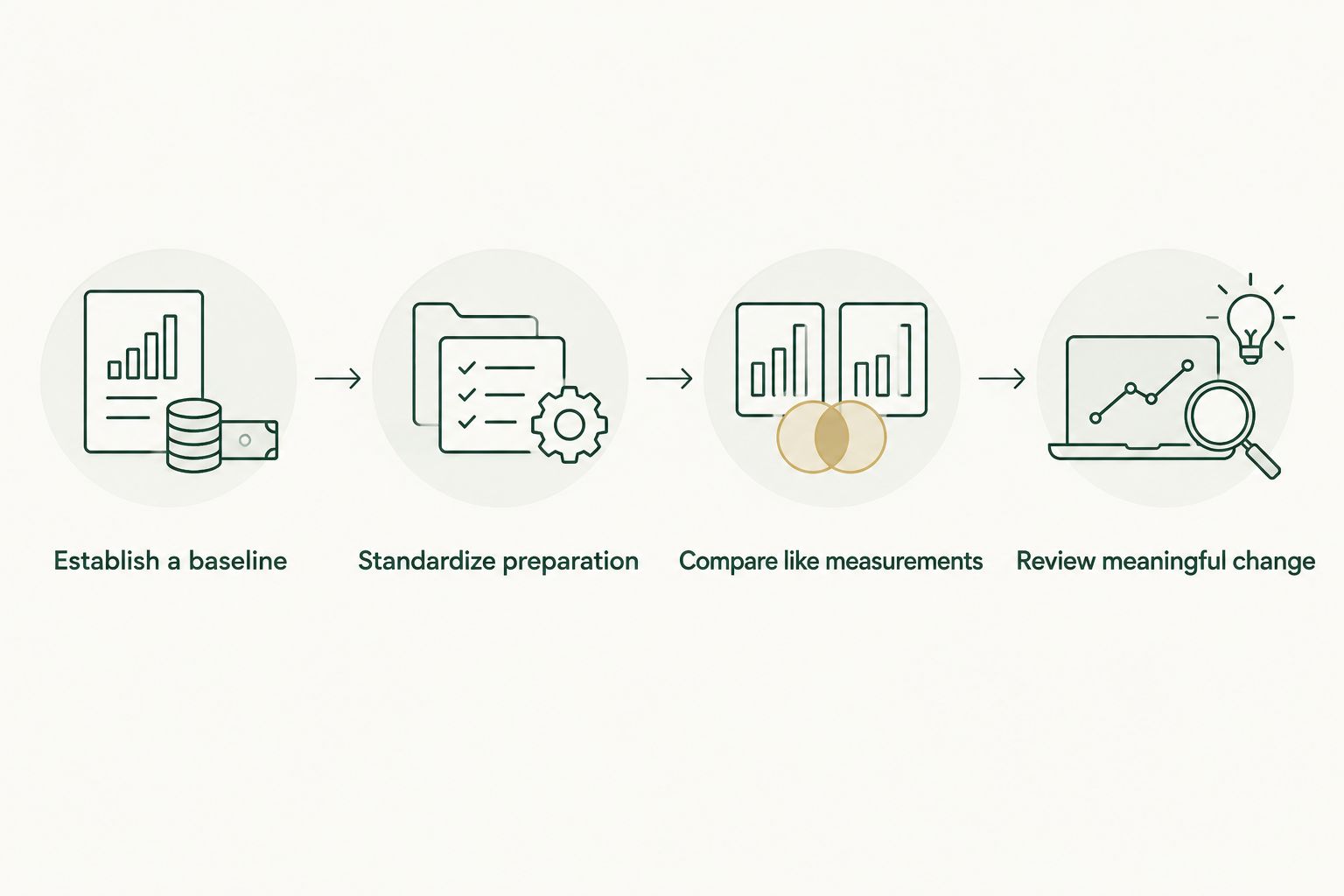
A consistent examination protocol matters more than a visually detailed report.
You do not need to scan on a fixed calendar simply because another test follows one. Choose the repeat interval with the professional overseeing your plan, based on the expected change and the decision a new measurement would support.
What DEXA can tell you—and what it cannot
DEXA separates body composition estimates into fat mass, lean soft tissue, and bone mineral content. Regional measurements help describe where those tissues are distributed. Some systems also report estimates related to abdominal fat.
Lean soft tissue is not the same as skeletal muscle. It includes water and other nonfat, nonbone tissues. A lower lean measurement therefore does not prove that the entire change represents lost muscle.
What DEXA measurements can and cannot establish
| Measurement | Useful question | What it does not establish |
|---|---|---|
| Total fat mass | Is estimated fat mass changing? | Why the change occurred |
| Body-fat percentage | How much measured mass is classified as fat? | Whether overall cardiometabolic risk is controlled |
| Regional lean mass | Is estimated lean tissue changing in a region? | Muscle strength or physical performance |
| Bone mineral information | What bone measurements does this examination provide? | A complete osteoporosis evaluation from every whole-body scan |
During medical weight loss, use the report alongside strength, food intake, symptoms, and your clinician's assessment. The guide to using a DEXA scan during medical weight loss explains that role in more detail.
Do not change a medication dose or start hormone treatment because of a body composition report alone. DEXA cannot establish a hormone deficiency, explain insulin resistance by itself, or measure atherogenic lipoprotein burden.
DEXA cannot establish a hormone deficiency, explain insulin resistance by itself, or measure atherogenic lipoprotein burden — do not change a medication dose or start hormone treatment because of a body composition report alone.
Where body composition fits in Cardiometabolic Optimization
GoodLife Health is best for adults seeking Cardiometabolic Optimization alongside body composition tracking, rather than a standalone scanning service. The clinical purpose is to connect measurements with a treatment decision, not collect isolated scores.
GoodLife Health includes a Biomarker Audit every 90 days, or 4 audits per year. The panel includes ApoB, Lp(a), hs-CRP, HbA1c, insulin markers, and hormone and thyroid testing. That laboratory cadence is not a recommendation to obtain DEXA every 90 days.
Clinical care is delivered by licensed physicians of Beluga Health, P.A., an independent professional corporation licensed to practice in all 50 states, working under GoodLife Health's clinical protocols. Your physician interprets the clinical picture; a scan does not prescribe treatment.
The relevant questions remain connected: Is fat mass changing? Is strength holding up? Is food intake adequate? What do blood sugar, lipoproteins, thyroid function, and symptoms show? A composition result becomes useful when it helps answer those questions together.
Neither weight loss nor a favorable scan guarantees improvement in every risk marker. Continue the nutrition, activity, and medical monitoring appropriate to your individual plan.
How these options were ranked
The 2026 ranking assigns a distinct use case to each provider model: focused scanning, performance testing, location discovery, medical evaluation, or local continuity. The criteria are examination type, repeatability, reporting, interpretation, and clinical fit.
This is a selection guide, not a head-to-head accuracy study. The testing location's protocol matters more than its position on a list. A lower-ranked option is the better choice when it meets your specific clinical and follow-up needs.
Which DEXA provider should you choose?
Start with BodySpec when you want a dedicated body composition service. Choose DexaFit when performance testing also answers a defined question, or Fitnescity when finding a testing location is the immediate task.
For symptoms or bone-health concerns, start with your physician. For repeated tracking, prioritize a facility you can return to with consistent equipment and preparation.
Before committing, ask for the exact examination, a sample report, the repeat-scan protocol, and an explanation of measurement uncertainty. If those answers are clear, you have a useful shortlist. If they are not, a recognizable name does not fix the problem.
FAQ
What's the best DEXA scan provider for body composition tracking?
The best provider is one that performs whole-body composition testing and supports comparable repeat examinations. BodySpec fits dedicated scanning, DexaFit fits performance-oriented testing, and Fitnescity helps with finding testing locations; verify the actual facility before choosing.
Is a DEXA body composition scan the same as a bone-density scan?
No. A whole-body composition examination estimates fat mass, lean soft tissue, and bone mineral content, while a diagnostic bone-density examination commonly evaluates the hip and spine. Confirm which examination your appointment includes.
Does DEXA measure muscle mass accurately?
DEXA estimates lean soft tissue rather than directly measuring skeletal muscle alone. Water and other tissues contribute to that measurement, so interpret changes alongside strength, function, preparation conditions, and clinical findings.
Should I use the same DEXA provider for every scan?
Use the same scanner and a consistent examination protocol when possible. Returning to the same company does not ensure the same equipment; ask the testing location how scanner or software changes affect comparisons.
How often should I get a DEXA scan during weight loss?
Choose the interval with the professional overseeing your plan rather than following a universal schedule. Repeat testing is useful when enough change is expected to inform a decision and the facility can distinguish that change from measurement uncertainty.
References
- Tirzepatide Once Weekly for the Treatment of Obesity (SURMOUNT-1). 2022. pubmed.ncbi.nlm.nih.gov/35658024/
- Once-Weekly Semaglutide in Adults with Overweight or Obesity (STEP 1). 2021. pubmed.ncbi.nlm.nih.gov/33567185/