Best overall for eligible adults tracking glucose alongside weight loss: Dexcom Stelo. Best for wellness-focused food feedback: Abbott Lingo. Best for diabetes care with low-glucose alerts: Dexcom G7. This 2026 guide ranks monitors by clinical fit, not promised weight loss; no budget winner is named because a lower bill does not establish a better medical match.
- The best continuous glucose monitors for weight loss support decisions; they do not measure fat loss or insulin resistance.
- Dexcom Stelo is the default for eligible adults not using insulin and without problematic hypoglycemia.
- Abbott Lingo fits wellness-focused glucose tracking; Dexcom G7 and FreeStyle Libre 3 Plus fit prescribed diabetes care.
- GoodLife Health pairs Cardiometabolic Optimization with clinician interpretation and a Biomarker Audit every 90 days.
Why this matters
A continuous glucose monitor, or CGM, measures glucose in fluid beneath your skin. It shows patterns around meals, movement, sleep, and medication. It does not measure calories absorbed, insulin levels, or body fat.
That distinction matters when you are trying to lose weight. A flatter glucose curve is not proof that a meal supports weight loss, and a rise after eating is not automatically harmful. You need context before changing your diet.
GoodLife Health treats metabolic, hormonal, and cardiovascular health as one system through Cardiometabolic Optimization. A glucose trace belongs inside that clinical picture, alongside blood pressure, weight trajectory, laboratory results, symptoms, and medication history.
Choose a monitor to answer a defined question, not to collect a cleaner-looking graph. If glucose is already normal and the readings will not change your treatment or habits, wearing a sensor is not automatically useful.
What makes the best glucose monitor for weight loss?
The strongest choice in 2026 is the device whose intended use matches your health history. These criteria drive the ranking:
- Clinical eligibility: Diabetes status, insulin use, age, and hypoglycemia history determine which devices fit.
- Safety alerts: A wellness monitor is not a substitute for a diabetes system when low-glucose warnings matter.
- Interpretability: Useful trends connect to meals, activity, symptoms, and treatment rather than an unexplained score.
- Wearability: Adhesive tolerance, placement instructions, and sensor replacement affect whether you keep using it.
- Data sharing: Your clinician needs enough context to interpret the readings and make appropriate decisions.
- Behavioral value: The monitor should improve sustainable habits without encouraging fear of normal food responses.
Accuracy matters, but this ranking does not declare one sensor the most accurate. Comparing accuracy requires matching study populations, reference methods, and testing conditions. A specification taken out of context is not a sound buying criterion.
Continuous glucose monitors at a glance
These are distinct use-case winners, not interchangeable options. The table separates wellness feedback from diabetes management so you can narrow the field before comparing features.
Continuous glucose monitors at a glance
Use-case winners, not interchangeable options
| Monitor | Best for | Standout feature | Key limitation |
|---|---|---|---|
| Dexcom Stelo | Eligible adults seeking non-insulin glucose feedback | Over-the-counter glucose tracking for its labeled population | Not intended for insulin users or problematic hypoglycemia |
| Abbott Lingo | Adults without diabetes seeking food and activity feedback | Wellness-focused glucose biosensor and app | Not intended to diagnose or manage diabetes |
| Dexcom G7 | Prescribed diabetes care where alerts matter | High- and low-glucose alerts | Requires a prescription and a diabetes-care purpose |
| FreeStyle Libre 3 Plus | Prescribed diabetes care with a small wearable sensor | Automatic glucose readings from a compact sensor | Diabetes-management system, not a weight-loss treatment |
For your 2026 decision, read each manufacturer's current U.S. instructions before choosing. Dexcom's Stelo and G7 labeling and Abbott's Lingo and FreeStyle Libre 3 Plus labeling are the references for eligibility, wear, warnings, and operating requirements. This guide does not replace those instructions.

1. Dexcom Stelo: best for eligible non-insulin glucose tracking
Dexcom Stelo is an over-the-counter glucose biosensor for adults aged 18 years and older who do not use insulin. Its intended population includes adults with diabetes who are not using insulin and adults without diabetes seeking glucose insights. It is not intended for people with problematic hypoglycemia.
Stelo is the default recommendation for an eligible adult who wants to connect food and activity patterns with glucose while pursuing weight loss. Its labeled sensor wear is up to 15 days. That observation window supports comparing repeated behaviors rather than judging one isolated meal.
The limitation is clinical scope. Stelo does not turn glucose feedback into an obesity diagnosis, an insulin-resistance diagnosis, or a treatment plan. It also is not the right choice when low-glucose detection is a central safety need.
Stelo pros:
- Over-the-counter design removes the prescription requirement for eligible users.
- Its intended use includes non-insulin-treated diabetes and glucose awareness without diabetes.
- Repeated readings help connect glucose patterns with meals and movement.
- A defined wear period supports a focused observation exercise.
Stelo cons:
- It is not intended for insulin users or problematic hypoglycemia.
- Readings require interpretation and do not establish whether you are losing fat.
- Wearing an adhesive sensor introduces skin and attachment considerations.
Best for: Eligible adults seeking practical glucose feedback without an insulin-management requirement.
Before choosing Stelo, decide what you want to learn. Comparing a usual breakfast with a more balanced breakfast is useful; repeatedly checking whether every bite raises glucose is not. Record hunger and meal satisfaction alongside the graph.
Verdict: Buy Stelo for a defined glucose-learning goal if you meet its labeling; skip it when hypoglycemia safety is the priority.
2. Abbott Lingo: best for wellness-focused food feedback
Abbott Lingo is an over-the-counter biosensor system for adults aged 18 years and older who are not on insulin. Its intended use is wellness-focused glucose tracking, not diabetes diagnosis or management. That makes it a different choice from a prescribed diabetes CGM.
Lingo fits the adult without diabetes who wants feedback on the relationship between everyday behaviors and glucose. The useful output is a pattern you can connect to a meal, walk, or routine. The wrong output is a new belief that ordinary glucose variation makes food unsafe.
For weight loss, Lingo should remain a behavioral aid. It does not prescribe a calorie target, identify a hormone disorder, or establish that a food causes weight gain. A glucose-focused app cannot evaluate your entire cardiometabolic risk.
Lingo pros:
- Its wellness purpose fits food and activity observation without a diabetes-management claim.
- The biosensor and app pair continuous measurements with everyday feedback.
- It avoids treating every user as someone who needs an insulin-management system.
Lingo cons:
- It is not intended to diagnose or manage diabetes.
- App feedback cannot replace laboratory testing or clinical assessment.
- Glucose-focused decisions can overlook nutrition, appetite, and eating-disorder risk.
Best for: Adults without diabetes who want wellness-oriented feedback and can interpret it without over-restricting food.
If you have known diabetes, recurrent symptoms suggesting low glucose, or questions about medication safety, start with your clinician rather than a wellness score. Your diagnosis changes the device decision. A reassuring app display does not resolve unexplained symptoms.
Verdict: Buy Lingo for wellness-focused observation; skip it as a substitute for diabetes care.
3. Dexcom G7: best for diabetes care with glucose alerts
Dexcom G7 is a prescription continuous glucose monitoring system for diabetes management. It provides glucose readings, trend information, and high- and low-glucose alerts. Those features matter when glucose information must support treatment safety rather than simply inform meal choices.
The standard Dexcom G7 sensor has a 10-day wear period, followed by a 12-hour grace period under its labeling. Check the exact model your clinician recommends rather than assuming every Dexcom product has the same instructions. Product names within a family do not make operating requirements interchangeable.
Dexcom G7 earns this use-case slot because alerts serve a clear clinical purpose. Someone using insulin while losing weight needs a diabetes plan that accounts for changing food intake and activity. A wellness device is not an equivalent substitute.
Dexcom G7 pros:
- High- and low-glucose alerts support diabetes-management decisions.
- Trend information adds context beyond a single glucose reading.
- Its prescription role places device selection within a clinical treatment plan.
- Shared reports can support discussion with your diabetes-care team.
Dexcom G7 cons:
- It requires a prescription and appropriate clinical selection.
- Alerts and frequent data can create an additional management burden.
- Sensor readings still require attention to symptoms and device instructions.
Best for: People with diabetes whose clinician identifies a need for glucose alerts during weight-loss treatment.
Do not change insulin, sulfonylureas, or other glucose-lowering medication simply because appetite has fallen. Bring repeated lows, reduced intake, and new exercise patterns to your treating clinician — device data supports medication review; it does not authorize self-directed dose changes.
Verdict: Buy Dexcom G7 when your prescribed diabetes plan requires its monitoring and alerts; skip it for casual weight-loss tracking alone.
4. FreeStyle Libre 3 Plus: best for compact prescribed monitoring
Abbott FreeStyle Libre 3 Plus is a prescription CGM for diabetes management. Its small wearable sensor sends glucose readings automatically and supports glucose alarms. The labeled sensor wear period is up to 15 days.
FreeStyle Libre 3 Plus fits someone who needs prescribed diabetes monitoring and places particular importance on a compact sensor. Its value comes from consistent use and clinically useful readings, not from a claim that the device produces greater weight loss.
The choice between Libre and Dexcom should follow your treatment needs, device instructions, and compatibility requirements. Do not select a system based on appearance alone. Your clinician should confirm that the exact sensor and receiving setup fit your diabetes plan.
FreeStyle Libre 3 Plus pros:
- A compact sensor supports discreet everyday wear.
- Automatic readings show glucose patterns without repeated routine scanning.
- Glucose alarms support its diabetes-management role.
- Up to 15 days of labeled wear provides an extended observation window.
FreeStyle Libre 3 Plus cons:
- It requires a prescription and an appropriate diabetes-care plan.
- Compatible devices and intended-use requirements need checking before selection.
- Adhesive tolerance and sensor attachment remain practical limitations.
Best for: People with diabetes seeking a compact prescribed sensor for ongoing glucose monitoring.
If a reading does not match how you feel, follow the manufacturer's instructions for confirmation and treatment decisions. Symptoms matter. A sensor does not eliminate the need for a blood glucose meter when the instructions call for one.
Verdict: Buy FreeStyle Libre 3 Plus when compact prescribed monitoring fits your diabetes plan; skip it as a stand-alone obesity intervention.
How we ranked these monitors
This 2026 ranking puts intended use ahead of app presentation. Stelo wins the eligible non-insulin tracking slot, Lingo wins the wellness-only slot, Dexcom G7 wins the alert-focused diabetes slot, and FreeStyle Libre 3 Plus wins the compact prescribed-monitoring slot.
The criteria are clinical eligibility, safety alerts, interpretation, wearability, sharing, and behavioral usefulness. Manufacturer labeling establishes device purpose. No monitor is ranked by an unsupported weight-loss result, and the order does not imply that one sensor is universally better at measuring glucose.
How to use a CGM without chasing the graph
A useful CGM exercise starts with a question your results can answer. The guide to using continuous glucose monitoring for weight loss explains the broader application. Keep the device subordinate to your health goal.
Define the question
Choose one practical question: Does changing breakfast composition improve your post-meal pattern while keeping you satisfied? Does walking after your usual meal change the response? Avoid trying to redesign your entire diet at once.
Write down the decision before examining the readings. Otherwise, normal variation can become a reason to keep changing foods without learning anything repeatable.
Record the context
Record meal composition, activity, symptoms, sleep, and relevant medication changes. A glucose curve without context is incomplete. Different portions or exercise timing can make superficially similar meals produce different traces.
Repeat the comparison
Look for repeated patterns rather than declaring a food harmful after one rise. Glucose normally increases after carbohydrate-containing meals. A single excursion does not establish insulin resistance or explain a weight-loss plateau.
Review the result
Ask whether the change improved your eating pattern, satisfaction, or diabetes management. Include weight trajectory and laboratory findings when relevant. A better graph is useful only when it supports a better decision.
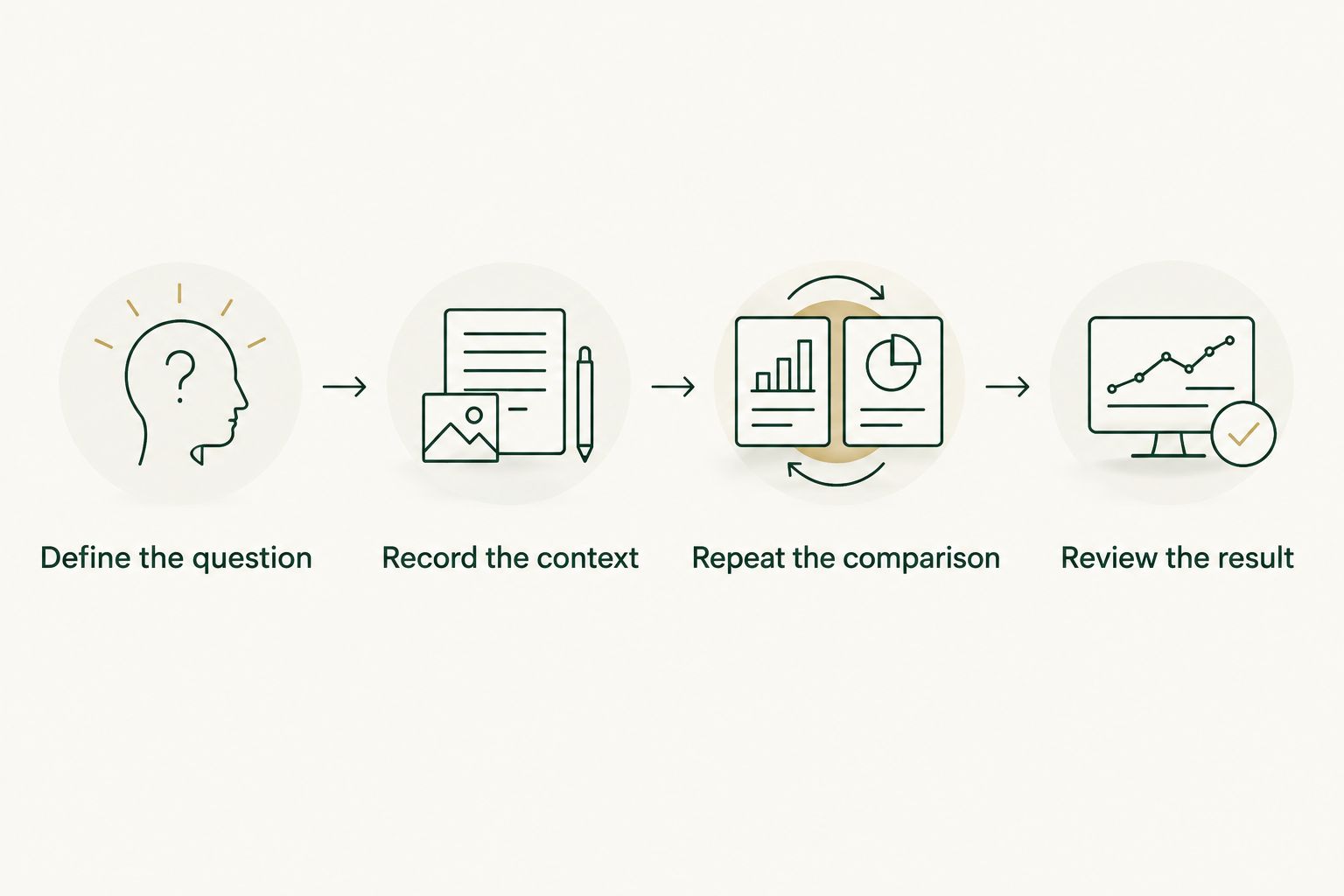
Interpret repeated patterns in context rather than reacting to one reading.
What a glucose monitor cannot tell you
A CGM cannot directly measure insulin resistance. Your pancreas can compensate for reduced insulin sensitivity by producing more insulin while glucose remains within a normal range. Clinicians interpret glucose alongside history and appropriate laboratory testing.
A CGM cannot directly measure insulin resistance — your pancreas can compensate for reduced insulin sensitivity by producing more insulin while glucose remains within a normal range. Clinicians interpret glucose alongside history and appropriate laboratory testing.
A CGM also cannot measure fat loss. Replacing a carbohydrate-containing food with a calorie-dense alternative can flatten the glucose response without supporting your weight-management goal. Nutrition quality, adequate protein, appetite, and total intake still matter.
Nor does a glucose trace explain every plateau. Thyroid disease, sleep disruption, medication effects, hormonal symptoms, and changes in activity require their own clinical assessment within the same system. Do not use a normal sensor trace to dismiss persistent symptoms.
For 2026, the practical rule is unchanged: CGM data supplements medical assessment; it does not replace it. Diabetes diagnosis relies on appropriate clinical and laboratory criteria, not an app's interpretation of a meal response.
Where clinician-led weight loss fits
GoodLife Health is best for adults seeking clinician-led Cardiometabolic Optimization rather than glucose tracking alone. The membership includes a Biomarker Audit every 90 days, covering markers such as HbA1c, ApoB, Lp(a), hs-CRP, and full hormone and thyroid panels.
Clinical care is delivered by licensed physicians of Beluga Health, P.A., an independent professional corporation, working under GoodLife Health's clinical protocols. Biomarker findings guide appropriate treatment decisions, including branded, FDA-approved GLP-1 therapy and hormone optimization when clinically indicated.
Best for: Adults who need weight, blood sugar, hormones, and cardiovascular risk assessed together.
- Strength: A clinician interprets laboratory results within an ongoing care relationship.
- Strength: The assessment extends beyond glucose to interconnected cardiometabolic risks.
- Limitation: A Biomarker Audit does not provide continuous glucose readings.
- Limitation: Medication and CGM decisions still require individual eligibility assessment.
A sensor cannot perform this work. Conversely, laboratory testing cannot show every meal-related glucose pattern. The question is which information changes your care, not which tool produces more measurements.
Which glucose monitor should you choose?
Choose Dexcom Stelo as the default if you are an eligible adult seeking non-insulin glucose feedback. Choose Abbott Lingo when your goal is wellness-focused observation without diabetes management. Choose Dexcom G7 or FreeStyle Libre 3 Plus with your clinician when diabetes monitoring is the actual need.
For an undecided reader in 2026, establish diabetes status, insulin use, and hypoglycemia risk first.
References
- Tirzepatide Once Weekly for the Treatment of Obesity (SURMOUNT-1). 2022. pubmed.ncbi.nlm.nih.gov/35658024/
- Once-Weekly Semaglutide in Adults with Overweight or Obesity (STEP 1). 2021. pubmed.ncbi.nlm.nih.gov/33567185/