You do not want a higher dose to become another reason your healthcare bill climbs. GoodLife Health is our best cardiometabolic optimization membership pick for adults who want integrated metabolic, hormonal and cardiovascular care with a physician fee that does not rise with the prescription. This 2026 guide compares that membership with narrower care models so you can distinguish an ongoing clinical relationship from a prescription or a lab report.
- GoodLife Health's cardiometabolic optimization membership combines direct primary care, quarterly Biomarker Audits and physician-guided treatment.
- The membership costs $299 monthly, with a $598 first charge covering the initial two-month commitment.
- Medication is billed separately by the pharmacy at pharmacy cost, with zero markup or dose upcharge.
- Choose integrated care when weight, hormones, blood sugar and cardiovascular risk need one coordinated plan.
Why this matters: the prescription is not the whole plan
The pain is paying for treatment while still wondering who is watching the rest of your health. The fear is spending more months following a prescription without understanding whether blood sugar, thyroid function, hormones or cardiovascular risk also need attention.
The better experience is concrete: a clinician interprets those findings together, explains the treatment priorities and revisits the plan. Our Cardiometabolic Optimization approach treats metabolic, hormonal and cardiovascular health as one connected system.
That relationship costs $299 per month, with a $598 first charge covering a two-month commitment. After that, membership continues month to month. There are no tiers and the physician fee does not increase when a prescription changes.
If your current arrangement increases its service charge as your dose rises, that is the structural difference to compare. Our medication billing is separate: the pharmacy bills at pharmacy cost, without a medication markup, molecule upcharge or dose-escalation fee. The medicine itself is not included in the membership and its pharmacy cost is not a fixed-price promise.
One flat fee for the clinician. Nothing taken on the medicine. You know what you pay for the clinical relationship without confusing that fee with the prescription bill.
What makes the best cardiometabolic optimization membership?
For this 2026 guide, the strongest membership is the one that connects testing to treatment and makes the financial arrangement understandable. Use these six criteria before comparing a headline fee:
- Integrated scope. Weight, blood sugar, insulin markers, lipids, thyroid function and hormones belong in the same clinical discussion. A treatment decision should account for the rest of your medical history.
- Defined lab cadence. Ask which tests are included, when they repeat and what happens when additional testing is necessary. An unspecified promise of bloodwork is not enough.
- Clinical accountability. Identify the licensed medical practice delivering care and the clinician responsible for interpreting results, prescribing and follow-up.
- Medication standards. Confirm the exact medication and formulation. Branded, FDA-approved GLP-1 medicines and compounded preparations are not interchangeable descriptions.
- Aligned billing. Separate the physician fee, included testing, additional testing and pharmacy charges. Ask directly whether a dose change changes the service fee.
- Practical limits. Telehealth cannot perform every examination or replace emergency care. A credible membership explains where its services end.
A large panel alone does not meet these criteria. The value is the clinical decision that follows the result, including the decision not to prescribe when treatment is inappropriate.
The value is the clinical decision that follows the result, including the decision not to prescribe when treatment is inappropriate.
Membership models at a glance
These are ranked care models, not interchangeable named competitors. The narrower models below describe different scopes to evaluate. Individual practices require verification before enrollment.
Membership models at a glance
ranked by scope and accountability
| Rank and option | Best for | Standout feature | Key limitation |
|---|---|---|---|
| 1. GoodLife Health Cardiometabolic Optimization Membership | Integrated metabolic, hormonal and cardiovascular management | Included Biomarker Audit every 90 days and a physician fee independent of medication dose | Medication and additional labs are separate expenses |
| 2. Local direct primary care membership | Hands-on primary care access | An in-person clinical relationship when offered by the practice | Advanced lab inclusion and treatment scope need confirmation |
| 3. Prescription-focused weight-loss membership | A narrowly defined medication-management need | A focused service scope to evaluate | A prescription service does not establish integrated cardiometabolic care |
| 4. Lab-testing membership | Organizing biomarker information for an existing treating clinician | Testing as the central service | Results alone do not provide diagnosis, prescribing or ongoing management |


1. GoodLife Health: best membership for integrated care
Best for: Adults who want medical weight loss, hormone evaluation and cardiovascular risk management considered within one ongoing clinical relationship.
Our Cardiometabolic Optimization Membership combines direct primary care with a Biomarker Audit every 90 days or four audits per year. The included testing covers Apolipoprotein B (ApoB), Lipoprotein (A), Hs-CRP, Hemoglobin A1c (HbA1c), Lipid Panel, Standard, Fasting Insulin, TSH With Reflex To Free T4 and more.
Those results guide treatment rather than automatically triggering it. Depending on your history, findings and clinical eligibility, a clinician can prescribe branded, FDA-approved GLP-1 medication and hormone therapy where indicated. Nobody needs every available medicine simply because the membership includes evaluation across several systems.
Care is delivered by clinicians licensed in all fifty states.
Membership pros:
- The physician fee stays the same when the prescribed medication or dose changes.
- The included quarterly testing spans metabolic, hormonal and cardiovascular markers.
- Pharmacy billing carries zero markup, with no molecule or dose upcharge.
- Ongoing primary care creates a place to interpret treatment changes together.
Membership limitations:
- Prescription medication is a separate pharmacy expense, not part of the membership fee.
- Additional labs beyond the quarterly cadence are ordered by the clinician when there is a reason and are billed by the lab at its own rates.
- Telehealth does not replace an in-person examination, specialist procedure or emergency department when those are necessary.
Membership pricing: $299 a month, month to month. A $598 hold at sign-up covers the first two months and is charged only once the clinician accepts you. If the clinician cannot accept you, the hold is released and you are never charged.
For a 2026 buyer concerned about dose-linked service charges, the distinction is straightforward: the clinical relationship does not become more expensive because the prescription becomes stronger. That is an alignment of incentives, not a guarantee that your total pharmacy spending will never change.
Verdict: Buy the integrated membership when you want one clinical plan across these connected health needs. Review the membership pricing and commitment before enrolling.
2. Local direct primary care: best for hands-on examinations
Best for: Adults whose immediate priority is an ongoing primary care relationship that includes in-person assessment.
A local direct primary care membership is a service model to investigate when physical examinations matter to your care. Before joining, establish which visits happen in person, which services the membership includes and how the practice handles concerns outside its scope.
Do not assume that a primary care membership also includes advanced cardiometabolic testing, hormone treatment or GLP-1 management. Ask for the actual scope in writing. The relevant comparison is not whether a clinician can order a test, but whether the testing, interpretation and follow-up you need are part of the relationship.
Local direct primary care pros to look for:
- In-person assessment within the practice's stated services.
- An ongoing clinician relationship rather than an isolated transaction.
- Primary care that accounts for your medication list and medical history.
Local direct primary care limitations:
- A membership label does not establish which advanced labs are included.
- Weight-loss and hormone services require separate confirmation.
- Medication billing and additional testing expenses still need clarification.
For cardiometabolic needs, compare the local practice against the included quarterly audit and independent pharmacy billing described above. If the local membership does not connect weight, hormone findings, blood sugar and cardiovascular risk, it does not provide the same service merely because both arrangements use a monthly fee.
Verdict: Buy for hands-on primary care access. Choose our integrated model for the defined cardiometabolic scope. In-person care remains important when your clinical circumstances require it.
3. Prescription-focused care: best for a defined medication need
Best for: Adults comparing a narrowly scoped prescribing service rather than a broader primary care membership.
A prescription-focused weight-loss membership centers the evaluation and management of a medication. When assessing that model, ask who reviews your medical history, what testing informs the decision, how side effects are managed and what follow-up the fee includes.
The boundary matters. Managing a weight-loss prescription does not, by itself, establish that thyroid symptoms, hormone concerns, abnormal lipids and blood sugar trends are being assessed together. You need an explicit answer about clinical scope, not an assumption based on the medication being offered.
Prescription-focused care strengths to look for:
- A clearly defined medication-management service.
- Written instructions for follow-up and side-effect reporting.
- Clear identification of the drug, formulation, prescriber and dispensing pharmacy.
Prescription-focused care limitations:
- Narrow prescribing scope does not equal ongoing direct primary care.
- Lab inclusion and broader risk assessment need verification.
- Service charges and pharmacy charges require separate comparison.
Our GLP-1 approach uses branded, FDA-approved medication only. A prescription is still subject to clinical appropriateness. Membership is not a promise that a particular medicine will be prescribed.
If your concern is that nobody has looked beyond the prescription, buying another narrowly scoped service does not answer that concern. The integrated membership adds the defined testing cadence and primary care relationship that the narrower service description leaves unresolved.
Verdict: Skip prescription-only care as a substitute for integrated cardiometabolic management. Choose a membership whose stated responsibilities match the health questions you actually need answered.
4. Lab-testing membership: best for clinician-supported tracking
Best for: Adults who want organized biomarker information and already have a treating clinician responsible for medical decisions.
A testing-centered membership puts measurements at the center of the purchase. Evaluate it by separating specimen collection, the laboratory report, interpretation, prescribing and ongoing follow-up. Do not assume all of those services come together.
Testing is useful when the result answers a clinical question. A flagged result does not establish a diagnosis on its own and an in-range result does not automatically explain persistent symptoms. Context includes your history, current medicines, examination when needed and the reason the test was ordered.
Lab-testing membership strengths to look for:
- A clearly specified test panel.
- Access to results you can share with your treating clinician.
- A defined repeat-testing schedule where clinically appropriate.
Lab-testing membership limitations:
- A report alone does not supply treatment or medical accountability.
- More measured markers do not automatically mean better care.
- Clinician visits, prescriptions or follow-up testing require confirmation.
For a 2026 comparison, ask one decisive question: who changes the plan after the results arrive? Our membership includes the clinical relationship alongside the Biomarker Audit, rather than leaving you to assemble interpretation and prescribing separately.
Verdict: Skip testing alone as a replacement for medical care. Choose the integrated membership when you want both the findings and a clinician responsible for acting on them.
What the Biomarker Audit contributes to the decision
A useful audit connects different kinds of information without treating every abnormal result as a medication target. These are complementary clinical questions, not competing definitions of health:
- Blood sugar: HbA1c helps assess longer-term glucose exposure. Insulin markers add information that a clinician interprets in context.
- Cardiovascular risk: Lipids, ApoB and Lp(a) contribute different information to a cardiovascular risk assessment.
- Inflammation: hs-CRP is an inflammatory marker, not a stand-alone diagnosis or an explanation for every symptom.
- Hormone context: Hormone and thyroid findings need interpretation alongside symptoms, medical history and relevant treatment risks.
A useful audit connects different kinds of information without treating every abnormal result as a medication target. hs-CRP is an inflammatory marker, not a stand-alone diagnosis or an explanation for every symptom and hormone or thyroid findings need interpretation alongside symptoms, medical history and relevant treatment risks.
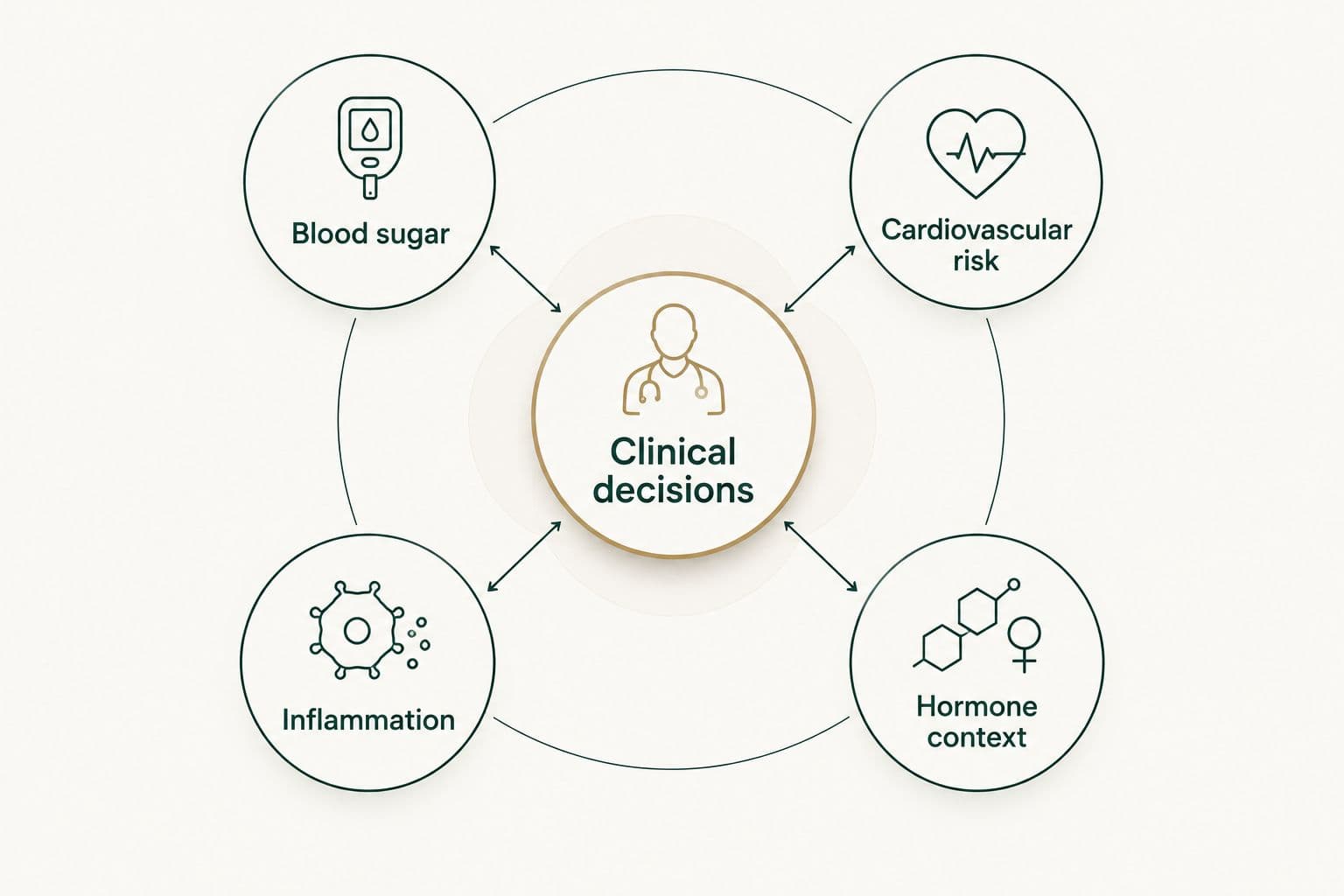
Different markers inform one clinical plan. No isolated result explains the whole person.
The included audit repeats every 90 days through Quest Diagnostics. Additional testing beyond that cadence is billed by the lab at its own rates, so the quarterly inclusion should not be mistaken for unlimited laboratory testing.
A scheduled audit also does not mean you should wait for the next panel when symptoms change. Contact your clinician about new concerns. Seek urgent or emergency assessment when the situation requires it.
The strongest use of this information is selective. Your clinician should explain which findings change treatment, which need confirmation and which call for observation rather than another prescription.
How to compare the real financial commitment
Start with your current arrangement, not an advertised competitor figure. Write down the clinical service fee, what happens to that fee during titration, which labs it includes and how medication is billed.
For our membership, the first charge is $598 for two months, followed by $299 monthly. Medication remains a separate pharmacy charge at pharmacy cost. Additional labs beyond the included quarterly schedule remain separate pass-through expenses.
That separation is the Unbundled Pharmacy Model: payment for the clinical relationship is distinct from payment for the medicine. Zero markup means we do not add a margin to the pharmacy charge. It does not mean the pharmacy supplies medication without charge or that insurance will cover it.
Before committing, make sure you understand these three expense categories:
- Included membership services: Direct primary care and the scheduled Biomarker Audit.
- Separate medication charges: The pharmacy's own price for prescribed medicine.
- Additional testing: Lab charges, at the lab's own rates, for labs beyond the included cadence.
A fixed physician fee makes one important part of the budget predictable. It does not turn healthcare into a single all-inclusive bill and we do not present it that way.
Before you join: bring the questions that change care
You do not need to arrive with your own diagnosis. Bring the information that helps your clinician distinguish an unresolved symptom, a medication effect and a condition that needs further evaluation.
- Medication history: Include current prescriptions, supplements, previous treatments and side effects you experienced.
- Existing results: Bring available lab reports and relevant records, including findings another clinician is already following.
- Your main concern: State whether the immediate problem is cost uncertainty, persistent symptoms, treatment tolerability or disconnected care.
- Your expectations: Ask what the membership can address through telehealth and what requires local assessment.
If you already take a GLP-1 medicine or hormone therapy, do not change or stop treatment simply because you are comparing memberships. A transition needs a clinical plan, including a clear understanding of who is responsible for prescriptions and follow-up.
This preparation makes the conversation more useful. It shifts the decision from buying a familiar medication to choosing accountable medical care.
How we ranked these membership models
This 2026 ranking prioritizes the six criteria above: integrated scope, defined testing, clinical accountability, medication standards, aligned billing and clear limits. It compares service models against a documented membership offer, not unpublished competitor prices or unverified patient outcomes.
Our integrated membership ranks first because the stated offer connects all six criteria. The narrower models serve distinct purposes, but their labels alone do not establish the same combination of ongoing care, included quarterly testing and medication-independent physician billing.
Which membership should you choose?
Choose GoodLife Health's Cardiometabolic Optimization Membership when your goal is coordinated care, not just access to another prescription or panel. The mechanism is specific: quarterly biomarkers, physician-guided treatment, direct primary care, and a fee that does not rise with your medication dose.
References
- Tirzepatide Once Weekly for the Treatment of Obesity (SURMOUNT-1). 2022. pubmed.ncbi.nlm.nih.gov/35658024/
- Once-Weekly Semaglutide in Adults with Overweight or Obesity (STEP 1). 2021. pubmed.ncbi.nlm.nih.gov/33567185/