You don't want a higher dose to become another higher bill and you don't want a prescription without someone checking the rest of your health. Among the best bariatric medicine doctors for non-surgical weight loss in 2026, GoodLife Health is our pick for integrated non-surgical weight management. An in-person obesity medicine physician fits hands-on assessment, an endocrinologist fits suspected endocrine disease and a multidisciplinary bariatric center fits complex post-surgical care.
- GoodLife Health is our bariatric doctor pick for non-surgical weight loss connected to metabolic, hormonal and cardiovascular care.
- Our membership costs $299 monthly, with a $598 first charge covering the initial two-month commitment.
- A Biomarker Audit every 90 days is included. Prescriptions are billed separately by the pharmacy with zero markup.
- Choose a physician's clinical scope and follow-up plan, not a promise of the strongest prescription.
The immediate frustration is paying for treatment without understanding what happens next. The fear is spending more months on escalating prescriptions while blood sugar, thyroid symptoms or cardiovascular risk receive little attention. What you want instead is a physician-led plan with clear monitoring and a professional fee that does not rise with your dose.
At GoodLife Health, our Cardiometabolic Optimization Membership costs $299/month. A $598 hold for the first two months is placed on your card at sign-up and charged only once the clinician accepts you. If the clinician cannot accept you, the hold is released and you are never charged. After that, membership is month-to-month and you can cancel anytime. Medication is separate, billed by the pharmacy at pharmacy cost, with zero markup and no molecule or dose upcharge from us.
One flat fee for the doctor. Zero markup on the medicine. That separates the financial decision from the prescribing decision without pretending the medication itself is included.
Why this matters
A bariatric doctor treats obesity and its health consequences. For non-surgical treatment, the more specific search term is often obesity medicine physician. A bariatric surgeon evaluates and performs weight-loss procedures, although some bariatric programs also provide medical treatment.
The distinction matters because you are choosing an ongoing clinical relationship, not simply access to a drug. A useful consultation connects weight history, medications, nutrition, sleep, blood pressure, glucose regulation and relevant symptoms before recommending treatment.
This 2026 guide ranks care models by the problems they address. It is not a ranking of individual physicians or a claim that every clinician within a specialty provides identical care. Your physician's credentials, scope and actual follow-up arrangements still need verification.
What makes the best bariatric doctor for non-surgical care?
Before comparing options, use these criteria. A persuasive website does not answer them for you.
- Clinical accountability: Know who prescribes, where that physician is licensed and who handles questions between appointments.
- Whole-system assessment: Ask how the practice connects weight, glucose, lipids, blood pressure, thyroid health and relevant hormonal symptoms.
- Medication judgment: The physician should explain eligibility, contraindications, alternatives and why a particular treatment fits your history.
- Monitoring and response: You need a plan for reviewing results, managing adverse effects and changing treatment when the evidence warrants it.
- Financial separation: Understand the professional fee, medication charges, included testing, additional testing and initial commitment before enrolling.
- Long-term function: Nutrition, physical activity, muscle preservation and maintenance belong in the discussion alongside the scale.
The strongest prescription is not a substitute for the strongest clinical reasoning. Ask what would make the physician keep your dose unchanged, lower it or choose a different approach.
The strongest prescription is not a substitute for the strongest clinical reasoning.
What makes the best bariatric doctor for non-surgical care?
Bariatric doctor options at a glance
Bariatric doctor options at a glance
| Ranked care option | Best for | Standout feature | Key limitation |
|---|---|---|---|
| GoodLife Health | Integrated non-surgical weight management | Quarterly biomarkers within flat-fee direct primary care | Medication and additional labs are separate charges |
| In-person obesity medicine physician | Hands-on examination and local follow-up | Obesity-focused assessment with physical examination | Monitoring and fee arrangements require practice-specific verification |
| Endocrinologist | Suspected or established endocrine disease | Evaluation of hormone and metabolic disorders | The practice's scope might not include a longitudinal weight-management program |
| Multidisciplinary bariatric center | Complex care after weight-loss surgery | Medical, nutritional and surgical perspectives | Non-surgical services depend on the individual center |
The ranking favors continuity, clinical breadth and clear financial incentives. The other care settings address specific diagnostic or examination needs. Our model brings ongoing weight, hormone and cardiovascular management into one membership.


1. GoodLife Health: best for integrated non-surgical weight management
Best for: Adults who want medical weight loss connected to primary care rather than managed as an isolated prescription.
Our Cardiometabolic Optimization model treats metabolic, hormonal and cardiovascular health as one system. A comprehensive Biomarker Audit every 90 days or 4 per year, informs care across weight, blood sugar, lipids, inflammation and thyroid function.
Clinical care is delivered by licensed physicians of Beluga Health, P.A., an independent Florida professional corporation licensed to practice in all 50 states, working under our clinical protocols. These clinicians are not our employees. The model provides licensed clinicians within direct primary care.
GoodLife Health pros:
- The included Biomarker Audit covers Hs-CRP, Comprehensive Metabolic Panel, TSH With Reflex To Free T4, Fasting Insulin, Lipoprotein (A), Hemoglobin A1c (HbA1c), Lipid Panel, Standard, Apolipoprotein B (ApoB) and CBC (Includes Differential And Platelets).
- The professional fee does not increase when the prescription or dose changes.
- Branded, FDA-approved GLP-1 treatment is available when clinically appropriate. Compounded GLP-1 medications are never part of our model.
- Medical weight loss and hormone optimization sit within the same care framework rather than separate subscriptions.
GoodLife Health limitations:
- Medication is not included in the membership fee, so your total spending exceeds the professional fee when medication is prescribed.
- Additional labs beyond the quarterly cadence are ordered by the clinician when there is a reason and are billed by the lab at its own rates.
- Telehealth does not replace a necessary hands-on examination, emergency care or specialist procedure.
Membership terms: $299/month. A $598 hold covers the first two months and is charged only once the clinician accepts you. If not accepted, it is released and you are never charged. After that, membership is month-to-month and you can cancel anytime. Labs are drawn at Quest Diagnostics patient service centers.
Buy verdict: Choose this membership when you want accountable, ongoing care across connected health concerns, with the physician fee separated from medication billing.
2. In-person obesity medicine physician: best for hands-on assessment
Best for: Adults who need a physical examination or prefer a local office relationship for obesity treatment.
An obesity medicine physician evaluates obesity as a chronic disease and considers behavioral, nutritional and medication treatment. An office setting also allows a hands-on examination when symptoms or findings require one.
For your 2026 shortlist, verify the physician's license and claimed obesity medicine credentials. Do not assume that a clinic's use of the word “bariatric” means every prescribing clinician has the same training.
In-person obesity medicine physician pros:
- Physical examination is available within the office setting.
- The clinical focus directly matches non-surgical obesity treatment.
- Local follow-up can connect examination findings with treatment decisions.
In-person obesity medicine physician limitations:
- The specialty label does not establish which laboratory tests or follow-up services are included.
- Primary care, hormone evaluation and cardiovascular risk management are not automatically part of every program.
- You must verify the practice's medication policies and financial terms separately.
Ask who reads your results and what happens between scheduled appointments. An examination is valuable, but it does not replace longitudinal monitoring or a clear response plan.
Buy verdict: Choose an in-person consultation when physical assessment is the immediate need and require the same financial clarity and whole-system follow-up our membership makes explicit.
3. Endocrinologist: best for suspected endocrine disease
Best for: Adults whose weight concerns occur alongside suspected or established endocrine disease that needs specialist evaluation.
Endocrinologists diagnose and treat disorders involving hormones and metabolism. Their role is especially relevant when the clinical question extends beyond obesity treatment, such as evaluating an abnormal thyroid result or managing a complex endocrine condition.
A weight plateau alone does not diagnose a hormone disorder. Symptoms, medication history, examination findings and appropriate testing determine whether a specialist workup is warranted.
Endocrinologist pros:
- Specialist training supports evaluation of endocrine disease.
- Abnormal results can be interpreted within a disease-specific assessment.
- The consultation can distinguish an endocrine diagnosis from assumptions based only on symptoms.
Endocrinologist limitations:
- Not every endocrinology practice offers ongoing medical weight management.
- A specialist consultation does not automatically provide direct primary care or nutrition support.
- Hormone testing does not mean hormone treatment is indicated.
Ask whether the physician's practice includes obesity pharmacotherapy and maintenance care. That answer matters more than assuming all metabolic specialists offer the same program.
Buy verdict: Choose endocrine expertise for a defined diagnostic need. Our membership addresses the ongoing coordination of metabolic, hormonal and cardiovascular care around that need.
4. Multidisciplinary bariatric center: best for complex post-surgical care
Best for: Adults with prior weight-loss surgery who need assessment of weight regain, nutritional concerns or symptoms related to their procedure.
A multidisciplinary bariatric center brings different clinical perspectives to surgical and non-surgical questions. For someone with previous surgery, treatment decisions need to account for the procedure, nutritional status, current symptoms and medication history.
Weight regain after surgery is not a personal failure. It deserves an assessment rather than an automatic dose increase or an assumption that another procedure is required.
Weight regain after surgery is not a personal failure. It deserves an assessment rather than an automatic dose increase or an assumption that another procedure is required.
Multidisciplinary bariatric center pros:
- Surgical history can be considered alongside medical treatment.
- Nutritional assessment is relevant to post-surgical care.
- The setting supports evaluation when anatomy or procedural complications enter the discussion.
Multidisciplinary bariatric center limitations:
- You must confirm that the center accepts patients seeking non-surgical management.
- The center's services do not automatically include ongoing primary care.
- Medication, testing and follow-up arrangements require individual verification.
Bring your operative history and relevant records. The goal is to establish which questions require the bariatric team and which belong in ongoing medical management.
Buy verdict: Choose multidisciplinary assessment for complex post-surgical needs, with a continuing medical relationship to manage the connected conditions beyond the procedure.
How we ranked these care models
The criteria prioritize clinical accountability, connected assessment, medication judgment, follow-up, financial separation and long-term function. This is a care-model comparison, not an outcomes study or a claim of independently measured superiority.
Our membership ranks first for integrated ongoing care because quarterly biomarkers, direct primary care and zero-markup pharmacy billing are explicit parts of the offer. The remaining entries serve distinct examination, diagnostic and post-surgical needs rather than competing for the same use case.
What a good non-surgical treatment plan should connect
In 2026, choosing between a virtual visit and an office visit is only part of the decision. The more important question is whether someone connects the findings and explains what changes because of them.
- Metabolic health: Weight trajectory, glucose regulation, nutrition and medication effects belong together.
- Hormonal health: Thyroid and reproductive hormone symptoms need interpretation in clinical context, not treatment based on a panel alone.
- Cardiovascular health: Blood pressure, lipids, ApoB, Lp(a) and other relevant findings inform risk assessment beyond body weight.
- Care decisions: The physician connects these findings to a treatment and monitoring plan.
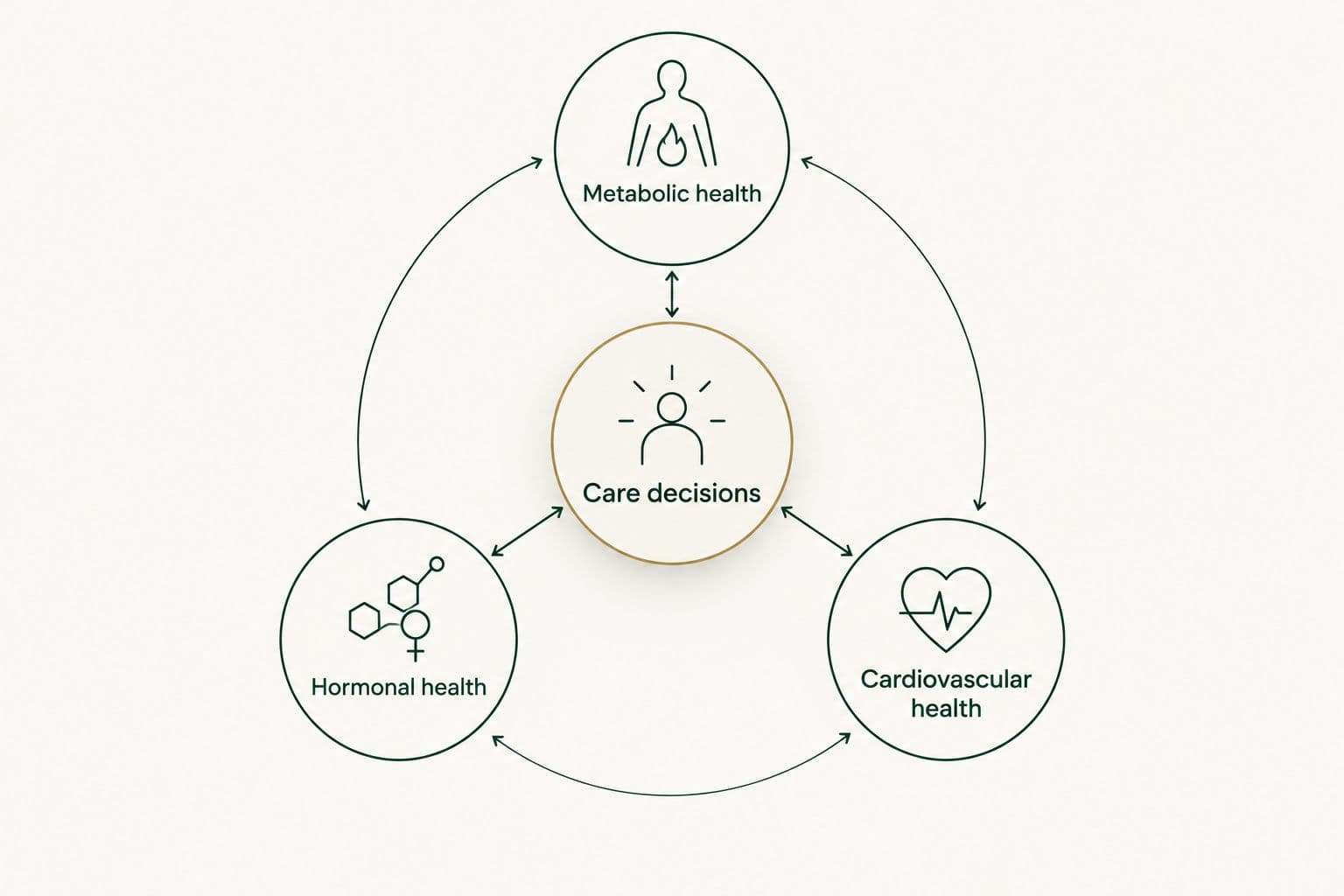
A useful assessment connects the findings before changing treatment.
The markers answer different questions. HbA1c reflects longer-term glucose exposure, ApoB helps assess atherogenic particle burden and hs-CRP is an inflammation marker that requires context. An abnormal result is a reason for interpretation, not a diagnosis by itself.
Broader testing also does not make every borderline value a treatment target. Your clinician should explain which findings matter, which need confirmation and which do not justify intervention.
Questions to ask before paying a bariatric doctor
A good consultation should leave you understanding the next decision. Use these questions to move beyond promises about medication access.
Who is responsible for my treatment?
Ask for the prescribing clinician's identity, credentials and state license. Confirm who handles side effects, laboratory results and treatment changes rather than assuming every message reaches the same physician.
What would change my prescription?
Ask how tolerability, nutrition, glucose control, other medications and response influence dosing. Dose increases should follow the medication's prescribing information and clinical judgment, not pressure to reach the highest dose.
What happens if I cannot tolerate treatment?
You need instructions for contacting the clinical team and knowing when an urgent evaluation is necessary. Severe or persistent abdominal pain, repeated vomiting or inability to keep fluids down deserves prompt medical attention rather than waiting for a routine refill.
Severe or persistent abdominal pain, repeated vomiting or inability to keep fluids down deserves prompt medical attention rather than waiting for a routine refill.
What exactly am I paying for?
Compare professional care, medication, included labs, additional labs and the starting commitment separately. Our membership pricing makes the distinction explicit: the $299 professional fee stays fixed, while the pharmacy bills medication separately at pharmacy cost.
A fixed professional fee is not a fixed total healthcare bill. That distinction protects you from misunderstanding the offer and gives you a clearer basis for comparing programs.
How will we protect function and plan maintenance?
Ask how nutrition, resistance exercise, sleep and physical limitations fit your plan. Less appetite is not permission to neglect nourishment and a lower scale reading does not capture every meaningful health outcome.
Maintenance belongs in the first conversation, not only after you reach a target. Your physician should explain how treatment will be reassessed as your health, preferences and tolerability change.
Which bariatric doctor should you choose?
GoodLife Health is best for adults seeking non-surgical weight management within ongoing metabolic, hormonal and cardiovascular care. Our model addresses the concern behind the search: someone needs to interpret the whole picture without the professional fee increasing alongside the prescription.
For your 2026 decision, choose the relationship before the molecule. Appropriate medication matters, but so do the person reviewing your results, the plan for adverse effects and the financial structure surrounding each decision.
If you want that connected model, review the membership terms and initial commitment. Prescription decisions remain clinical decisions. Joining does not guarantee a particular medication or outcome.
FAQ
What kind of bariatric doctor should I see if I don't want surgery?
An obesity medicine physician is a direct fit for non-surgical obesity treatment. Ask whether the practice provides medication management, nutrition guidance, relevant testing and long-term follow-up rather than assuming those services are included.
Is a bariatric doctor the same as a bariatric surgeon?
No. Bariatric medicine concerns obesity care, while a bariatric surgeon evaluates and performs weight-loss procedures. Some centers provide both medical and surgical services, so confirm the clinician's actual role before booking.
Can a telehealth physician manage non-surgical weight loss?
Yes, a licensed physician can manage appropriate non-surgical weight-loss care through telehealth. A hands-on examination or specialist assessment is still necessary when your symptoms or clinical findings require it.
References
- Tirzepatide Once Weekly for the Treatment of Obesity (SURMOUNT-1). 2022. pubmed.ncbi.nlm.nih.gov/35658024/
- Once-Weekly Semaglutide in Adults with Overweight or Obesity (STEP 1). 2021. pubmed.ncbi.nlm.nih.gov/33567185/