You are tired of feeling exhausted and wondering whether another round of bloodwork will only delay getting help. Can you start TRT without doing labs first? No. You should not start testosterone replacement therapy (TRT) without diagnostic and safety labs first, because symptoms alone cannot confirm testosterone deficiency. Starting before testing also changes your natural hormone levels, which makes the original cause harder to establish.
Key Takeaways
- Can you start TRT without labs? No. Confirm testosterone deficiency and assess treatment risks before prescribing.
- Testosterone deficiency generally requires symptoms plus low testosterone on two separate early-morning blood tests.
- GoodLife Health connects hormone optimization with metabolic and cardiovascular care, rather than treating testosterone in isolation.
- Discuss fertility before TRT: external testosterone can suppress sperm production.
- The pain is not simply another appointment.
- A symptom questionnaire can organize your concerns.
- There is no single panel that fits every man.
- The workup varies because the same symptom can arise through different mechanisms.
- Follow your clinician's collection instructions rather than trying to produce a particular result.
Why this matters
The pain is not simply another appointment. It is feeling unlike yourself while nobody explains whether testosterone, sleep, thyroid function, medication or metabolic health is contributing. The fear is spending more months on a prescription that misses the actual problem.
The better outcome is a clinician who explains the evidence, checks safety and builds a plan around your health rather than a predetermined prescription. At GoodLife Health, our Cardiometabolic Optimization Membership costs $299/month, with a Biomarker Audit every 90 days included. Instead of making routine quarterly testing a separate purchase, we include it in the clinical relationship.
The first charge is $598 for the initial two-month commitment. After that, membership continues at $299/month, month to month. Once accepted, the first two months are charged and non-refundable. Medication is separate and billed by the pharmacy at that pharmacy's own price. Your membership fee does not rise because your prescription changes.
This 2026 guide focuses on evaluating adult men for testosterone deficiency. Testosterone treatment in women follows a different evidence base and should not use male diagnostic thresholds.
Can you start TRT without doing labs first?
You can start the evaluation without existing bloodwork, but you should not start the medication without appropriate testing. A consultation can establish your symptoms, medical history, fertility goals and the bloodwork needed. It cannot replace that bloodwork.
The American Urological Association's Testosterone Deficiency Guideline and the Endocrine Society's guideline on testosterone therapy in men support diagnosis using symptoms or signs alongside consistently low testosterone. The AUA uses total testosterone below 300 ng/dL as a reasonable cutoff supporting diagnosis, confirmed through two separate early-morning measurements. A cutoff supports a diagnosis. It does not make the diagnosis by itself.
The usual sequence is:
- Review symptoms. Describe changes in libido, erections, energy, strength, mood and when they started.
- Confirm testosterone. Obtain separate early-morning measurements under the conditions your clinician specifies.
- Investigate the cause. Review medications, sleep, illness and additional hormone testing where indicated.
- Check safety. Assess blood counts, fertility plans, prostate considerations and relevant medical conditions.
- Agree on follow-up. Establish how benefit, adverse effects and laboratory results will guide treatment.
These steps answer different questions. A low result does not establish that testosterone is the cause of every symptom and a confirmed deficiency does not automatically mean TRT is the safest next step.
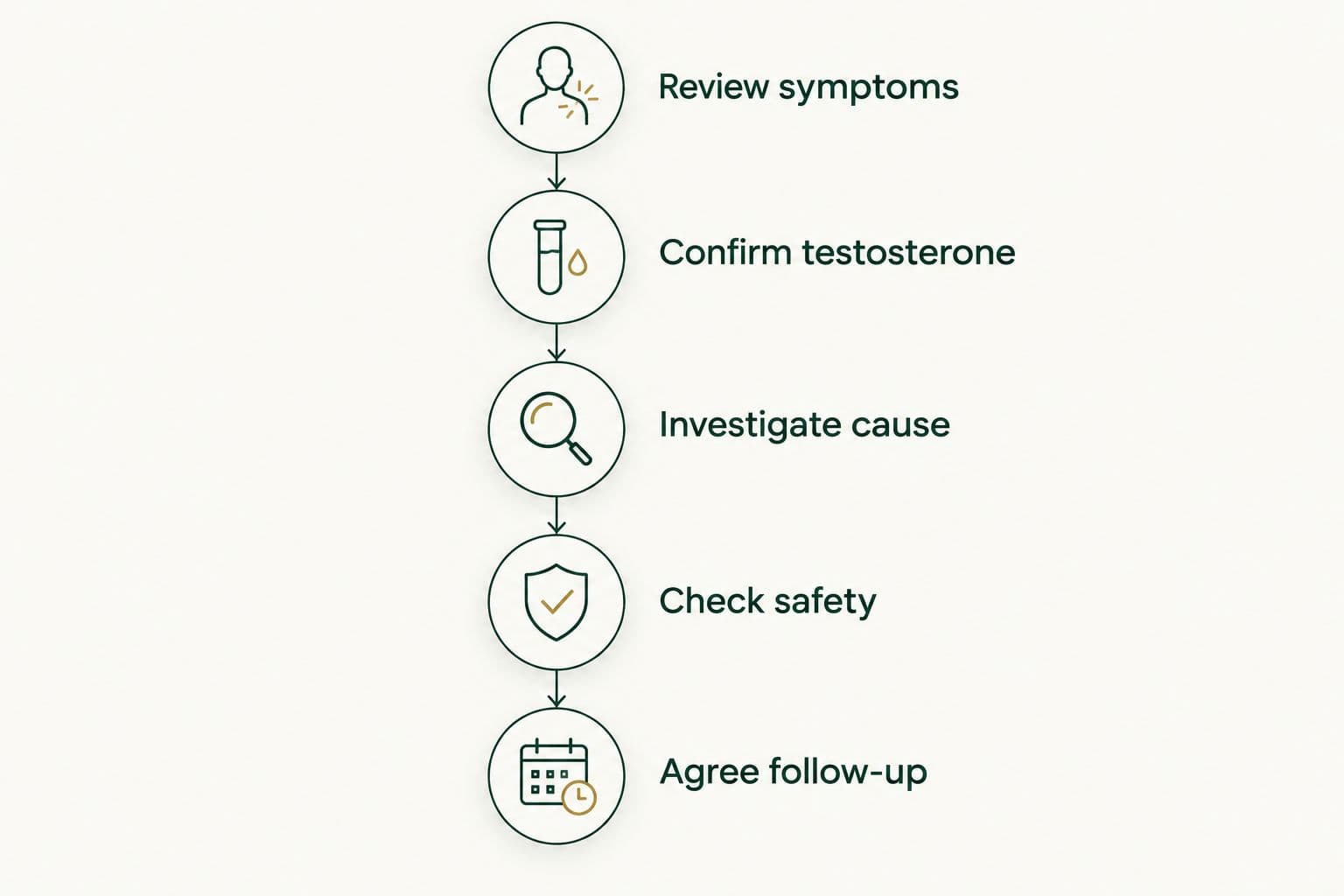
The decision to prescribe follows diagnosis and safety assessment, not a symptom questionnaire alone.
What is missing when a TRT evaluation skips bloodwork?
A symptom questionnaire can organize your concerns. Its advantage is convenience. Its limitation is that fatigue, low motivation and reduced libido have many possible causes. Bloodwork adds objective evidence, although it still needs interpretation alongside your history.
For your 2026 evaluation, distinguish an easy intake process from a complete diagnostic process. Online access changes where the conversation happens, not what evidence a clinician needs.
| Evaluation approach | What it contributes | What it cannot establish | Best use |
|---|---|---|---|
| Symptom questionnaire alone | Documents your experience and priorities | Testosterone deficiency, blood-count safety or the underlying cause | Preparing for a clinical conversation |
| One testosterone measurement | Provides an initial hormone result | Whether a low result persists under appropriate testing conditions | Starting the diagnostic workup |
| Repeat testosterone plus clinical and safety assessment | Confirms the pattern and identifies treatment considerations | Guaranteed symptom improvement or absence of every risk | Making an informed treatment decision |
Choose an evaluation that can explain both why treatment is indicated and why it is safe enough to begin. A prescription without those answers leaves you responsible for uncertainty that belongs in the clinical assessment.
Testing also protects against treating a temporary change as a permanent condition. Acute illness, disrupted sleep and certain medications can affect testosterone results. Your clinician needs that context before attaching a diagnosis to the number.


Which labs do you need before starting TRT?
There is no single panel that fits every man. The core workup confirms testosterone deficiency, helps locate its cause and establishes a safety baseline. Additional testing depends on your symptoms, examination, history and initial results.
A broader panel is useful only when someone connects its findings to decisions. More tests do not automatically mean better care and an abnormal result does not automatically require medication.
Testosterone testing: confirm the pattern
Total testosterone is generally the starting point. Two separate early-morning measurements reduce the chance that a diagnosis rests on an unrepresentative result. The Endocrine Society recommends confirming the result with a repeat morning, fasting total testosterone measurement.
Free testosterone can help when total testosterone is near the lower limit or when sex hormone-binding globulin, called SHBG, is altered. Obesity and thyroid conditions can affect SHBG, so total testosterone and biologically available hormone do not always tell the same story. The testing method matters, too.
Do not compare a result with an online chart without checking the laboratory's units, reference interval and collection conditions. Your clinician should explain which result carries the most weight in your particular case.
Cause testing: understand why testosterone is low
Luteinizing hormone or LH, helps distinguish a problem originating in the testes from a problem involving the brain's hormonal signaling. Follicle-stimulating hormone or FSH, adds information when testicular function and fertility are concerns.
Prolactin testing is indicated in selected situations, including low testosterone with low or low-normal LH. Persistent abnormalities can require further evaluation rather than an immediate prescription. Imaging is not a routine requirement for everyone. It depends on the clinical findings.
Safety testing: establish your starting point
| Test or assessment | Why it matters before TRT | Important limitation |
|---|---|---|
| Complete blood count, including hemoglobin and hematocrit | Identifies anemia or an elevated red-cell concentration before treatment | Does not diagnose testosterone deficiency |
| PSA and prostate assessment when appropriate | Supports prostate-risk evaluation and shared decision-making | PSA alone neither confirms nor excludes prostate cancer |
| LH, with FSH where indicated | Helps identify the source of testosterone deficiency | Requires interpretation alongside testosterone and history |
| Prolactin when indicated | Investigates selected hormonal signaling problems | Is not necessary for every presentation |
| Thyroid and metabolic testing based on clinical context | Assesses overlapping contributors and connected health risks | Does not replace testosterone confirmation |
Blood pressure, sleep-apnea history, cardiovascular history and fertility goals also matter. These are not all laboratory measurements, but they belong in the same decision. A blood panel cannot substitute for a clinician asking the right questions.
Why the pre-TRT workup varies
The workup varies because the same symptom can arise through different mechanisms. For a 2026 treatment decision, the relevant question is not whether every available hormone was measured, but whether the evaluation addresses your actual risks.
- Borderline testosterone: A result near the lower limit can require closer attention to repeat testing, SHBG and free testosterone.
- Sleep and work schedule: Interrupted sleep and overnight shifts affect how collection timing should be interpreted.
- Medications and prior hormones: Opioids, glucocorticoids, anabolic steroids and previous testosterone use can change the hormonal picture.
- Fertility goals: Plans for biological children change the discussion before external testosterone is prescribed.
- Blood-count or prostate findings: Abnormal baseline results require assessment rather than being treated as paperwork.
- Metabolic and thyroid health: Obesity, diabetes and thyroid conditions can overlap with symptoms and influence interpretation.
This is why your friend's panel, prescription or dose is not a template for your care. Similar symptoms do not establish the same diagnosis and similar laboratory numbers do not erase differences in medical history.
How should you prepare for testosterone bloodwork?
Follow your clinician's collection instructions rather than trying to produce a particular result. The purpose is an accurate baseline, not a number low enough to qualify for treatment.
Tell the clinician what you already take
Provide a complete medication and supplement list, including testosterone, anabolic steroids, nonprescription hormone products and medications obtained elsewhere. Include the formulation and timing of your last dose when relevant. That information changes how results are interpreted.
Do not stop prescribed medication to manipulate testing. Ask the prescribing clinician how to prepare, particularly if you already use testosterone. Interrupting treatment without a plan does not reliably recreate an untreated baseline.
Explain your sleep and recent health
Tell the clinical team if you work nights, recently had an illness or had unusually disrupted sleep. Standard early-morning collection instructions assume a conventional sleep schedule. Shift workers need individualized instructions.
If you are acutely unwell, ask whether testing should be postponed until recovery. A result collected during illness can be misleading. Repeating an unsuitable sample is not the same as dismissing your symptoms.
Bring the actual laboratory report
Share the collection date, collection time, result, units and reference interval, not just a screenshot saying low. Previous results are particularly useful when the clinician can compare them with your symptoms and medication history.
If needle anxiety is the obstacle, say so before scheduling. Ask the collection team about a reclined position and other appropriate accommodations. You deserve help completing necessary testing, not pressure to hide the reason you are avoiding it.
What risks do baseline labs help identify?
Baseline testing does not make TRT risk-free. It establishes whether there are findings that need attention before treatment and gives the clinician something meaningful to compare against later.
Testosterone can increase hematocrit. The Endocrine Society recommends stopping therapy when hematocrit rises above 54%, evaluating contributing factors and reconsidering treatment after the level is safe. That is a clinician-managed action threshold, not permission to adjust your own dose or arrange blood donation as a substitute for evaluation.
An elevated pretreatment hematocrit deserves an explanation before prescribing. Smoking, sleep-related breathing problems and other conditions can contribute. Starting testosterone first can complicate an existing problem.
Fertility needs a separate conversation because a normal blood count does not protect sperm production. External testosterone suppresses hormonal signals involved in sperm production and can substantially reduce fertility. Men planning conception should discuss this before beginning treatment, not after a prescription is filled.
Untreated severe obstructive sleep apnea, certain prostate or breast cancers and other significant conditions can make TRT inappropriate or require additional assessment. Your clinician should review the full history rather than promise that normal testosterone follow-up alone covers every concern.
Seek urgent medical care for chest pain, sudden shortness of breath or stroke symptoms. Those symptoms require immediate evaluation, not a routine hormone appointment.
How our model connects hormones with the rest of your health
You should not have to choose between someone taking your symptoms seriously and someone taking testing seriously. Our model is built around both. GoodLife Health's Cardiometabolic Optimization Membership is best for adults seeking hormone evaluation within ongoing metabolic and cardiovascular care.
Cardiometabolic Optimization means treating metabolic, hormonal and cardiovascular health as one system. Weight, thyroid function, blood sugar, lipids and inflammation belong in the clinical picture rather than becoming disconnected prescriptions. TRT is considered within that picture, not promised in advance.
Our included Biomarker Audit runs every 90 days or four times per year, at Quest Diagnostics. It includes Apolipoprotein B (ApoB), Lipoprotein (A), Hs-CRP, Hemoglobin A1c (HbA1c), Lipid Panel, Standard, Fasting Insulin, TSH With Reflex To Free T4 and more. Individual diagnostic confirmation and safety monitoring still follow the clinician's judgment. A quarterly schedule does not eliminate the need for earlier testing.
The financial distinction is specific. The $299/month membership pays for the clinical relationship and included quarterly audit. Medication is billed separately by the pharmacy at that pharmacy's own price. GoodLife Health takes nothing on medication and charges no molecule upcharge or dose upcharge. Additional labs ordered by the clinician are billed by the lab at its own rates.
That structure removes a membership-fee increase tied to a stronger prescription. It does not mean every pharmacy bill remains identical when a medication changes. One flat fee for the clinician. GoodLife Health takes nothing on the medicine.
The trade-off is a recurring membership and an initial two-month commitment, not a one-time prescription purchase. Membership does not guarantee TRT eligibility or make medication free. It pairs with insurance for catastrophic coverage and does not replace insurance. You can review our membership pricing before deciding.
Care is delivered by clinicians licensed in all fifty states. The clinician's job is to determine what is appropriate, including when testosterone is not the answer.
Can one low testosterone result qualify you for TRT?
Two separate early-morning testosterone measurements generally support confirmation. One low result is not enough by itself. Symptoms, collection conditions and the cause of the abnormality still matter. In 2026, a convenient intake process should not be confused with confirmed testosterone deficiency.
The AUA's 300 ng/dL cutoff is a diagnostic aid, not a treatment target or a promise of benefit. A clinician should explain how your repeat results fit your symptoms and whether additional investigation is needed.
Can you use old labs instead of repeating bloodwork?
Existing labs can contribute to the evaluation, but your clinician decides whether they are suitable for the current decision. Collection timing, testing method, intervening illness, medication changes and missing safety measurements can all justify repeating part of the workup.
Bring previous reports rather than assuming they are useless or automatically sufficient. The useful question is which clinical question each report answers and which questions remain unanswered.
What if you already started testosterone without baseline labs?
Tell a licensed clinician exactly what you have used, where it came from and when you last took it. Do not increase, stop or add medication on your own to correct the situation. Testing during treatment reflects exposure to that treatment and does not reliably establish your original untreated hormone status.
Your clinician can assess current safety, review any earlier records and decide how to investigate the original diagnosis. Be candid about nonprescription products. Withholding that information makes interpretation harder and care less safe.
What should happen after treatment begins?
A prescription should come with a monitoring plan. Agree on which symptoms you are tracking, when laboratory testing occurs and how to contact the clinical team about adverse effects. Testosterone measurements during treatment need timing appropriate to the formulation. An untimed result can be difficult to interpret.
Follow-up should assess benefit as well as safety. A higher testosterone result does not prove that fatigue, sexual symptoms or quality of life improved. If laboratory levels improve but your symptoms do not, the clinician should reconsider contributing causes rather than automatically keep increasing the dose.
For your 2026 care plan, ask who reviews results and what happens when something is abnormal. A laboratory portal is a place to view numbers, not a replacement for medical interpretation.
FAQ
Can I start TRT without getting any blood tests?
No. Starting TRT without diagnostic and safety bloodwork is not an appropriate clinical approach. Symptoms alone cannot establish testosterone deficiency or identify important pretreatment risks.
Do I need two testosterone tests before starting TRT?
Two separate early-morning testosterone measurements generally support confirmation of testosterone deficiency in men. Your clinician also considers symptoms, testing conditions and relevant medical history.
Does testosterone below 300 ng/dL mean I need TRT?
Total testosterone below 300 ng/dL supports the AUA's diagnostic cutoff, but it does not automatically mean you need TRT. Repeat testing, symptoms, the cause of the low result and treatment risks determine the next step.
Can an online clinician prescribe testosterone without labs?
An online consultation does not remove the clinical need for diagnostic and safety testing before TRT. Telehealth is a way to deliver care, not a substitute for confirming the diagnosis.
Can starting TRT affect my fertility?
Yes. External testosterone can suppress sperm production and reduce fertility. Discuss plans for biological children before treatment so your clinician can evaluate an appropriate approach.
Are quarterly labs enough after I start TRT?
Quarterly testing does not automatically cover every monitoring need after starting TRT. Your clinician sets the timing based on your treatment, baseline findings, symptoms and dose changes.
How much is GoodLife Health's membership for hormone evaluation?
GoodLife Health's Cardiometabolic Optimization Membership is $299/month, with a $598 first charge covering the initial two-month commitment. Quarterly Biomarker Audits are included. Medication and any additional labs are billed separately.
What should I do if I am afraid of the blood draw?
Tell your clinician and the collection team about needle anxiety before the appointment. Ask about appropriate accommodations, such as reclining during collection, rather than skipping essential diagnostic testing.
One last thing
Starting testosterone can remove the clearest opportunity to measure your untreated baseline. That is why the order matters: investigate first, then decide. Testing before treatment is not a judgment about whether your symptoms are real.
Before you agree to a prescription, ask the clinician to complete this sentence: the evidence supports testosterone deficiency because these symptoms match these confirmed results and this is the monitoring plan. You should understand the answer without needing to interpret the entire laboratory report yourself.
Bring your symptoms, previous reports, medication list and fertility goals to the evaluation. You do not need to arrive with a diagnosis. You need a clinical relationship that will establish one carefully and explain what comes next.
Related Guides
- Hormone replacement therapy for men with low testosterone
- How to read your testosterone lab results
- How to protect fertility while on testosterone replacement therapy
References
- Treatment of Symptoms of the Menopause: An Endocrine Society Clinical Practice Guideline. 2015. doi.org/10.1210/jc.2015-2236
- Testosterone Therapy in Men with Hypogonadism: An Endocrine Society Clinical Practice Guideline. 2018. doi.org/10.1210/jc.2018-00229